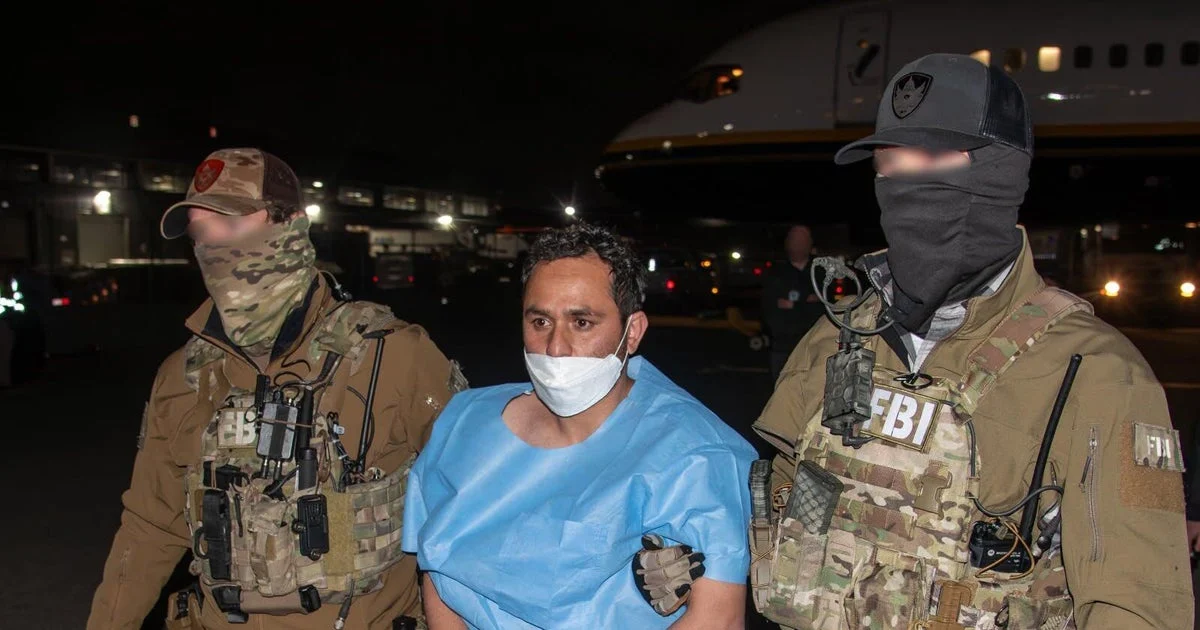
Five years after one of the darkest and most chaotic chapters of America’s military exit from Afghanistan, a federal court in Virginia has delivered a definitive judicial milestone regarding the devastating attack at Kabul’s Hamid Karzai International Airport. On Wednesday, Mohammad Sharifullah, a 28-year-old operative affiliated with the regional Islamic State branch known as ISIS-K, was sentenced to 20 years in federal prison. The sentence follows his conviction earlier this year on charges of providing material support to a designated foreign terrorist organization.
The penalty, representing the maximum statutory limit for the single-count conviction, closes a complex international terrorism case that has drawn intense scrutiny from lawmakers, intelligence agencies, and the American public. While federal prosecutors aggressively pursued a heavier penalty—arguing that Sharifullah bore direct culpability for the deaths resulting from the August 26, 2021, suicide bombing—a federal jury ultimately stopped short of establishing direct legal responsibility for the blast itself. Nevertheless, the sentencing judge characterized Sharifullah as an unrepentant, dedicated extremist whose logistical facilitation directly enabled catastrophic violence.
The Legal Battle and Sentencing Proceedings
U.S. District Judge Anthony Trenga handed down the sentence after a harrowing court session that featured emotional victim impact statements from the parents of fallen U.S. service members. Addressing the court directly, Judge Trenga noted that Sharifullah displayed a total lack of remorse for the profound grief and generational trauma he helped inflict.
During the trial, federal prosecutors presented extensive evidence outlining Sharifullah’s long-standing allegiance to ISIS-K, which he joined as a teenager. According to the Justice Department, Sharifullah’s hatred toward the United States served as the foundational driver for nearly a decade of continuous terrorist plotting. Prosecutors detailed his role in a global web of violence, alleging that he provided critical logistical support—including surveillance, weapons transport, and communications routing—not only for the Kabul airport attack but also for other high-profile atrocities. These included a March 2024 assault on a concert hall in Moscow that claimed approximately 140 lives, and a 2016 suicide bombing targeting security guards at the Canadian embassy in Kabul.
Despite the gravity of these accusations, defense attorneys maintained a rigorous defense throughout the proceedings. Sharifullah’s legal team argued that their client was never a high-ranking commander or architect within ISIS-K, but rather a low-level intermediary who merely functioned as a messaging conduit. They aggressively challenged the prosecution’s narrative regarding his involvement in the Abbey Gate bombing, emphasizing that the jury acquitted him of charges directly linking his actions to the fatalities at the airport.
Furthermore, the defense raised concerns regarding the reliability of incriminating statements Sharifullah made during FBI interrogations. Attorneys argued that these admissions were heavily influenced by duress, asserting that Sharifullah may have told investigators what they wanted to hear out of fear of retribution or torture while detained by Pakistani intelligence authorities prior to his extradition to the United States. Sharifullah chose not to testify during the trial and declined the opportunity to address the court prior to sentencing.
The Shadow of Abbey Gate: Background and Context
The sentencing marks another painful chapter in a tragedy that remains etched into the collective memory of the American military community. On August 26, 2021, the United States was in the final stages of executing a frantic, massive military airlift out of Afghanistan following the rapid collapse of the Western-backed Afghan government and the resurgence of the Taliban.
As tens of thousands of desperate Afghan civilians and foreign nationals crowded around the perimeter of Hamid Karzai International Airport in Kabul, an ISIS-K suicide bomber—identified by investigators as Abdul Rahman al-Logari—breached a perimeter checkpoint at Abbey Gate. The ensuing detonation of an improvised explosive device caused unimaginable carnage. The blast instantly killed 13 U.S. service members—consisting of 11 Marines, one Navy corpsman, and one Army soldier—alongside approximately 160 Afghan civilians. Scores of others sustained severe, life-altering injuries.
The attack instantly became a political and military flashpoint, intensifying criticisms of the execution of the U.S. withdrawal from Afghanistan. For families of the fallen, the pursuit of accountability became an agonizing, multi-year endeavor.
The Chronology of Capture and Extradition
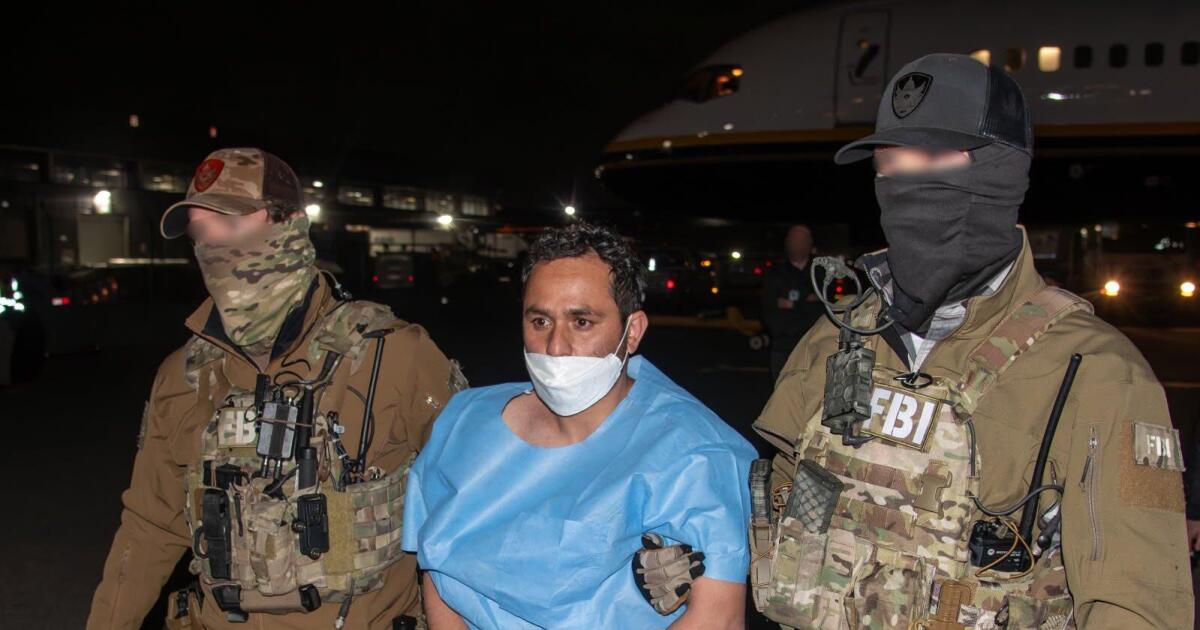
The path to bringing Sharifullah to an American courtroom was a testament to clandestine international intelligence cooperation and persistent law enforcement tracking. The chronology of his apprehension and subsequent legal journey highlights the sustained focus of U.S. national security agencies:
- August 26, 2021: An ISIS-K suicide bomber detonates an explosive device at Abbey Gate during the Kabul airport evacuation, killing 13 U.S. service members and roughly 160 Afghan nationals.
- March 2024: Intelligence agencies link regional ISIS-K cells to wider global plots, including a mass-casualty attack on a Moscow concert hall, reinforcing the transnational threat posed by the network.
- Early 2025: Pakistani intelligence services, operating in close coordination with the U.S. Central Intelligence Agency (CIA), locate and capture Mohammad Sharifullah near the rugged border separating Pakistan and Afghanistan.
- March 2025: Following his capture, Sharifullah is extradited to the United States to face federal terrorism charges. High-ranking U.S. security officials, including FBI Director Kash Patel, publicly acknowledge his custody.
- April 2026: A federal jury in Virginia convicts Sharifullah on charges of providing material support to a designated foreign terrorist organization, though jurors deadlocked on whether his actions directly caused the Abbey Gate fatalities.
- September 16, 2026: U.S. District Judge Anthony Trenga sentences Sharifullah to 20 years in federal prison, marking the maximum statutory penalty for the conviction.
Voices of the Families: Pain and Legacy
Outside of the courtroom procedures, the human toll of the tragedy remained the emotional epicenter of the hearings. Several parents of the fallen service members traveled to Virginia to confront the man tied to the apparatus that stole their children’s futures. Standing mere feet from the defense table, they utilized their time to honor their children’s bravery and articulate the permanent fractures left within their families.
Mark Schmitz, whose 20-year-old son, Marine Corps Lance Cpl. Jared Schmitz, was killed in the blast, directly urged Sharifullah to look him in the eye. In a powerful statement, Schmitz emphasized that while an explosive device ended his son’s physical life, it could never extinguish his enduring values and character. "They may have taken his life, but they’ll never take his legacy," Schmitz declared. "A bomb killed my son. It did not kill what he stood for."
Similarly, Paula Knauss-Selph, the mother of Army Staff Sgt. Ryan Knauss, who also perished at Abbey Gate, expressed the immutable grief shared by the grieving families. Addressing the court, she noted that no judicial outcome could ever fully heal the wounds inflicted by the attack. "No justice will ever be enough to mend my broken heart," she stated.
Official Reactions and National Security Implications
The conclusion of the trial prompted strong statements from top federal law enforcement and national security officials, who underscored the enduring global reach of U.S. counterterrorism efforts.
Assistant Attorney General for National Security John Eisenberg issued a statement following the sentencing, emphasizing that Sharifullah’s decades-long dedication to ISIS-K had direct, lethal consequences for innocent people worldwide. "Sharifullah spent nearly a decade at the heart of a horrific campaign of terror, providing critical support for attacks against civilians around the world and, ultimately, contributed to the deaths of 13 U.S. servicemembers and dozens of others at Abbey Gate," Eisenberg said.
The case also holds broader political significance. The capture and subsequent prosecution of high-level terrorism suspects connected to the Afghanistan withdrawal have frequently been spotlighted by U.S. leadership as proof of relentless counterterrorism perseverance. Last year, President Trump referenced the ongoing operations against ISIS-K during an address to a joint session of Congress, pointing to the collaborative intelligence efforts that brought regional operatives to American soil to face justice.
Broader Analytical Implications
From a geopolitical and counterterrorism perspective, the sentencing of Mohammad Sharifullah illuminates several key facets of modern intelligence operations against decentralized extremist networks. First, it demonstrates the persistent efficacy of transnational intelligence-sharing—specifically between U.S. agencies and regional partners like Pakistan—in locating and apprehending operatives who seek refuge in complex borderlands.
Second, the trial highlights the legal challenges inherent in prosecuting international terrorism cases within federal civilian courts. While prosecutors successfully established a pattern of material support spanning multiple international attacks, the jury’s inability to reach a unanimous verdict on whether Sharifullah’s specific actions directly "resulted in" the Abbey Gate deaths underscores the high burden of proof required in American jurisprudence for causal links in complex conspiracies.
Nevertheless, the 20-year sentence ensures that a vital logistical facilitator for ISIS-K has been permanently removed from the battlefield. For the families of the victims and the broader military community, the conclusion of the trial offers a measure of closure, even as the emotional echoes of the Kabul airport bombing continue to resonate across the nation.