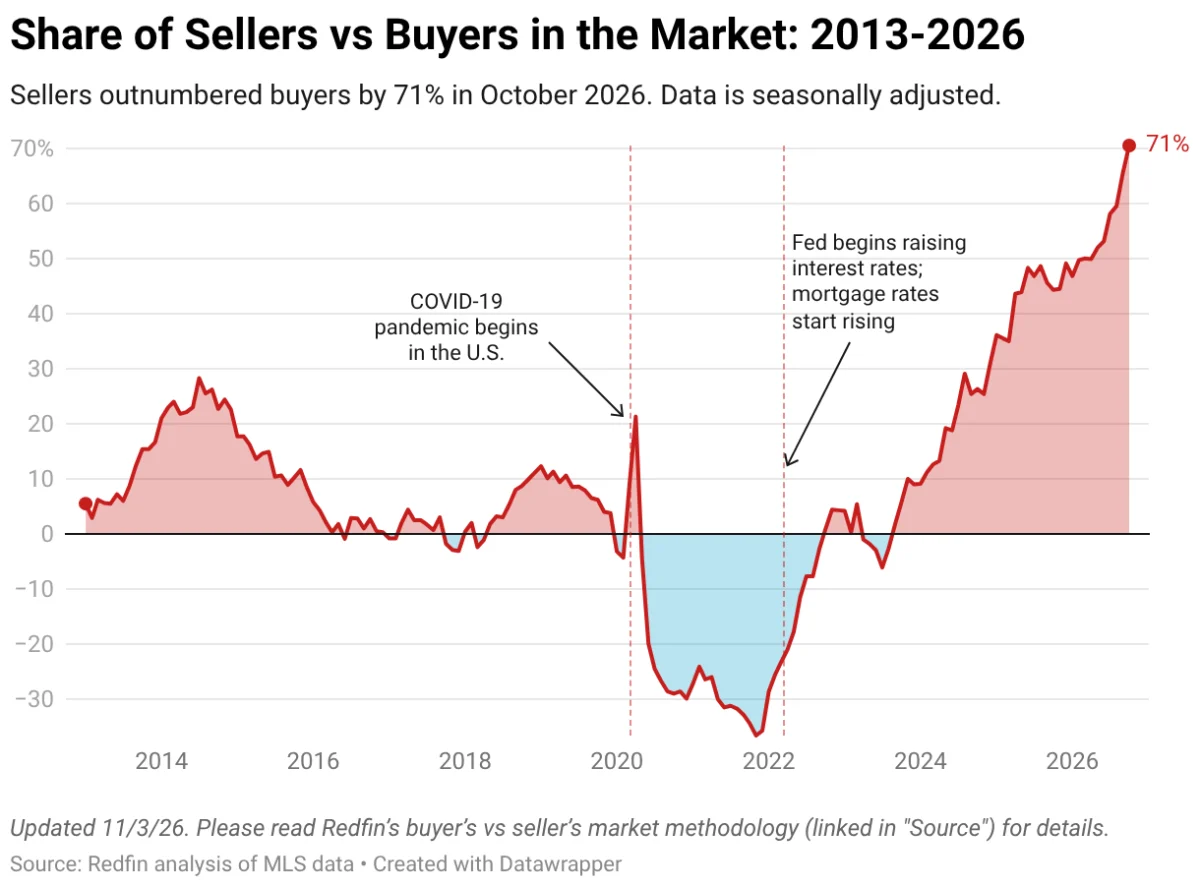
The American residential real estate landscape stands at a critical juncture as the final quarter of 2026 unfolds. Homeowners considering entering the market are grappling with a complex matrix of persistent inflation, elevated mortgage rates, and shifting regional supply dynamics that have decisively tipped the scales in favor of purchasers. With the typical monthly housing payment stubbornly hovering above $2,700 and national median home sale prices experiencing their first annual decline in three years—dropping 0.4% to $388,634 as of October 2026—sellers are forced to reevaluate long-held expectations regarding property valuation and market velocity.
This environment of economic recal
ibration has transformed what was once a hyper-competitive seller’s haven into a nuanced buyer’s market. Macroeconomic headwinds, including geopolitical tensions in the Middle East, fluctuating oil prices, emerging artificial intelligence-driven market shifts, and ongoing trade tariff debates, have kept mortgage rates persistently above the 7% threshold since September. For property owners weighing whether to capitalize on accumulated equity this autumn or postpone their listing ambitions until 2027, understanding the interplay of regional supply disparities, monetary policy, and shifting consumer behavior is more crucial than ever.
Background Context and Macroeconomic Pressures
To comprehend the current trajectory of the housing market, one must examine the cascading economic forces that have reshaped consumer sentiment since the post-pandemic boom. The rapid interest rate hikes initiated by the Federal Reserve in 2022 and 2023 were designed to cool an overheated economy, but they inadvertently froze the secondary housing market. Homeowners who secured historically low mortgage rates in the 3% range during 2020 and 2021 chose to "lock in" those rates, drastically reducing housing inventory and creating a severe supply crunch.
By mid-2026, however, the logjam began to break. An increasing number of homeowners, motivated by life changes, growing families, or job relocations, felt antsy to move, prompting a notable surge in new listings. Unfortunately, this influx of inventory collided with mounting affordability barriers. Inflationary pressures on everyday consumer goods, combined with elevated borrowing costs, severely constrained household budgets.
Furthermore, global economic anxieties have directly influenced domestic borrowing conditions. Speculation surrounding artificial intelligence industry spending, coupled with ongoing conflicts in the Middle East threatening energy stability, has triggered bond market volatility. Bond yields have reacted sensitively to these global tremors, keeping mortgage rates elevated and dampening prospective buyers’ enthusiasm. Consequently, the national inventory gap has widened significantly, with data indicating over 600,000 more home sellers than active buyers nationwide.
Expert Insights and Economic Analysis
Industry leaders and financial analysts emphasize that today’s market demands a stark departure from the aggressive bidding wars of previous years. Daryl Fairweather, Redfin’s Chief Economist, points out that while elevated inventory gives purchasers a wider selection, record-high ownership costs continue to breed caution.
"Home sellers should prepare for a strong buyer’s market," Fairweather notes. "Elevated inventory has given buyers more options, but record costs have made them wary. Volatile mortgage rates and an unstable economy are adding a layer of uncertainty as well, making it harder for buyers to plan and act with confidence. Affordability has only marginally improved over the last year, so those willing to brave today’s market are prepared to lead negotiations and pay a fair price."
This sentiment is echoed by Chen Zhao, Head of Economics Research at Redfin, who highlights the external pressures governing mortgage trends. "Mortgage rates are reacting to AI fears and the conflict in the Middle East, as rising energy costs and concerns over inflation and a bond market selloff put pressure on the economy," Zhao explains. "Prolonged tensions have kept investors and consumers on edge, waiting to react to changes in oil prices and fresh economic data. Broadly speaking, unless homebuilding skyrockets or the country falls into a severe recession, buyer activity and housing affordability are unlikely to improve substantially in the near future."
This dynamic has altered the timeline of transactions. The average duration required to sell a residential property has lengthened to approximately 50 days nationally—a noticeable increase from the sub-30-day timelines recorded during the peak frenzy of 2022, though still quicker than the 60-to-100-day averages seen in the early 2010s.
Regional Divergence: A Tale of Two Markets
A national overview obscures the stark geographical variances defining the 2026 housing sector. While the broader market tilts heavily toward buyers, specific regions experience entirely different economic realities driven by local supply and demand fundamentals.
The Midwest and Northeast Supply Crunch
In contrast to national trends, metropolitan areas in the Midwest and Northeast continue to suffer from chronic housing shortages. Cities such as Rochester, New York, and Milwaukee, Wisconsin, exhibit resilient demand that consistently outpaces local inventory. In these pockets, sellers frequently benefit from rapid sales cycles, competitive multi-offer scenarios, and minimal need for price reductions. Buyers in these regions find themselves competing intensely for a limited pool of available properties, mirroring aspects of the hyper-competitive market conditions of prior years.
The Sun Belt Surge and Buyer Leverage
Conversely, Sun Belt markets present a definitive buyer’s paradise. A prolonged surge in new residential construction over the past several years has flooded these markets with fresh inventory. Metropolitan hubs across Florida, Texas, and the broader Sun Belt have seen supply outstrip organic demand growth. As a result, sellers in these regions must exercise extreme flexibility, frequently offering financial concessions, paying for buyer rate buydowns, or adjusting asking prices downward to remain competitive. Asking prices nationwide have dipped to their lowest levels in a year, largely driven by the volume of concessions offered in over-supplied southern markets.
Evaluating the Decision: When to Sell Versus When to Wait
Deciding the optimal moment to part with a property requires an objective assessment of both macro-trends and personal financial circumstances. Financial advisors and real estate professionals outline specific criteria to help homeowners navigate this complex decision-making process.
Favorable Conditions for Selling
- Low Local Housing Supply: If a property is located in a high-demand, low-inventory market—particularly within the Midwest or Northeast—sellers maintain structural advantages that support strong valuations and faster transactions.
- Potential Mortgage Rate Declines: Anticipated shifts in monetary policy could trigger sudden influxes of buyer demand. Sellers monitoring local market indicators who list as rates soften can capture heightened buyer urgency.
- Compelling Personal Milestones: Life events such as family expansion, career relocations, or the necessity to downsize often outweigh purely financial calculations. When life dictates a move, strategic pricing with the assistance of a qualified agent remains paramount.
Disadvantageous Conditions for Selling
- Elevated Borrowing Costs: High mortgage rates reduce consumer purchasing power, forcing buyers to submit lower offers or demand concessions. Homeowners who do not face an urgent need to relocate may find patience to be the most prudent financial strategy.
- Recent Refinancing Obligations: Property owners who secured historically low rates prior to the pandemic and subsequently refinanced may find that selling incurs transaction costs and higher future borrowing expenses that erase accumulated equity gains.
- Deferred Maintenance and Necessary Repairs: In a buyer’s market characterized by abundant inventory, properties requiring significant structural or cosmetic updates face extended days on market and steep price discounting. Completing necessary repairs prior to listing is essential to avoid substantial valuation penalties.
Broader Economic Impact and Future Outlook
The current stasis in the housing market carries profound implications for the broader American economy. Real estate transactions traditionally serve as a major economic catalyst, driving ancillary spending on home improvement, furnishings, appliance manufacturing, and financial services. When market velocity slows—exemplified by rising contract cancellations, strategic property delistings, and extended days on market—these secondary industries experience cooling demand.
Furthermore, the wealth effect generated by home equity appreciation has historically supported consumer spending. With national median home prices experiencing a modest 0.4% year-over-year contraction, the rate of wealth accumulation for middle-class homeowners has temporarily paused. However, economists note that this minor price correction, paired with modest wage growth over the past year, has marginally improved long-term housing affordability metrics, laying a healthier foundation for future market participation.
Looking ahead toward 2027, real estate experts suggest that waiting for a dramatic, sudden shift in market fundamentals is an unreliable strategy. The persistent stickiness of inflation, ongoing international trade developments, and structural deficits in nationwide housing production indicate that extreme volatility will remain a fixture of the economic landscape.
For prospective sellers, success in the 2026 market hinges less on attempting to time the economic cycle to absolute perfection and more on disciplined execution. Partnering with experienced real estate professionals, establishing competitive pricing strategies from day one, and maintaining openness to buyer negotiations represent the most effective blueprint for achieving a successful sale amidst economic uncertainty.





