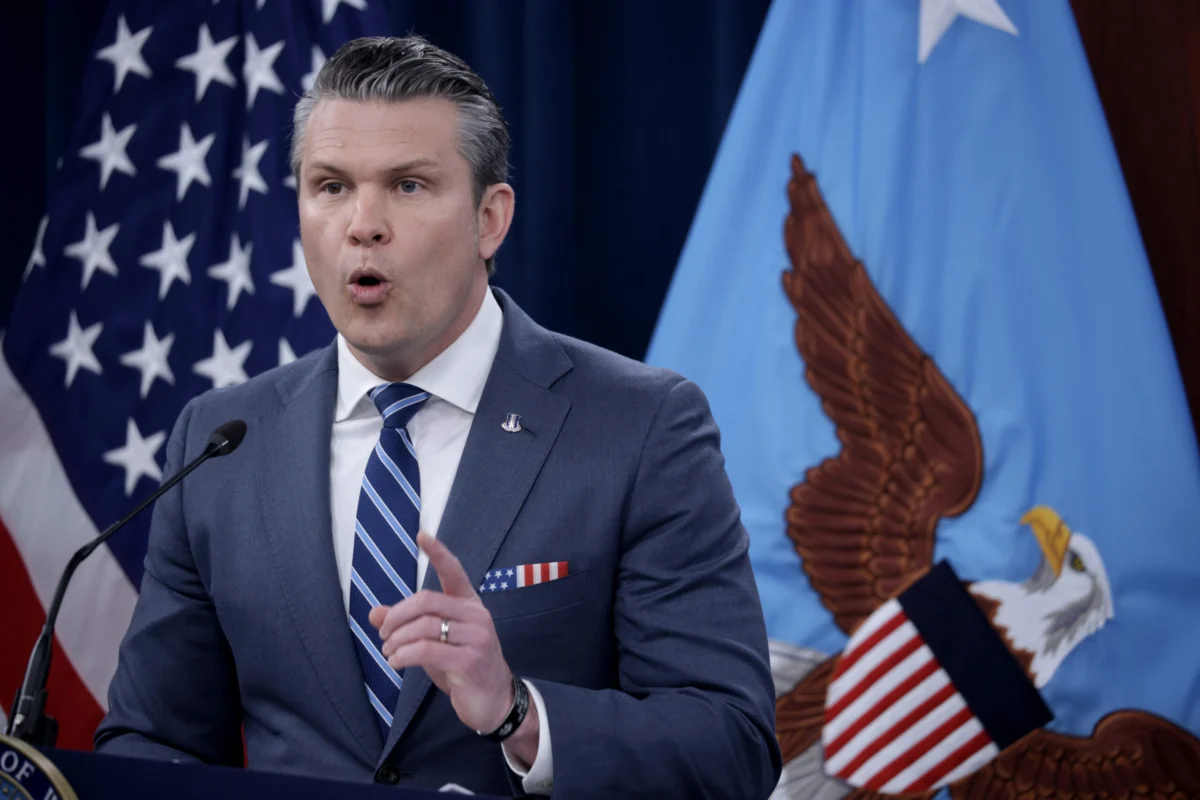
Secretary of Defense Pete Hegseth has ignited controversy by drawing a direct parallel between the contemporary press and the Pharisees, a group historically depicted as antagonists to Jesus Christ, during a recent press briefing concerning the war in Iran. Hegseth’s remarks, delivered with a theological framing, accused segments of the media, particularly those he characterized as the "legacy Trump-hating press," of exhibiting a hardened animus that blinds them to the valor of American military personnel and distorts coverage of critical operations. This strong condemnation comes amidst ongoing scrutiny of Pentagon press policies and a recent judicial ruling that found certain restrictions on reporting unconstitutional.
Hegseth’s sermon-like analogy began during a press conference where he recounted a personal experience at church. He described a sermon based on the Book of Mark, specifically a passage where Jesus heals a man with a withered hand on the Sabbath. Hegseth highlighted the Pharisees’ reaction in the scripture, stating they "came to see whether he Jesus would heal him on the Sabbath, so that they might accuse him." He elaborated on their motivations, asserting they were "self-appointed elites of their time" who "witnessed a literal miracle" but were solely focused on reporting and explaining away the "goodness in pursuit of their agenda."
The Secretary then explicitly linked this ancient biblical narrative to his perception of current journalistic practices. "As the passage ends, the Pharisees went out and immediately held counsel against him, how to destroy him," Hegseth stated. "I sat there in church and I thought, ‘Our press are just like these Pharisees, not all of you, not all of you, but the legacy Trump-hating press.’ Your politically motivated animus for President Trump nearly completely blinds you from the brilliance of our American warriors. The Pharisees scrutinized every good act in order to find a violation, only looking for the negative."
Hegseth’s critique extended to specific instances of alleged media shortcomings. He lamented that the press had not sufficiently focused on crucial aspects of the war, such as the rescue missions undertaken to save two airmen whose aircraft had been shot down in Iran. This assertion stands in contrast to extensive reporting that did indeed cover these high-stakes rescue operations. He further characterized the media’s output as an "endless stream of garbage, the relentlessly negative coverage you cannot resist pedaling, despite the historic and important success of this effort and the success of our troops."
The Secretary also invoked the withdrawal from Afghanistan during the Biden administration, a complex and widely reported event. Hegseth claimed that media outlets had "explained away the disastrous and disgraceful Afghanistan withdrawal." This assertion appears to dismiss the significant coverage that followed the August 26, 2021, suicide bombing at Kabul airport, an attack that claimed the lives of 13 U.S. service members and 170 Afghan civilians. During that period, the world watched as Afghans desperately sought evacuation amidst the Taliban’s rapid resurgence. The withdrawal also significantly impacted President Biden’s approval ratings, which experienced a notable decline from which they have not fully recovered.
Background on Hegseth’s Criticisms and Pentagon Press Policies
This is not the first time Secretary Hegseth has voiced strong opinions regarding media coverage and access to information. His public statements often reflect a broader trend within certain political circles to question the integrity and objectivity of mainstream news organizations. His reliance on religious scripture to frame his arguments underscores a deliberate rhetorical strategy to imbue his criticisms with a moral and historical weight.
The context for Hegseth’s remarks is also shaped by recent legal challenges to Pentagon press policies. Just last week, a federal judge ruled that certain press restrictions implemented by the Pentagon, which Hegseth was involved in, violated the U.S. Constitution. The Pentagon had sought to relocate reporter workspaces outside the main building, a move that followed an earlier judicial order that had already struck down policies attempting to limit reporting to officially sanctioned releases of information. This ruling suggests a legal tension between the Pentagon’s desire to control information flow and the media’s constitutional right to gather and report news.
The timing of Hegseth’s Pharisee comparison also bears a notable, albeit indirect, relation to a recent controversy involving former President Donald Trump. Earlier this week, Trump faced significant public backlash for posting an AI-generated image on Truth Social that depicted him in a Christ-like pose, seemingly healing a sick individual. Trump later claimed he believed the image portrayed him as a doctor, but the image was subsequently removed from his social media platform. While Hegseth did not directly reference this event, the use of biblical imagery and comparisons to Jesus by prominent political figures has become a recurring theme, highlighting a complex interplay between faith, politics, and public discourse.
Analysis of Hegseth’s Rhetorical Strategy and its Implications
Hegseth’s use of the Pharisee analogy is a potent, albeit divisive, rhetorical device. By casting journalists as modern-day Pharisees, he aims to delegitimize their reporting as inherently biased and driven by a desire to undermine rather than inform. This tactic serves several potential purposes:
- Mobilizing Support: It appeals to an audience that may already harbor distrust towards established media outlets and resonates with those who view political discourse through a lens of moral struggle.
- Deflecting Scrutiny: By framing negative coverage as a malicious attack, it shifts the focus from the substance of the reporting to the perceived motives of the reporters.
- Reinforcing a Narrative: It aligns with a broader narrative of persecution and unfair treatment often voiced by figures associated with the Trump administration, portraying themselves as victims of a biased establishment.
However, this approach carries significant risks.
- Alienating Potential Allies: While it may energize his base, it is likely to alienate a broader spectrum of journalists and the public who value independent reporting.
- Undermining Credibility: Employing such charged religious imagery in a secular political context can be seen as inappropriate or manipulative, potentially undermining Hegseth’s own credibility.
- Ignoring Complexities: The analogy risks oversimplifying the complex role of the press in a democracy, which includes holding power accountable and providing essential information to the public, even when that information is critical.
Broader Impact on Pentagon-Media Relations
The escalating rhetoric from high-ranking officials like Secretary Hegseth, coupled with legal challenges to press access, points to a deepening chasm in Pentagon-media relations. Such tensions can have profound implications for transparency and public understanding of military operations and national security matters.
- Reduced Transparency: When officials consistently characterize the press as adversarial, it can foster an environment where access is curtailed, and information is tightly controlled, making it harder for the public to receive a comprehensive picture.
- Erosion of Trust: The ongoing conflict between the Pentagon and elements of the press can erode public trust in both institutions. A well-informed public is crucial for democratic oversight of military actions and policy.
- Impact on Morale: Negative or perceived unfair coverage can impact the morale of service members and their families, who may feel their sacrifices are not being accurately or respectfully portrayed. Conversely, overly sanitized or uncritical reporting can leave the public uninformed about the true costs and complexities of conflict.
The legal ruling that found Pentagon press restrictions unconstitutional suggests a judicial recognition of the importance of the press’s role. However, the continued vocal opposition from figures like Hegseth indicates that the struggle for information access and balanced coverage is far from over. As the war in Iran and other geopolitical events unfold, the dynamic between the Department of Defense and the journalists tasked with reporting on it will remain a critical barometer of transparency and accountability in the United States. The Secretary’s chosen analogy, while potent, highlights the deep divisions and challenges inherent in this vital relationship.