The conventional scientific understanding of the jaguar, Panthera onca, has long depicted the species as the quintessential solitary hunter, an apex predator that maintains strict territorial boundaries and only seeks the company of others for the fleeting purposes of mating or the maternal duties of raising cubs. However, a groundbreaking longitudinal study conducted in Brazil’s Pantanal—the world’s most expansive tropical wetland—has shattered this long-held biological assumption. Data gathered over more than a decade reveals that these iconic big cats are significantly more social than previously believed, frequently engaging in complex interpersonal interactions, cooperative behaviors, and sustained social pairings that suggest a higher level of cognitive and behavioral flexibility than the “solitary” label implies.
The research, spearheaded by Valeria Boron, a senior program adviser for Latin America with WWF UK, represents a paradigm shift in felid ethology. By leveraging 13 years of observational data collected by the Jaguar ID Project, researchers have compiled a comprehensive catalog of social interactions that challenges the rigid classification of the jaguar as an exclusively antisocial creature. The findings indicate that in high-density environments like the Pantanal, the environmental pressures and resource abundance have fostered a social complexity previously reserved for other social carnivores.
The Evolution of Observation: From Camera Traps to Citizen Science
For decades, the study of elusive felids was limited by the technology of the era. Prior to the widespread adoption of high-resolution digital imaging and the rise of organized citizen science, researchers relied heavily on indirect methods such as camera traps, genetic sampling from scat, and infrequent opportunistic sightings. While these methods provided vital data on population density and range, they were fundamentally incapable of capturing the nuanced, real-time behavioral interactions that occur between individuals.
Since 2013, the Jaguar ID Project has transformed this landscape. By focusing their efforts on the dry season—running from June through October—when water levels recede and jaguars become more visible along the riverbanks, the project has successfully identified 459 individual cats. Each jaguar is cataloged through its unique rosette pattern, a form of natural identification that acts as a fingerprint. This extensive database, supplemented by images and videos provided by tourist boat operators and researchers, has created a "treasure trove" of behavioral data. According to Boron, this transition from passive monitoring to sustained, high-frequency observation has allowed scientists to document behaviors that would have been missed by static camera traps.
Decoding the Interactions: A Breakdown of Social Behavior
The study analyzed 167 documented instances of jaguar-to-jaguar interactions, providing a clear statistical breakdown of the social architecture of the Pantanal population. The data reveals that the nature of these meetings is far more varied than simple territorial disputes.
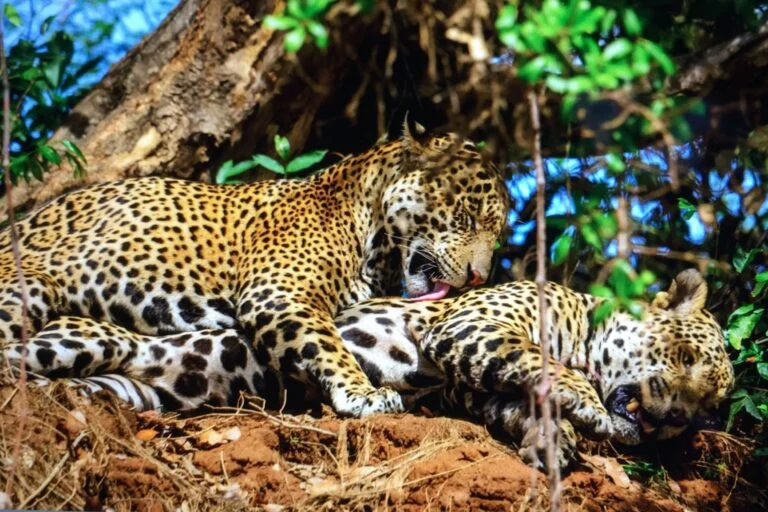
Of the recorded interactions, 49% involved two males, 31% involved a male-female pairing, and 17% involved two females. When categorizing these interactions by temperament, the researchers found that 25% were aggressive, 36.5% were neutral—often involving cats resting or hunting in close proximity without overt interaction—and a striking 39% were categorized as positive social behaviors. These positive interactions included playful sparring, mutual grooming, and, in some instances, cooperative hunting.
The existence of such a high percentage of social, non-aggressive behavior among males is perhaps the most surprising finding. Traditionally, male jaguars are viewed as fiercely competitive, constantly patrolling borders to defend access to females. The observation of two related males patrolling a territory together, or two unrelated males engaging in grooming, suggests that the social structure of the Pantanal is mediated by the specific conditions of the environment.

Environmental Drivers: The "Pantanal Exception"
The primary driver behind this increased sociality appears to be the extreme resource abundance found within the Pantanal. As the world’s largest wetland, the region supports a massive prey base, including caimans, capybaras, and fish. In an environment where food is plentiful and territories can overlap without inducing nutritional stress, the need for aggressive territorial exclusion is significantly reduced.
Stijn Verschueren, a conservation biologist at the University of Bern who was not involved in the research, noted that the results must be contextualized within the unique geography of the study area. "All observations come from riverbanks in an area with very high prey and jaguar density, so the results don’t necessarily apply to jaguars elsewhere," Verschueren stated. He emphasized that the "Pantanal effect" might be a localized phenomenon, where the biological imperative to defend a massive territory is outweighed by the benefits of tolerance in a resource-rich corridor.
This hypothesis is further supported by the gender differences observed in the study. While related males displayed a propensity for positive interactions, this was not mirrored in the female population. Females, particularly those accompanied by cubs, remained highly defensive. Boron attributes this to the high stakes of motherhood in a competitive environment, citing recorded instances of infanticide by other females. For a female, the risk of interacting with another adult is high, as the potential threat to her offspring outweighs the benefits of social bonding.
Broader Implications for Conservation and Science
The implications of this study extend beyond the academic interest in cat behavior; they influence how conservationists approach the protection of the species. Understanding that jaguars are capable of social tolerance suggests that habitat connectivity is even more vital than previously assumed. If jaguars are capable of navigating shared spaces, corridor management becomes a more effective tool for preventing genetic bottlenecks.
Furthermore, this research demonstrates the power of the "citizen science" model in wildlife conservation. Without the thousands of images provided by the tourism industry in the Pantanal, the sample size of 167 interactions would have been impossible to attain. This model provides a blueprint for studying other high-density populations, such as those in the Mamirauá reserve in the Amazon. By applying similar observational methodologies in different ecosystems, researchers can determine whether the Pantanal’s social jaguars are an anomaly or if, under the right conditions, the species possesses a latent social capacity that has been overlooked by traditional ecological frameworks.
Future Research Directions: Beyond the Quantitative
While the current findings provide a robust statistical foundation, the research team is looking toward a more qualitative future. Boron expressed a keen interest in moving beyond the mere counting of interactions to a deeper, descriptive analysis of the behaviors themselves. Future studies may look into the linguistic or non-verbal cues used during these interactions, the long-term impact of early-life social play on adult success, and the potential for "cultural transmission" of hunting techniques among the socialized groups.
The transition from a view of the jaguar as a "solitary ghost of the forest" to an animal capable of complex, if selective, social life is a testament to the importance of long-term ecological monitoring. As the Pantanal faces increasing pressures—ranging from climate change-induced droughts to the expansion of human tourism—understanding the social needs of the jaguar will be essential. If these cats rely on social networks to navigate their environment, then habitat fragmentation may do more than just limit hunting grounds; it may disrupt the very social fabric that allows these predators to thrive in the world’s most unique wetland.
In conclusion, the 13-year dataset from the Jaguar ID Project marks a turning point in our understanding of Panthera onca. By documenting the nuances of their daily lives, researchers have shown that while the jaguar remains a formidable apex predator, it is also a species defined by a surprising degree of behavioral plasticity. As scientists continue to peel back the layers of these cats’ lives, the image of the solitary prowler is slowly being replaced by a much more nuanced, social, and intelligent portrait of one of nature’s most fascinating survivors.