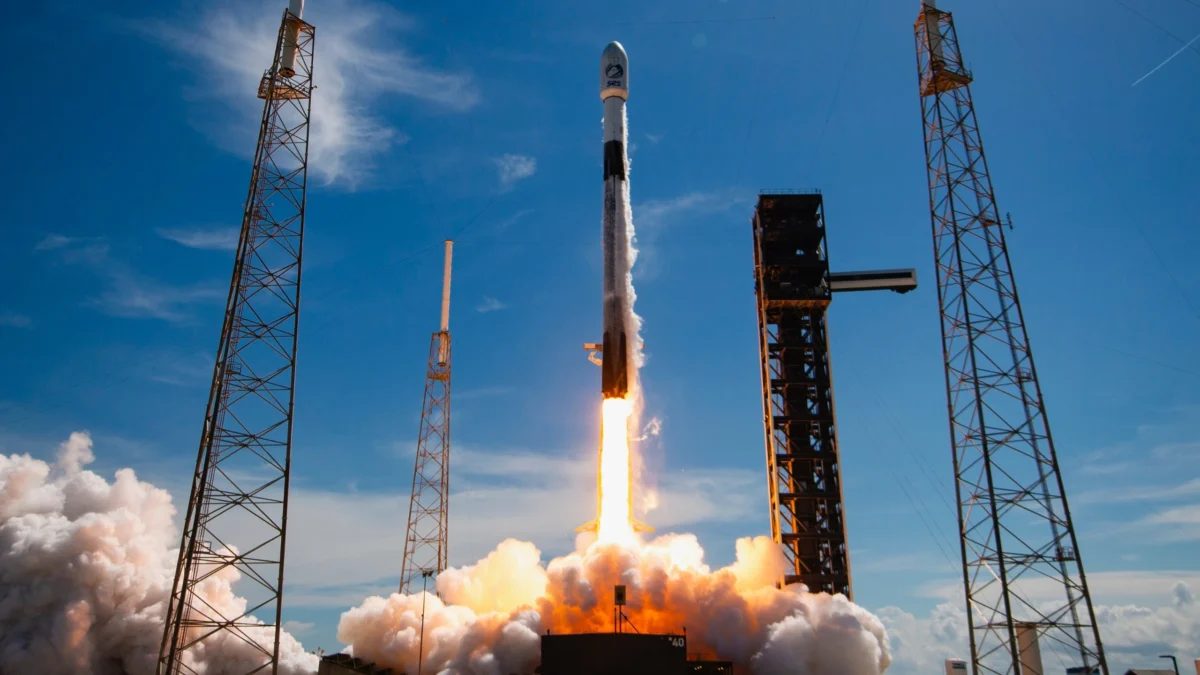
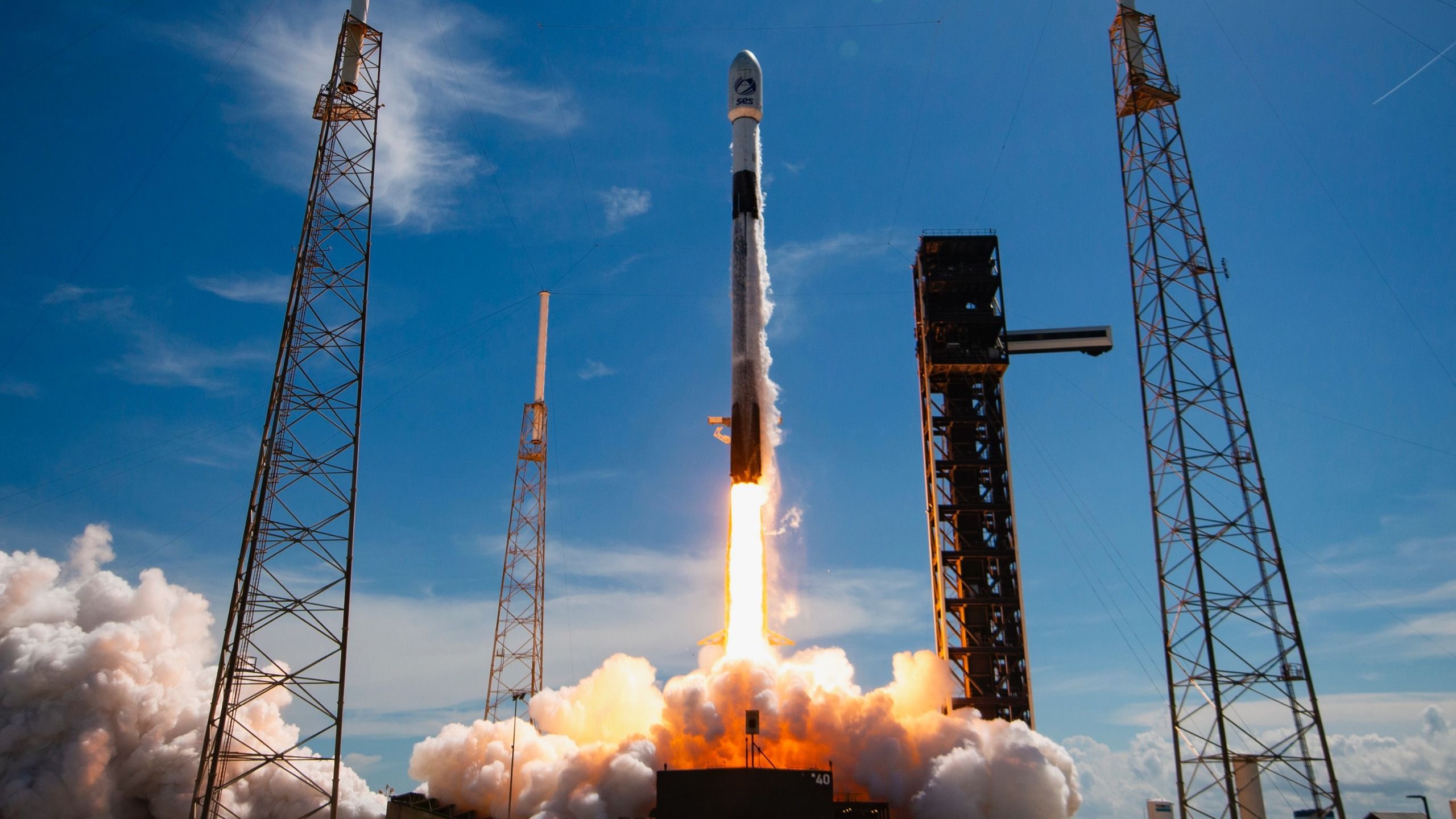
SpaceX achieved a major milestone in modern aerospace history today, successfully launching its 700th Falcon-class rocket from Florida’s Cape Canaveral Space Force Station. Blasting off at 2:49 p.m. EDT (1849 GMT), the reliable Falcon 9 vehicle carried the final three telecommunications satellites for Luxembourg-based provider SES, completing the company’s next-generation O3b mPOWER constellation.
The mission not only underscored the relentless operational tempo of Elon Musk’s aerospace company, but it also finalized a critical infrastructure project designed to revolutionize global connectivity for enterprise, maritime, aeronautical, and government sectors requiring high-throughput and low-latency communication.
A Milestone Decades in the Making: The 700th Falcon Mission
The successful flight on September 13 marked the 700th launch of a vehicle belonging to the SpaceX Falcon rocket family, a dominant lineage that traces its roots back nearly two decades. The saga began in March 2006 with the maiden flight of the light-lift Falcon 1. Although pioneering for its time, the Falcon 1 achieved only two successful flights out of five attempts before being retired to make way for a far more ambitious design.
In 2010, SpaceX debuted the Falcon 9, a two-stage medium-lift vehicle that would fundamentally transform the economics of space access through its pioneering vertical landing and booster reusability. The Falcon 9 has since shouldered the vast majority of the company’s historic flight rate, carrying everything from commercial payloads and NASA cargo to crewed Dragon capsules and massive batches of Starlink internet satellites.
The broader Falcon family also includes the Falcon Heavy, a heavy-lift configuration made by strapping three Falcon 9 first stages together. Debuting in February 2018 with a dramatic simultaneous booster landing and the launch of a Tesla Roadster into deep space, the Falcon Heavy has since flown 13 times. Combined, the Falcon 9 and Falcon Heavy have established an unprecedented cadence of reliable launches, cementing SpaceX’s status as the world’s premier commercial launch provider.
Mission Chronology and Flight Profile
Today’s flight followed a well-rehearsed choreography that has become routine for SpaceX engineers and flight controllers, yet remains a marvel of modern engineering. Liftoff from Space Launch Complex 40 (SLC-40) at Cape Canaveral Space Force Station occurred precisely on schedule, with the nine Merlin engines on the Falcon 9’s first stage roaring to life to push the 230-foot-tall rocket through the atmosphere.
Roughly two and a half minutes into flight, main engine cutoff (MECO) occurred, followed by stage separation. While the upper stage continued its journey into the upper atmosphere, the first-stage booster—designated B1080 and flying for a remarkable 29th time—flipped and executed its entry burn to bleed off speed.
A little less than nine minutes after liftoff, booster B1080 successfully touched down on SpaceX’s Atlantic Ocean drone ship, "A Shortfall of Gravitas," marking another successful recovery for the company’s rapidly expanding inventory of flight-proven hardware. Reusing rocket boosters has allowed SpaceX to drastically lower turnaround times between missions while maintaining a pristine safety record.
Meanwhile, the Falcon 9’s single-engine upper stage continued to execute a series of burns to transport its valuable payload to medium Earth orbit (MEO), located thousands of miles above the planet. Satellite deployment commenced roughly 33.5 minutes after launch. Over a tightly coordinated 14-minute window, the three Boeing-built spacecraft were released smoothly into their targeted orbit at an altitude of approximately 5,000 miles (8,000 kilometers).
Completing the O3b mPOWER Constellation
With the successful separation of today’s payload, SES now has its complete constellation of 13 operational O3b mPOWER satellites stationed in medium Earth orbit. Built by aerospace giant Boeing, each satellite weighs approximately 3,750 pounds (1,700 kilograms) and is packed with advanced digital payload capabilities.
The O3b mPOWER system is engineered from the ground up to serve enterprise and government clients requiring guaranteed performance in remote or bandwidth-starved environments. Unlike traditional geostationary (GEO) satellites, which operate at high altitudes and suffer from noticeable signal latency, or low Earth orbit (LEO) constellations that require massive numbers of handoffs, MEO strikes a strategic balance. It delivers fiber-equivalent connectivity with exceptionally low latency, massive throughput, and dynamic routing capabilities.
According to SES, the constellation pairs advanced software-defined satellites with an intelligent ground ecosystem. This architecture allows the network to adapt dynamically to shifting traffic demands on a global scale. Industries such as commercial aviation, maritime shipping, offshore energy exploration, and global telecommunications operators rely on the system to provide uninterrupted, high-speed connectivity where traditional terrestrial infrastructure is absent or inadequate.
SpaceX has been the exclusive launch partner for the O3b mPOWER program, deploying all 13 satellites across six dedicated Falcon 9 missions starting in December 2022. The completion of this deployment phase represents a major milestone for SES as it transitions its next-generation network into full commercial service.
Context Within SpaceX’s Record-Breaking 2026 Manifest
Today’s mission represents the 107th orbital flight of the calendar year for SpaceX, highlighting an extraordinary launch cadence that leaves traditional space agencies and competing commercial firms far behind. Of those 107 flights, 105 have been executed by the tireless Falcon 9, while the Falcon Heavy has handled the remaining two missions.
In addition to its dominant workhorse fleet, SpaceX is rapidly pushing forward with the development and testing of Starship, its fully reusable next-generation megarocket designed to carry crew and cargo to the moon, Mars, and destinations beyond. Having already executed two successful suborbital test flights earlier this year, SpaceX is currently preparing for its third flight test—an ambitious endeavor widely anticipated to mark the first time the massive integrated vehicle attempts to reach orbital velocity.
Strategic Implications for the Global Space Economy
The successful completion of the O3b mPOWER deployment and the realization of SpaceX’s 700th Falcon mission carry profound implications for the global space economy.
First, SES’s fully realized constellation signals a maturation of multi-orbit hybrid strategies for global telecommunications. As demand for data surges exponentially across mobile devices, cloud computing platforms, and connected transportation networks, the ability to leverage MEO assets alongside LEO and GEO networks ensures greater resilience and flexibility. Enterprises can no longer afford network downtime, making resilient architecture a baseline requirement rather than a luxury.
Second, SpaceX’s milestone of 700 successful Falcon launches demonstrates the unprecedented commercial viability of rocket reusability. By routinely flying first-stage boosters nearly 30 times—as evidenced by booster B1080’s performance today—SpaceX has effectively rewritten the economics of space launch. This capability has compressed the cost per kilogram to orbit, enabling commercial satellite operators to deploy sophisticated multi-satellite constellations at a scale that was economically impossible just a decade ago.
As SpaceX looks toward its upcoming Starship orbital tests and continues to service commercial and governmental customers with unmatched reliability, today’s flight serves as both a celebration of past engineering achievements and a foundational stepping stone toward a deeply interconnected, space-enabled future.