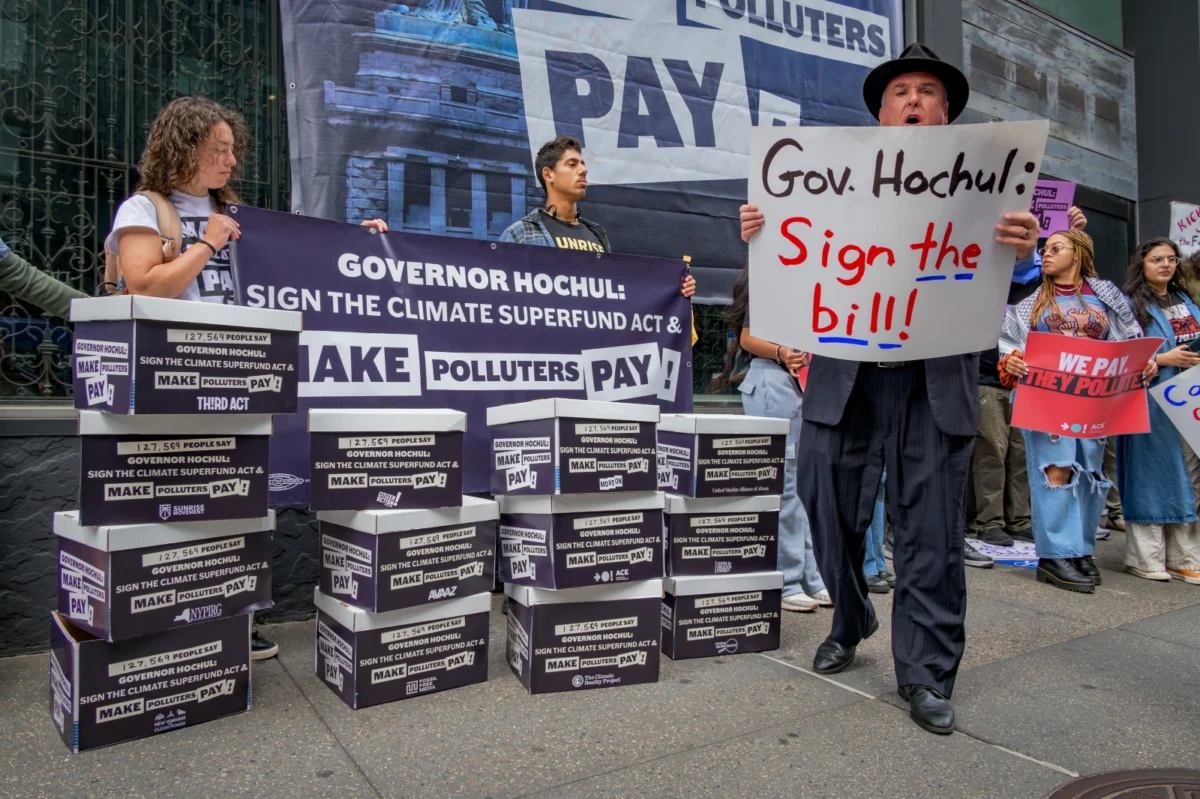
Recent federal court rulings striking down New York’s landmark climate legislation have cast a long shadow over state-level efforts to hold fossil fuel companies financially accountable for the impacts of a warming planet. However, despite these judicial setbacks and aggressive pushback from industry advocates and Republican attorneys general, lawmakers across the United States are signaling that they have no intention of backing down.
Even as New York reels from twin judicial decisions dismantling its attempt to secure billions from major energy corporations, legislators in states ranging from New England to the Pacific remain resolute. Yet, the ultimate survival of climate liability laws may not rest on these regional skirmishes. Instead, the entire movement faces a definitive trial before the Supreme Court of the United States, where an upcoming landmark case could either validate state authority or completely preempt local accountability measures nationwide.
The Genesis of Climate Superfunds: Drawing From the 1980 Playbook
The concept of a climate superfund originates from a proven legislative framework. In 1980, Congress enacted the federal Superfund Act—formally known as the Comprehensive Environmental Response, Compensation, and Liability Act (CERCLA)—to address the catastrophic ecological and public health threats posed by abandoned hazardous waste sites. That federal statute established a strict liability scheme, forcing chemical and petroleum companies to foot the bill for cleaning up heavily polluted areas across the country.
More than four decades later, progressive lawmakers and environmental advocates sought to adapt that model to the planetary scale of climate change. In 2024, New York enacted its Climate Change Superfund Act. The legislation was designed to extract $75 billion from major fossil fuel corporations over a multi-year period. These funds were specifically earmarked to offset the escalating costs of climate-related damages, including the recovery and reconstruction required after extreme weather events, alongside long-term adaptive infrastructure projects such as upgraded stormwater drainage systems and advanced cooling mechanisms in public buildings.
The passage of New York’s law served as a vital catalyst for the environmental movement, inspiring numerous other state legislatures to draft their own versions of polluter-pays legislation. Vermont quickly followed suit, becoming the only other state to officially pass a climate superfund law. Meanwhile, lawmakers in states including California, Illinois, Massachusetts, New Jersey, Connecticut, Rhode Island, and Hawaiʻi began exploring similar measures to protect taxpayers from bearing the staggering financial burdens of climate adaptation.
A Double Judicial Blow in New York
The momentum behind these legislative efforts suffered a severe disruption last week when federal judges handed down two decisive rulings against New York’s superfund law.
In the first major ruling, Judge Brenda Sannes of the U.S. District Court for the Northern District of New York sided with fossil fuel companies and a coalition of 22 red-state attorneys general who had filed lawsuits to block the measure. Judge Sannes concluded that New York’s legislation was preempted by federal law—specifically the Clean Air Act—and ruled that the state-level attempt to regulate and penalize global emissions was simply beyond the constitutional limits of state authority.
A second federal ruling reinforced this barrier, delivering a profound blow to the state’s advocates and environmental groups who had championed the law for years. Legal analysts anticipate that New York will formally appeal both decisions, setting the stage for higher-court reviews in the U.S. Court of Appeals for the Second Circuit.
Nevertheless, the immediate fallout has empowered industry interests and conservative state leaders. Vermont’s enacted superfund law is currently facing parallel legal challenges from many of the same plaintiffs who targeted New York. Vermont legal scholars note that the past month has seen a coordinated flurry of briefings, industry-backed press statements, and lobbying efforts demanding the immediate repeal of the statute.
Opposition has also reverberated across other states contemplating similar pathways. In New Jersey, Republican state Senator Michael Testa publicly declared that pursuing a climate superfund measure would represent an irresponsible waste of state time and resources. More aggressively, West Virginia Attorney General JB McCuskey warned in interviews with legal publications that if any other state attempts to pass a similar policy, his office will file lawsuits almost instantaneously.
Lawmakers Push Forward Despite Regional Setbacks
Despite the hostile judicial landscape in New York and the vocal warnings from opposing attorneys general, numerous state lawmakers insist that the recent rulings do not sound the death knell for climate accountability initiatives.
During interviews with policy reporters, several legislators emphasized that legal dynamics vary significantly by jurisdiction and that the New York decisions do not automatically invalidate proposals in other regions. Karl Rhoads, an outgoing state senator in Hawaiʻi who sponsored a superfund bill during the previous legislative cycle, maintained an unyielding stance. “I don’t think it’ll make any difference,” Rhoads stated. “There’s no reason for the rest of us not to continue.”
In New England, representatives are actively preparing for upcoming legislative sessions. Rhode Island Representative Jennifer Boylan and Connecticut Representative Josh Elliott both confirmed plans to reintroduce climate superfund bills when their respective legislatures reconvene. Boylan dismissed the idea that the New York ruling would automatically doom parallel legislation nationwide, characterizing such narratives as a convenient scare tactic employed by opponents. “I’m full speed ahead,” she affirmed.
Similar resilience is evident in New Jersey, where a climate superfund bill sponsored by Democratic Senator John McKeon stalled prior to the legislative summer recess. Despite the delay, supporters believe the measure remains viable during the remainder of the current two-year session. McKeon brushed off concerns regarding the New York ruling, noting that New Jersey operates within a different federal court circuit and is governed by distinct legal precedents.
Even in states where immediate legislation has stalled due to partisan friction, lawmakers note that the barriers are political rather than legal. Tony Caplan, a Democratic representative from New Hampshire who previously sponsored an unsuccessful bill to calculate and recoup the monetary costs of climate damages, explained that his current focus has shifted toward broader decarbonization statutes. However, Caplan attributed this pivot to long-standing opposition from his state’s Republican-controlled Legislature rather than the recent federal rulings out of New York.
“The lawfare goes on,” Caplan observed. “The decision can be appealed, obviously, and there are blue states that will continue to push forward with these kinds of bills.”
The Looming Threat of Suncor v. Boulder County
While state-level lawmakers debate the resilience of their regional statutes, legal scholars warn that a far greater existential threat is rapidly approaching the U.S. Supreme Court. Beginning next week, the nation’s highest court will hear oral arguments in Suncor v. Boulder County, a pivotal case that could fundamentally reshape the legal landscape of climate liability.

The core of the Suncor litigation stems from a 2018 lawsuit filed by Boulder County and the City of Boulder against major energy companies including Suncor and ExxonMobil. Local officials sought to hold these corporations accountable through state tort claims for the local costs of climate change. Fossil fuel interests countered that state courts are an improper forum for such claims, arguing that allowing localities to penalize energy companies for global emissions represents an unconstitutional attempt to dictate national foreign and environmental policy.
If the Supreme Court rules in favor of the fossil fuel industry, the consequences could be sweeping and permanent. Pat Parenteau, an emeritus professor at Vermont Law School, outlined the severity of the potential outcome. “Worst case, they rule that federal law—both statutory and constitutional federal law—preempts all of these cases, throws them all out,” Parenteau warned.
A broad ruling against the municipalities could invalidate not only climate superfund proposals, but also consumer protection actions, racketeering lawsuits, and antitrust claims brought against energy producers. Such an outcome would effectively block every state in the country from seeking judicial recourse, leaving billions of dollars in climate adaptation costs unaddressed by the corporate entities that historically contributed to greenhouse gas emissions.
Rachel Rothschild, an assistant professor at the University of Michigan Law School, echoed these concerns while noting that states technically retain the freedom to pursue policies unconstrained by district-level rulings in New York or even the Second Circuit. Nevertheless, she characterized a potential adverse ruling in Suncor as a devastating blow to broader governance. “My fear is that this is going to be another notch in a long list of decisions that are threatening to our broader country and democracy, leaving states without the ability to do much on very flimsy and poorly reasoned legal grounds,” Rothschild stated.
Conversely, some legal experts suggest the Supreme Court might adopt a narrow or cautious approach. Rather than issuing a sweeping preemption order, the justices could punt on the core constitutional questions because the case has not yet wound its way through the complete Colorado state court system. While this “wait-and-see” approach would avoid an immediate nationwide ban, scholars note it would leave existing federal preemption rulings and district-level roadblocks intact.
Implications for the Future of Environmental Federalism
Should the plaintiffs in Boulder prevail, state-level climate accountability measures would be permitted to move forward, providing a clearer roadmap for policymakers. Legal scholars suggest that a nuanced ruling from the Supreme Court might establish explicit boundaries for state authority—potentially clarifying whether states can legally claim damages exclusively for pollution generated within their own borders, or whether they are restricted to collecting penalties for empirically demonstrated local harms.
Jonathan Adler, a professor at William and Mary Law School, emphasized that the legal community will be monitoring the proceedings closely for judicial benchmarks. “That might give us something of a yardstick with which we could evaluate what could be done under the climate superfund statutes,” Adler said. “We’ll have to pay a lot of attention.”
As the legal battle moves from regional federal courts to the steps of the Supreme Court, the interplay between state sovereignty and federal environmental statutes hangs in the balance. For now, state lawmakers and climate advocates remain locked in a high-stakes standoff, determined to advance accountability legislation even as the ground beneath their feet shifts dramatically.