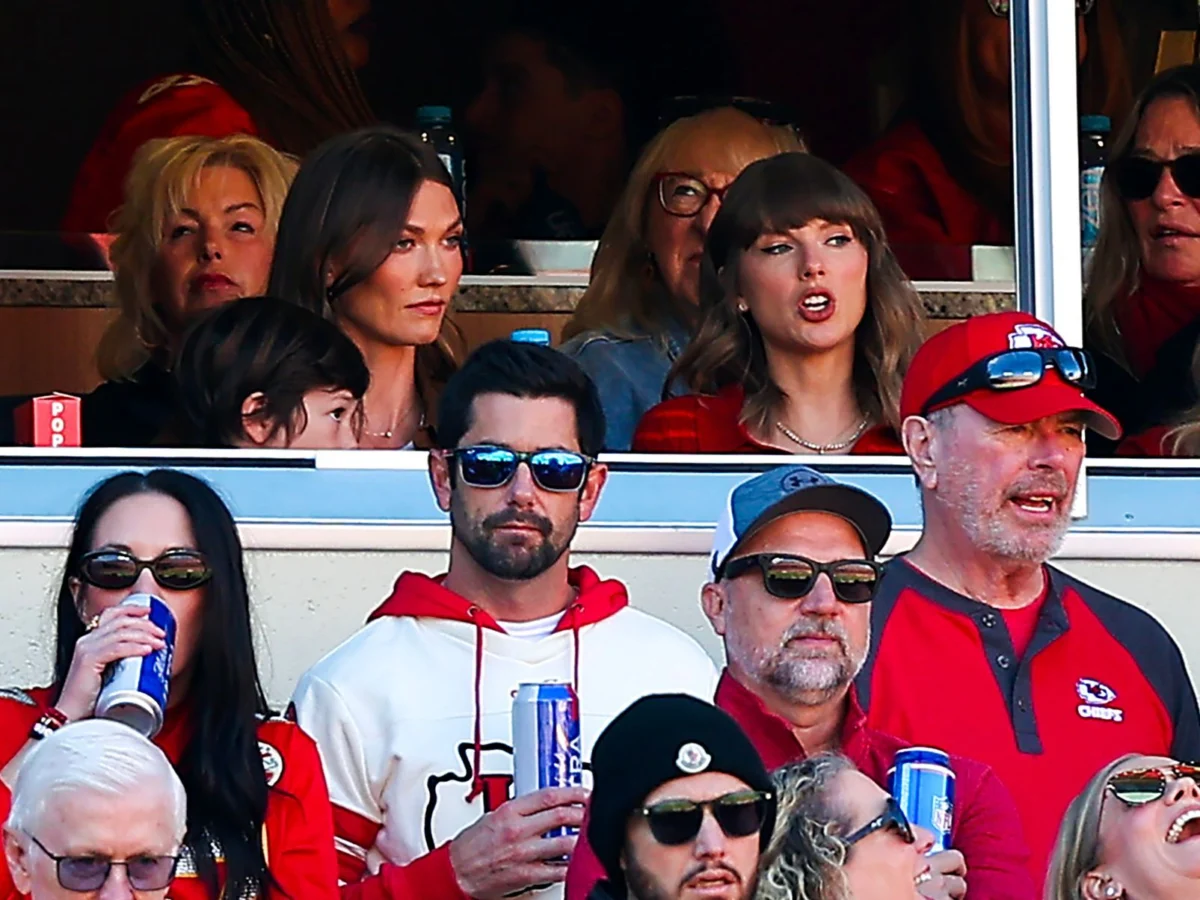
The intersection of professional sports, pop culture, and high-profile friendships commanded global attention on a brisk evening at Arrowhead Stadium, where the Kansas City Chiefs hosted the New York Jets. Among the high-intensity atmosphere of regular-season NFL play, global pop superstar Taylor Swift maintained her familiar position within the venue’s VIP suites. However, the evening’s guest list carried profound cultural significance beyond standard game-day attendance. Seated alongside Swift’s parents, Andrea and Scott Swift, was supermodel and longtime entrepreneur Karlie Kloss. The appearance effectively signaled a public reaffirmation of a high-profile friendship that has weathered years of intense media scrutiny, public speculation, and shifting personal trajectories.
The gathering served a dual purpose: supporting Chiefs tight end Travis Kelce as he crossed a monumental professional threshold, and quietly putting to rest years of persistent tabloid narratives regarding an alleged estrangement between two of the 2010s most recognizable cultural figures.
Main Facts of the Arrowhead Stadium Gathering
The matchup between the Kansas City Chiefs and the New York Jets drew an anticipated capacity crowd, yet the media attention inside the stadium’s suite level rivaled the action on the gridiron. Taylor Swift, maintaining her established tradition of displaying team solidarity through sartorial choices, arrived dressed in a vibrant red sweater accented by a striking statement necklace. Her presence at Chiefs home games has become a staple of the NFL season, driving unprecedented viewership demographics and merging mainstream sports broadcasting with global entertainment culture.
What distinguished this particular fixture, however, was the presence of Karlie Kloss. Kloss, a fixture of the fashion industry and digital media entrepreneur, was photographed seated directly beside Swift and her parents. The visual confirmation of their renewed proximity instantly dominated digital news cycles and social media platforms, transforming a standard athletic event into a major entertainment news milestone.
The Chronology of a Friendship: From 2010s Icons to Madison Square Garden
To fully understand the cultural weight of the Arrowhead Stadium reunion, one must examine the documented timeline of Swift and Kloss’s relationship. The two first crossed paths in the early 2010s, quickly ascending to the upper echelons of contemporary pop culture iconography. Their bond was cemented publicly in March 2015, when they appeared together on the cover of American Vogue, lensed by renowned fashion photographer Mario Testino. During this era, Kloss was frequently documented as a core member of Swift’s inner circle, appearing in the star-studded music video for Bad Blood and sharing prominent moments at major award shows and fashion weeks.
However, by the late 2010s, public sightings of the duo dwindled significantly. The conspicuous absence of social media acknowledgments and mutual appearances sparked years of intense fan speculation and tabloid reporting regarding an alleged rift. Neither Swift nor Kloss ever publicly addressed or confirmed the rumors, maintaining a professional silence that only fueled further public curiosity.
The thawing of this perceived distance began to materialize behind closed doors. Earlier this year, in July, Kloss made headlines as an invited guest at the high-profile wedding of Taylor Swift and Travis Kelce at Madison Square Garden. Addressing the media following the ceremony, Kloss offered a diplomatic yet warm acknowledgment of her return to Swift’s inner circle. “Listen, I try to protect the privacy of my friends’ personal lives,” Kloss remarked to reporters. “But what I will say is that they’re an amazing couple and I’m so happy for them.”
The culmination of this reconciliation arrived on the turf of Arrowhead Stadium, shifting the narrative from past speculation to a unified public display of enduring friendship.

Supporting Data: The Travis Kelce Milestone and NFL Cultural Economics
While the personal dynamics within the VIP suite captured the attention of entertainment journalists, the athletic context of the evening held immense significance for the Kansas City Chiefs franchise. The matchup against the New York Jets marked Travis Kelce’s 200th career NFL game.
Achieving 200 regular-season appearances in the National Football League represents an elite threshold of athletic longevity, physical endurance, and professional consistency, particularly for the rigorous tight end position. Kelce, drafted by the Chiefs in the third round of the 2013 NFL Draft, has spent his entire professional career with the organization, establishing himself as one of the most prolific pass-catching tight ends in the history of the sport. His career milestones include multiple Super Bowl championships, numerous Pro Bowl selections, and record-setting postseason receptions.
The convergence of Kelce’s athletic milestones and Swift’s high-profile attendance has historically yielded quantifiable economic and viewership impacts for the NFL. According to data analytics firms and sports marketing agencies, Swift’s presence at Chiefs games during the 2023 and 2024 seasons generated an equivalent of hundreds of millions of dollars in brand value for the NFL, the Kansas City Chiefs, and league broadcast partners. The phenomenon, often dubbed the "Taylor Swift effect," introduced the sport to significant new demographic cohorts, notably young women and teenage girls, resulting in record-breaking television ratings for regular-season broadcasts.
Official Responses and Media Ecosystem Reactions
The sports and entertainment media ecosystems reacted swiftly to the Arrowhead Stadium sighting, deploying digital analysis, fashion breakdowns, and cultural commentary across global platforms. Representatives for both Swift and Kloss maintained a standard policy of discretion regarding their private schedules, allowing the visual evidence from the stadium suites to speak for itself.
Sports broadcasting networks covering the game tactfully integrated the appearance into their pre-game and in-game narratives. Broadcasters routinely balance the coverage of high-profile attendees with on-field play analysis, recognizing the dual appeal of modern NFL broadcasts as both athletic competitions and premier entertainment spectacles. Analysts noted that Kelce’s performance on the field remained focused despite the intense off-field spotlight, a testament to his veteran poise across a two-decade-long career landscape.
Broader Impact and Implications of the Swift-Kloss Public Reunion
The public reconciliation of Swift and Kloss carries broader implications within the context of celebrity image management and digital culture. In an era where public figures are subjected to perpetual digital surveillance and algorithmic scrutiny, the resolution of interpersonal dynamics—whether real or perceived—serves as a compelling narrative arc for consumers of celebrity culture.
Furthermore, the event underscores the evolving intersection of elite athletics and mainstream fashion and music industries. The traditional boundaries separating the NFL from high fashion and pop music have dissolved entirely, largely catalyzed by the relationship between Kelce and Swift. By hosting figures like Kloss in NFL suites, the ecosystem demonstrates a sophisticated cross-pollination of audiences, where high-fashion models, global music icons, and professional athletes occupy the same physical and cultural space.
As the NFL season progresses, the presence of Taylor Swift at Arrowhead Stadium remains a reliable constant of the league’s cultural footprint. Yet, the inclusion of Karlie Kloss in the narrative transforms a standard athletic milestone into a multi-layered cultural moment. It bridges the worlds of athletic endurance, high-profile romance, and the enduring resilience of female friendships in the public eye, ensuring that the legacy of Arrowhead Stadium’s suite-level gatherings extends far beyond the final whistle of the game.