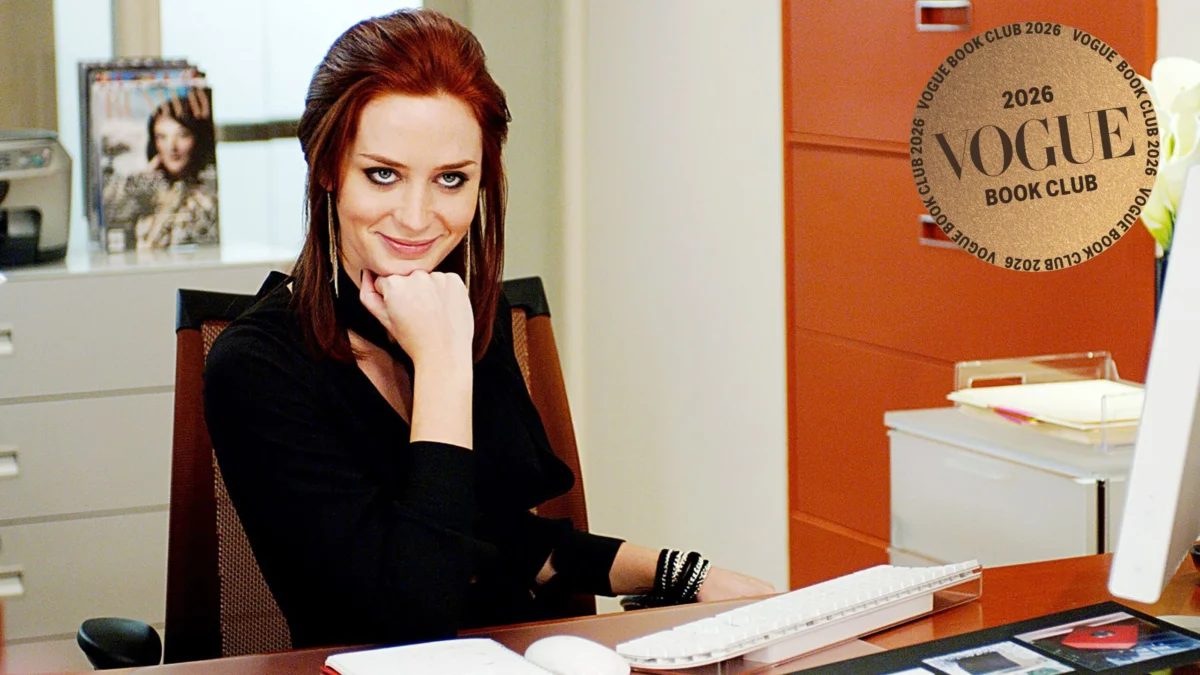
The intersection of fashion history, digital folklore, and the enduring legacy of the 2006 film The Devil Wears Prada has recently converged on a singular figure: Plum Sykes. For years, Sykes, a long-time Vogue contributor and novelist, has been the subject of intense speculation regarding her role in inspiring the character of Emily Charlton, the acerbic English assistant played by Emily Blunt in the cinematic adaptation of Lauren Weisberger’s best-selling novel. This speculation has transitioned from industry whispers to a viral TikTok phenomenon, prompting a re-examination of the early 2000s Vogue office culture and the real-life figures who occupied the desks at 4 Times Square.
.jpg)
The resurgence of interest follows the announcement of a sequel to The Devil Wears Prada, currently in development, and the circulation of archival footage from the 2003 BBC documentary Boss Women. Digital detectives on social media platforms have utilized these clips to draw parallels between Sykes’s televised persona and the "hoity-toity" character of Emily. While Sykes has historically remained silent on the matter, the mounting pressure from social media and the upcoming film franchise expansion has led to a formal inquiry into the origins of one of cinema’s most recognizable fashion archetypes.
The Catalyst: TikTok and the Boss Women Documentary
The primary driver of the current identity crisis is a series of viral videos on TikTok, where users have juxtaposed clips of the DWP2 trailer with segments from the 2003 documentary Boss Women. The documentary, which provided a rare behind-the-scenes look at the professional life of Vogue Editor-in-Chief Anna Wintour, featured Plum Sykes prominently. In the footage, Sykes is seen discussing the necessity of wearing cocktail attire for work—specifically a chiffon Dolce skirt—and navigating the office with a level of sartorial rigor that mirrored the fictional Emily’s dedication to high fashion.

The "Emily" character in the 2006 film is portrayed as a high-strung, status-conscious assistant who views the protagonist, Andy Sachs (Anne Hathaway), with disdain. Social media users have pointed to Sykes’s English accent, her tenure at Vogue during Lauren Weisberger’s employment, and her televised commitment to fashion standards as "proof" of her being the muse for the character. This digital narrative has gained such momentum that it has reached Sykes’s own family, with her daughter, Tess, and school associates citing Google data as definitive evidence of the connection.
Historical Context: The 4 Times Square Era
To understand the validity of these claims, one must look at the environment of Condé Nast in the early 2000s. At the time, the Vogue offices were located at 4 Times Square, a skyscraper that became the epicenter of the global fashion industry. The culture of the office was characterized by a strict hierarchy of assistants, a standard of dress that bordered on the ceremonial, and an atmosphere of extreme professional intensity.

Lauren Weisberger served as an assistant to Anna Wintour in the late 1990s and early 2000s, a period that informed her 2003 roman à clef. While the character of Miranda Priestly is widely accepted as a fictionalized version of Wintour, the supporting characters were often composites of several individuals. During this era, the "Voguette" archetype—a term used to describe the young, impeccably dressed women working under Wintour—was at its peak. This lifestyle included biweekly manicures, hour-long blowouts at John Barrett at Bergdorf Goodman, and a refusal to wear flat shoes in a professional setting.
The Hierarchy of Assistants and Potential Inspirations
A critical component of the "Emily" investigation is the specific hierarchy of the Editor-in-Chief’s office. In both the novel and the film, there is a clear distinction between the "first assistant" and the "second assistant." Lauren Weisberger held the position of second assistant. According to industry veterans, the individuals who occupied the first assistant role during or near Weisberger’s tenure are the most likely candidates for the character’s inspiration.

Kate Young
Kate Young, now one of Hollywood’s most prominent celebrity stylists, was a second assistant at Vogue for one year before moving up the ranks. Young, who possessed a "chic English twang" after studying at Oxford University, was known for her immaculate grooming and protective stance over the editor’s office. However, Young has publicly denied being the primary inspiration for the "mean" aspects of the Emily character, describing herself instead as a "task rabbit" who managed logistics, dry cleaning, and party planning.
Leslie Fremar
Leslie Fremar, another highly successful stylist, served as the first assistant during the period when Weisberger was the second assistant. Fremar has been described by colleagues as stern, beautiful, and highly efficient. In recent communications, Fremar noted that while the professional expectations and workload depicted in the book "track" with reality, she does not identify with the character’s perceived cruelty.

Plum Sykes
Sykes herself, while possessing the requisite English accent and high-maintenance wardrobe, was never actually an assistant to Anna Wintour. She was a contributing fashion editor and a writer. However, her public-facing role in the Boss Women documentary likely made her the most visible "Voguette" to the public, leading to the conflation of her persona with the fictional assistant character.
Chronology of the "Emily" Identity Evolution
- 1999–2000: Lauren Weisberger works as the second assistant to Anna Wintour at Vogue.
- 2002: The BBC films the Boss Women documentary at the Vogue offices, featuring Plum Sykes.
- 2003: Weisberger publishes The Devil Wears Prada; the novel becomes a bestseller. The Boss Women documentary airs in the UK.
- 2004: Sykes is photographed for Vogue, cementing her image as a leading figure of the era’s fashion scene.
- 2006: The film adaptation of The Devil Wears Prada is released. The character of Emily is changed from the novel’s American version to an English version specifically for actress Emily Blunt.
- 2024: TikTok clips of Sykes in Boss Women go viral. News of a movie sequel breaks, leading to a renewed search for the "real Emily."
Supporting Data: The Impact of the Archetype
The enduring nature of the Emily character is supported by the film’s massive cultural footprint. The Devil Wears Prada grossed over $326 million globally and earned Emily Blunt a Golden Globe nomination. The character’s "Englishness" was a creative decision made during the film’s casting, which inadvertently fueled the association with Sykes.

Data from social media analytics suggests that interest in "early 2000s office sirens" and "Vogue history" has seen a 40% increase in engagement over the last 12 months. This "nostalgia-core" trend relies heavily on archival footage, often removing context in favor of creating a cohesive social media narrative. For Sykes, this has resulted in a "slur of mistaken identity" that overlooks her actual role at the magazine in favor of a more entertaining villainous trope.
Official Responses and Broader Implications
When approached for comment, the office of Lauren Weisberger has remained silent regarding the specific inspirations for the Emily character. Former colleagues, such as Amy Astley, now Editor-in-Chief of Architectural Digest, have offered a more nuanced view. Astley noted that while Sykes was never an assistant, she shared Emily’s "sharp and clever" nature and high-maintenance aesthetic. Astley also observed that Wintour’s assistants were notoriously protective and busy, creating a "you can’t sit with us" atmosphere that likely inspired the colder traits of the fictional characters.

The broader implication of this investigation highlights a shift in how public personas are constructed in the digital age. Plum Sykes, a journalist and author in her own right, has been retroactively cast as a movie villain by a generation that views 2003 as a historical era. The case also underscores the "English Villain" trope in Hollywood, where posh British accents are frequently used as shorthand for snobbery or elitism.
As the production of The Devil Wears Prada 2 moves forward, the fascination with the real-life counterparts of Miranda Priestly’s staff is expected to intensify. While the "real Emily" may be a composite of Leslie Fremar’s efficiency, Kate Young’s proximity, and Plum Sykes’s televised wardrobe, the digital public has clearly chosen Sykes as the face of the era. For the "Vogue sisterhood," the investigation remains an ongoing effort to reclaim their professional narratives from the simplified versions found on cinema screens and TikTok feeds.