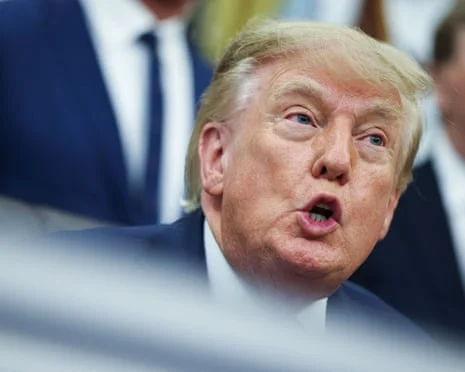
In a turbulent sequence of developments that underscores mounting friction between the executive branch and the American media, President Donald Trump doubled down on his recent decision to bar several prominent news organizations from the White House. Speaking during a chaotic Oval Office event ostensibly convened to highlight alterations to the United States healthcare system—including drug price initiatives and pediatric vaccination policy updates—the president defended his unprecedented punitive measures against CNN, MS Now (formerly MSNBC), and Politico.
The policy of restricting press access based on editorial content has ignited a fierce constitutional debate. Critics, legal scholars, and lawmakers from across the political spectrum have condemned the move as a direct assault on the First Amendment, drawing sharp parallels to authoritarian suppression of the press. Despite these warnings, the administration has signaled that the current bans may merely be the opening salvo in a broader campaign targeting mainstream journalistic outlets.
The Oval Office Confrontation and the Definition of the Ban
The defense of the press restrictions came during a tense exchange with reporters near the conclusion of Friday’s Oval Office briefing. When pressed by a correspondent regarding the practical application of the ban—specifically whether it involved revoking press badges or excluding outlets from the White House press pool—President Trump initially deflected before offering a stark clarification.
"When you say ‘the ban,’ which ban?" Trump responded, before asserting, "Do you know how many bans I’m involved in? I’ve got more bans going than any human being!"
When the question was rephrased to focus exclusively on the three targeted outlets, the president acknowledged the scope of his directive. "A very simple ban. I don’t want them in my office. I don’t want them here. I would say the ban would go as far as you can," he stated. He added that the restriction would persist until the organizations "straighten themselves out," characterizing their reporting as inherently dishonest.
During the same conference, Trump hinted that other mainstream publications, specifically naming The New York Times and The Washington Post, could soon face similar restrictions. Furthermore, he launched into a series of grievances concerning non-partisan media coverage, contrasting it favorably with the supportive commentary he receives from partisan right-wing outlets such as Breitbart and portions of Fox News. "I don’t get fair press," Trump remarked. "What I do ask is just a semblance of truth."
Legal Precedents and Historical Context
The administration’s latest attempt to restrict journalistic access immediately drew comparisons to previous clashes between the Trump administration and the press corps. Legal analysts were quick to point out that attempts to bar specific reporters or organizations from the White House have repeatedly faced judicial roadblocks.
During Trump’s first term in 2018, the White House attempted to revoke the hard pass of CNN correspondent Jim Acosta following a contentious news conference. CNN subsequently filed a lawsuit, resulting in a federal judge ordering the immediate restoration of Acosta’s press credentials. The first Trump administration complied with the ruling without pursuing further appeals. Similarly, at the outset of his second term, the administration restricted the Associated Press from entering specific White House spaces following a disagreement over the outlet’s geographic stylebook entries.

Despite these precedents, President Trump expressed explicit skepticism regarding judicial intervention in press relations. "I don’t think that a court should allow fake news to be written day after day after day," he argued during Friday’s briefing. "I think that somebody has a right to keep them away if they’re going to write false stories all the time."
Reactions from Legal Experts and Lawmakers
The administration’s actions provoked immediate and severe backlash from constitutional scholars, press freedom advocates, and political figures.
Jameel Jaffer, executive director of the Knight First Amendment Institute at Columbia University, issued a scathing critique of the directive. "The First Amendment prohibits the president from punishing journalists because he doesn’t like their coverage, just as it prohibits him from punishing universities because he doesn’t like the courses they offer," Jaffer stated. He emphasized that the White House press pool functions as a designated public forum under constitutional law, rendering any viewpoint-based exclusion legally untenable.
Political opposition was equally swift. Illinois Governor JB Pritzker, frequently mentioned as a potential 2028 Democratic presidential contender, characterized the decision on social media as "yet another attack on the First Amendment from a president who knows he and his party are deeply unpopular." Senator Ruben Gallego of Arizona echoed these sentiments, labeling the ban as a tactic "straight out of the authoritarian playbook."
Senate Majority Leader Chuck Schumer delivered an even sharper rebuke, writing online, "Donald Trump just did what dictators throughout history have done. This is a democracy. You will not be able to manipulate the news or hide the truth."
Broader Domestic and Foreign Policy Developments
The controversy over press credentials unfolded against a backdrop of intense domestic and international challenges for the administration as the nation approaches the 2026 midterm elections.
In foreign policy, the administration continues to grapple with the protracted and escalating conflict with Iran. Recent reports from The Washington Post indicate that the official Pentagon tally of 18 American service member deaths may be an undercount, with internal defense sources placing the actual fatality figure at 22 or higher as regional instability persists. Concurrently, the administration’s trade policies—particularly escalating tariffs against Canada—have generated significant voter anxiety in crucial swing states like Michigan, where polling indicates substantial local disapproval despite ongoing legislative campaigns.
Domestically, the administration’s broader policy agenda faced significant hurdles this week. The Supreme Court recently struck down a central component of the executive branch’s effort to centralize control over mail-in voting through the United States Postal Service, forcing federal officials to halt implementation of the controversial oversight system. Additionally, internal debates over artificial intelligence regulation, foreign military sales, and immigration enforcement procedures have contributed to an increasingly polarized political environment.
As legal challenges to the White House press ban are anticipated in the coming days, the standoff between the executive branch and major news organizations highlights a deepening institutional crisis over the boundaries of presidential authority and the protection of constitutional rights.