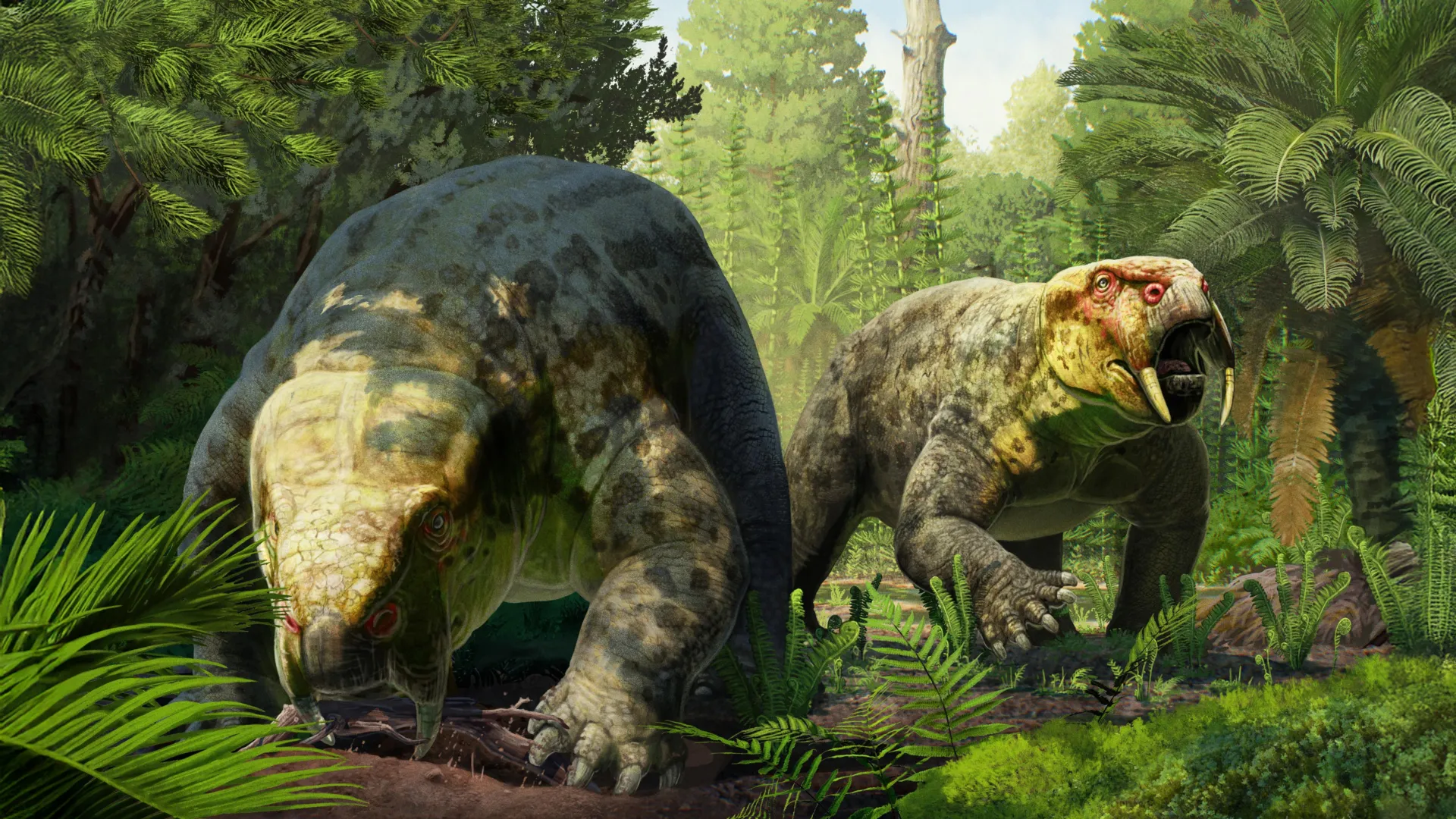
An international research team has identified a previously unknown prehistoric animal that lived in what is now Tanzania roughly 240 million years ago during the Triassic period, a discovery that fundamentally challenges established theories regarding the emergence and dispersal of the world’s first dinosaurs. The new species, formally named Dinodontosaurus isiyavamanda, was identified through the meticulous re-examination of fossils collected more than six decades ago, proving that museum archives remain one of the most potent frontiers in modern paleontology.
The findings, published on September 15 in the Journal of Vertebrate Palaeontology, serve as more than a simple addition to the catalog of ancient life. By establishing a clear geological link between the Manda Beds of Tanzania and the fossil-rich deposits of South America, the research provides a critical recalibration of the Triassic timeline. This adjustment suggests that the Tanzanian fossils previously hailed as the "oldest dinosaurs" may, in fact, be younger than previously assumed, shifting the geographical and temporal context of the dawn of the Age of Reptiles.
A Legacy Unearthed: The 1963 Expedition
The narrative of Dinodontosaurus isiyavamanda began in 1963, during a landmark British expedition to the Ruhuhu Basin in Tanzania. At the time, field researchers were scouring the region for evidence of synapsids—a group of vertebrate ancestors that share a common lineage with modern mammals. These creatures dominated terrestrial ecosystems long before the archosaurs, which would eventually give rise to dinosaurs, rose to global prominence.
The expedition successfully unearthed a massive collection of fossilized remains, which were subsequently transported to the Natural History Museum in London. For decades, these crates remained part of the museum’s vast, partially explored collections. While some specimens were cataloged and studied, others—including a partial skeleton of a large, herbivorous dicynodont—languished in storage, their significance unrecognized. It was only through the convergence of modern analytical technology and the persistence of paleontologists that this specific skeleton was pulled from obscurity to be analyzed with fresh eyes.
Anatomy and Identification: The South American Connection
Dicynodonts were a remarkably successful group of plant-eating synapsids, characterized by their unique beak-like structures and, in many cases, tusks. When researchers, led by Hady George of the University of Bristol, began investigating the Tanzanian skeleton alongside a more recently discovered fragmentary skull, they were looking for taxonomic clarity.
The anatomical analysis revealed a startling result: the specimens belonged to the genus Dinodontosaurus. Prior to this discovery, this genus had been confirmed exclusively in South American deposits, primarily in the Chañares Formation of Argentina and Brazil. The identification of Dinodontosaurus isiyavamanda—named in honor of the Wamanda people who inhabit the region where the fossils were found—marks the first confirmed record of the genus on the African continent.
This geographical bridge is highly significant. Because the genus is now confirmed to inhabit both regions, paleontologists can use the species as a "biostratigraphic marker." By matching the presence of this specific organism in both Tanzanian and South American rocks, scientists can conclude that these geological formations were deposited during the same window of time.
Recalibrating the Chronology of the Triassic
The implications for the history of life on Earth are profound. The Triassic period (approximately 252 to 201 million years ago) was a time of recovery following the Permian-Triassic extinction, the most severe mass extinction event in Earth’s history. It was during this recovery that the first dinosaurs began to diverge from their reptilian ancestors.
For years, researchers have debated the precise age of the fossil-bearing strata in Tanzania. These rocks were often correlated with South African deposits and were thought to be older than the dinosaur-bearing strata in South America. If the Tanzanian rocks were indeed older, then the fossils found within them—some of which have been interpreted as "basal" or "earliest" dinosaurs—would represent the true origin point of the dinosaur lineage.
However, recent radiometric dating of volcanic ash layers within South American strata has provided more precise ages for those formations. When the new Dinodontosaurus data is integrated into this framework, the timeline shifts. The Tanzanian deposits are now understood to be roughly equivalent in age to their South American counterparts, rather than significantly older. This implies that the specimens once touted as the "earliest dinosaurs" are likely contemporaneous with known South American dinosaurs, rather than their predecessors. This discovery effectively compresses the timeline of early dinosaur evolution, suggesting that the rapid radiation of these animals occurred more synchronously across the supercontinent Pangea than previously theorized.
Technological Advancements and Scientific Persistence
The journey to this publication spans 30 years, highlighting the evolving nature of paleontological science. Nigel Larkin, a Visiting Research Fellow at the University of Reading and co-author of the study, first examined the Tanzanian dicynodont skeleton as part of his MSc thesis in 1994. Even then, he suspected it was a new species, but the limitations of the era meant the full confirmation of its evolutionary status would have to wait.
"I’m glad I waited," Larkin noted. "The international team we put together has done an amazing job of fleshing out this story in much more detail than I could have achieved on my own. Techniques have improved vastly over the last 30 years; we can do so much more with micro-CT scanning and high-resolution imaging to examine such specimens than we ever could have imagined in the 1990s."
The use of micro-CT scanning allowed the team to look inside the fossilized bone and analyze internal structures that were previously invisible without damaging the specimen. This level of granular detail, combined with global collaboration, allowed the team to conduct a comparative analysis that bridged two continents, effectively transforming a dusty museum specimen into a vital piece of evidence for the global evolution of Triassic vertebrates.
The Value of Institutional Collections
Dr. Mike Day, Curator of Non-Mammalian Tetrapods at the Natural History Museum in London, emphasized that this discovery serves as a powerful reminder of why museums are essential to the scientific method. "This fossil specimen has been in our care for over 60 years," Dr. Day stated. "It goes to show how revisiting museum collections can change our understanding of the past just as much as finding new fossils in the field. It demonstrates the importance of the long-term stewardship of these invaluable records of life on Earth."
In the current era of paleontology, where high-tech field expeditions often dominate the headlines, the case of Dinodontosaurus isiyavamanda underscores that the "field" is not always a remote desert or mountain range; it is also the climate-controlled basement of a museum. Millions of specimens collected during the 20th century remain largely under-researched, waiting for the right combination of updated taxonomy, improved scanning technology, and interdisciplinary collaboration to unlock their secrets.
Future Directions: Biomechanics and Ecology
The identification of this species is only the beginning of a broader research agenda. A significant portion of the Tanzanian Dinodontosaurus material, particularly the postcranial remains (the bones excluding the skull), remains to be fully analyzed. The team plans to examine these bones to better understand the locomotion and overall skeletal structure of the animal.
Furthermore, the researchers intend to conduct biomechanical modeling to understand how these large herbivores interacted with their environment. Dicynodonts were incredibly successful, occupying niches that supported multiple species of large-bodied herbivores simultaneously. By comparing the Tanzanian specimens with their South American cousins, the team hopes to shed light on the ecological strategies that allowed these animals to flourish in the shadow of the rising dinosaur lineage.
As the team moves forward, their work will likely continue to reshape our understanding of the Middle-to-Late Triassic. By refining the timeline of these ancient ecosystems, scientists are gaining a clearer view of the environmental pressures that guided the transition from a world dominated by synapsids to one that would eventually belong to the dinosaurs. For now, Dinodontosaurus isiyavamanda stands as a testament to the fact that, in the study of deep time, no discovery is ever truly finished—it is simply waiting for the next generation of researchers to look at it again.