For years, Volkswagen has maintained a conservative approach to advanced driver assistance systems (ADAS), often positioning itself as a brand that prioritizes the driver’s direct connection to the road. While competitors like Tesla, General Motors, and Mercedes-Benz aggressively pursued high-level automation—pioneering features like hands-free highway cruising and advanced self-parking—Volkswagen remained focused on refining the fundamentals of vehicle dynamics. However, the automotive landscape is shifting rapidly, and Volkswagen is now responding with a significant technological overhaul. The introduction of the IQ.Drive suite, debuting with the highly anticipated 2027 Volkswagen ID.Buzz for the North American market, represents a definitive step toward closing the capability gap between the German automaker and its technology-forward rivals.
A New Technological Foundation
The IQ.Drive suite is not merely a collection of sensors; it is an integrated ecosystem of safety and convenience technologies designed to work in tandem across Volkswagen’s modern vehicle architecture. This system is primarily deployed on vehicles utilizing the MQB Evo platform, which underpins the latest Tiguan, Golf, and Atlas models, as well as the MEB electric platform, which serves as the backbone for the ID.Buzz.
The suite comprises four primary pillars: Travel Assist, Emergency Assist Plus, Predictive Active Cruise Control (pACC), and Road Experience Management (REM). By centralizing these functions, Volkswagen is moving toward a more cohesive user experience, ensuring that safety protocols are not just reactive, but increasingly proactive.
Evolution of Predictive Active Cruise Control
At the core of the new system is the enhanced Predictive Active Cruise Control (pACC). While standard adaptive cruise control has been a staple of the Volkswagen lineup for over a decade, the new pACC introduces a layer of environmental awareness previously absent from the brand’s offerings.
The system now processes topographical and traffic data to handle complex driving scenarios, such as highway off-ramps. By analyzing GPS data and real-time traffic flow, the vehicle can independently navigate the transition from a highway lane to an exit ramp, modulating speed to match legal limits and safety requirements without manual intervention. Furthermore, the system incorporates an intelligent speed-adjustment feature. When traffic conditions shift, the car suggests speed changes to the driver via the Digital Cockpit. For safety, these adjustments require driver confirmation, ensuring that the human remains the final authority in the operation of the vehicle.
Travel Assist and the Future of Lane Management
Perhaps the most significant addition to the driver’s interface is the updated Travel Assist. This feature serves as the primary gateway to semi-automated driving. By integrating lane-centering technology with the pACC, Travel Assist allows for hands-on, semi-autonomous operation on major roadways.
The standout capability of this iteration is the assisted lane-change function. When the driver activates the turn signal, the vehicle uses a suite of side-facing sensors to monitor for gaps in adjacent traffic. If a safe window is identified, a green flashing arrow appears in the instrument cluster, signaling that the maneuver is ready to commence. The system maintains a 12-second observation window to ensure the path remains clear. If the path is obstructed by high-speed traffic or a closing gap, the system displays a red hash, indicating that the maneuver is currently unsafe. This methodical approach prioritizes reliability and transparency, ensuring that the driver understands exactly what the vehicle is attempting to do and why.
Emergency Assist Plus: The Last Line of Defense
Volkswagen has also significantly bolstered its safety net with the introduction of Emergency Assist Plus. This system acts as a sophisticated fail-safe designed to mitigate the risks associated with driver incapacitation.
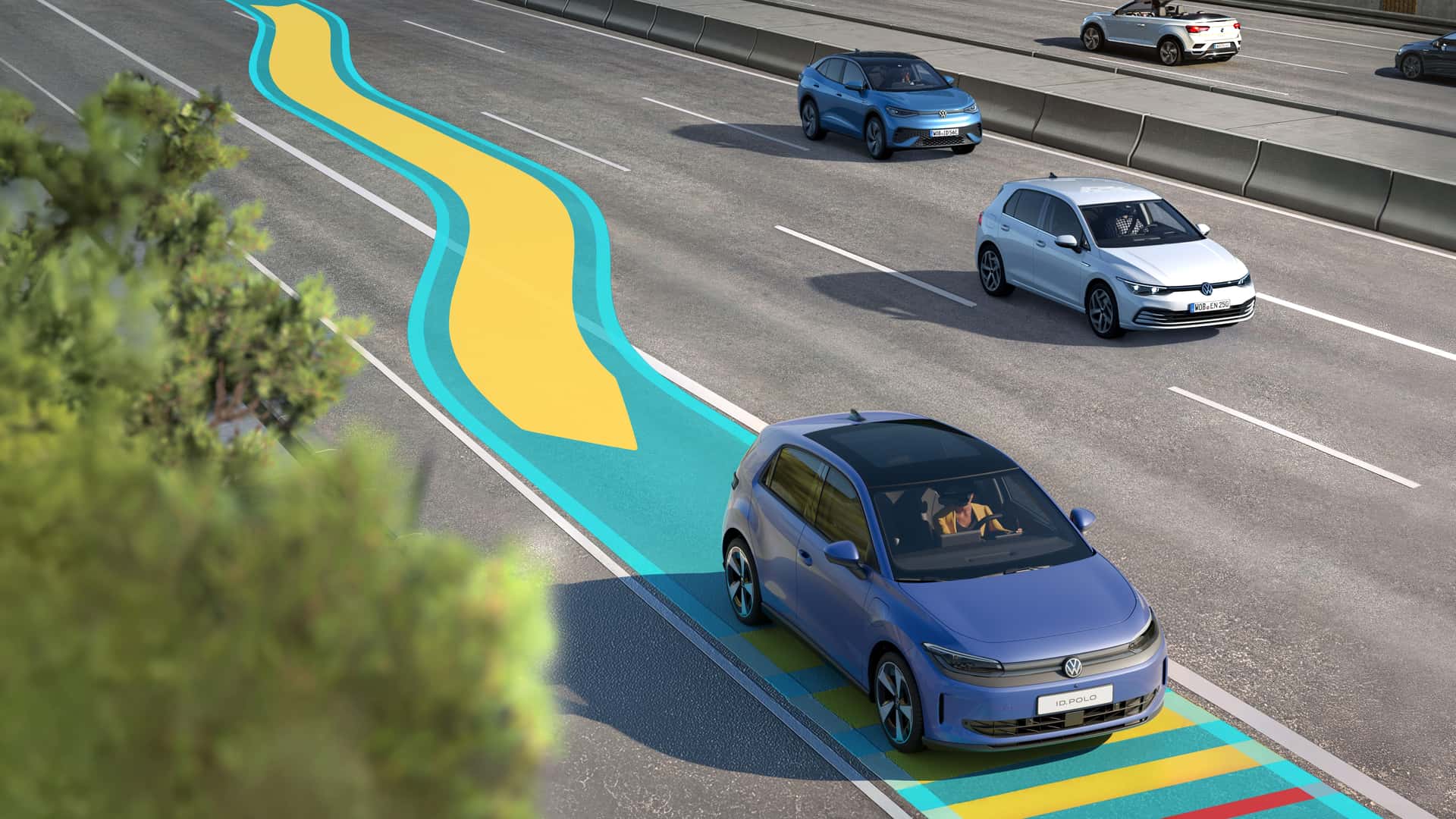
When the vehicle is operating under the guidance of Lane Assist or Travel Assist, the system monitors for signs of driver engagement. If Lane Assist detects multiple consecutive instances of lane departure without corrective steering input, the vehicle enters a warning phase. It utilizes both visual and audible alerts to prompt the driver. Should these alerts go unacknowledged, the car assumes a medical or emergency event is occurring and initiates a controlled pull-over sequence to the shoulder of the road.
In scenarios where Travel Assist is active, the system is even more precise. If steering input is absent for 25 seconds, the vehicle triggers a multi-stage alert sequence: it sounds the horn, applies a series of sharp brake pulses to alert the driver, and automatically tightens the seatbelts. If no response is received, the vehicle executes a safe maneuver to the shoulder, engages its hazard lights, shifts into park, unlocks the doors, activates the interior lighting, and initiates an automatic emergency call to dispatch services. This level of automation reflects a commitment to occupant protection that exceeds previous industry standards for the brand.
The Role of Cloud-Based Data: Road Experience Management
A critical component exclusive to the ID.Buzz is Road Experience Management (REM). This feature represents a shift toward cloud-based intelligence, requiring a subscription to Volkswagen’s In-Vehicle Premium plan. REM utilizes anonymous camera data harvested from the fleet of Volkswagen vehicles currently on the road.
By continuously uploading data points—such as the location of lane markings, street lights, and traffic signage—to a centralized cloud, the system creates a high-definition, dynamic map of the road environment. This is particularly advantageous in poor weather conditions or in areas where lane markings have faded or are obscured by snow or construction. Even when the vehicle’s onboard cameras cannot "see" the road, REM provides the vehicle with a digital reference point, allowing for more consistent performance of the driver assistance systems. This crowdsourced data model is essential for the future of autonomous navigation, as it reduces reliance on localized sensor inputs.
Industry Context and Strategic Implications
The deployment of IQ.Drive comes at a pivotal moment for Volkswagen. As the company navigates the transition to an all-electric lineup, it must address the increasing consumer demand for "smart" vehicles. Historically, Volkswagen has been criticized for a lack of parity with Tesla’s Autopilot or GM’s Super Cruise, both of which offer more aggressive hands-free capabilities.
However, Volkswagen’s strategy appears to be one of "responsible integration." By focusing on robust, rule-based systems that keep the driver informed and in control, the company is avoiding some of the regulatory and safety scrutiny that has plagued more "beta-stage" ADAS offerings. Analysts note that by standardizing this technology across the MQB Evo and MEB platforms, Volkswagen is effectively democratizing advanced safety features, ensuring that even mid-range vehicles benefit from technologies that were once reserved for luxury segments.
The Road Ahead
While the IQ.Drive suite does not currently offer full point-to-point autonomy, it establishes a new baseline for the brand. The integration of cloud-based mapping and more intuitive emergency protocols suggests that Volkswagen is laying the groundwork for more advanced automation in the coming decade.
For the 2027 ID.Buzz, this suite is not merely an optional extra; it is a fundamental selling point that aligns the electric van with the expectations of modern, tech-savvy families. As the automotive industry continues to move toward higher levels of SAE automation, Volkswagen’s methodical, safety-first deployment of IQ.Drive positions it to remain a competitive force, balancing the need for innovation with the brand’s enduring reputation for reliability and structural safety. The introduction of these features marks a clear pivot point, signaling that while Volkswagen may have arrived at the table later than some of its rivals, it has done so with a comprehensive, well-vetted, and highly capable set of tools.