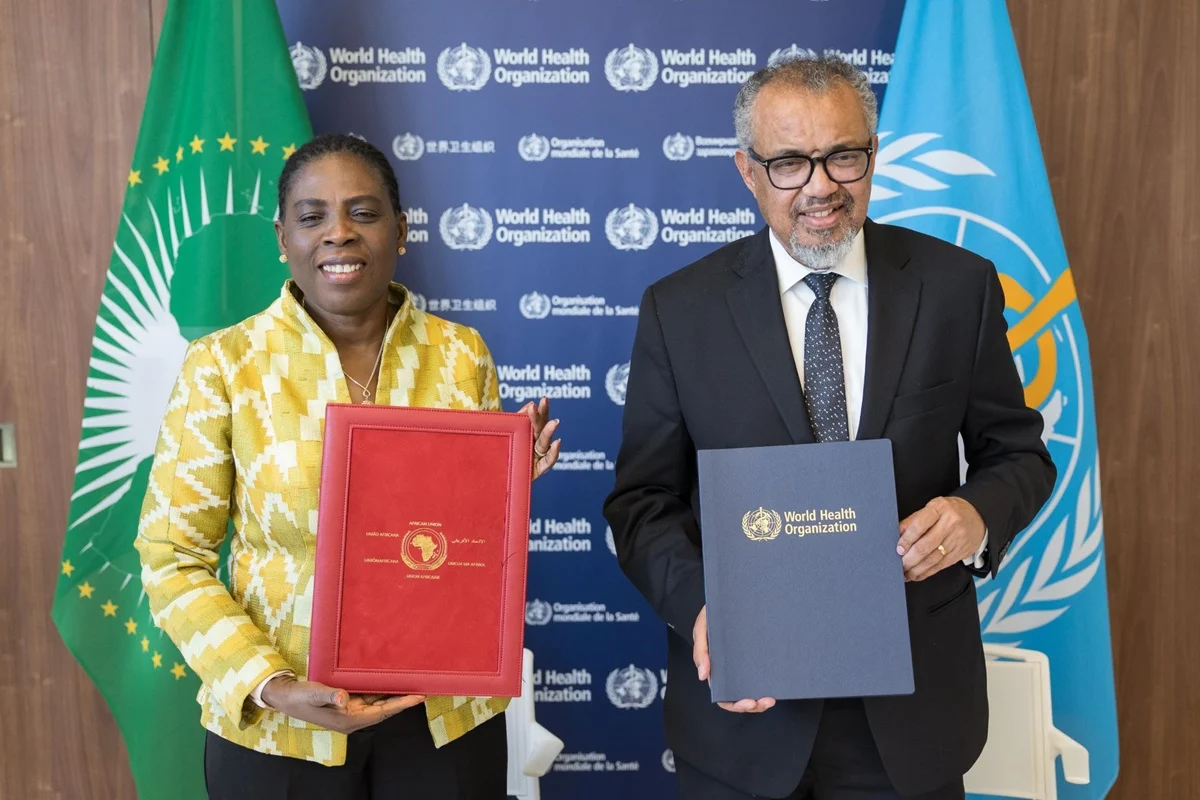
GENEVA — In a decisive move to fortify the African continent against mounting international financial vulnerabilities and shifting geopolitical landscapes, the World Health Organization (WHO) and the African Union (AU) Commission officially renewed their foundational strategic partnership today. Signed on the vibrant sidelines of the 78th World Health Assembly in Geneva, Switzerland, the updated Memorandum of Understanding (MoU) establishes a revitalized framework for addressing health security, accelerating universal health coverage (UHC), and advancing sustainable development across all fifty-five AU member states.
The high-stakes agreement arrives at a critical juncture for international public health. Amid unprecedented financial strains characterized by sweeping cuts to bilateral aid and tightening donor budgets globally, the newly minted pact seeks to pivot the African continent away from traditional cycles of foreign aid dependency toward a more robust paradigm of structural health sovereignty, regional self-reliance, and long-term economic resilience.
A Defining Moment for African Health Leadership
The formal signing ceremony brought together high-ranking delegations from both multilateral institutions. Her Excellency Ambassador Amma Adomaa Twum-Amoah, Commissioner for Health, Humanitarian Affairs, and Social Development, put pen to paper on behalf of His Excellency Mahmoud Ali Youssouf, Chairperson of the African Union Commission. They were joined by Dr. Tedros Adhanom Ghebreyesus, Director-General of the World Health Organization.
According to officials from both organizations, the updated agreement explicitly positions the AU’s Department of Health, Humanitarian Affairs, and Social Development at the operational core of the continent’s health policy implementation matrix. By streamlining collaboration across diverse AU specialized technical agencies and regional bodies, the MoU aims to eliminate bureaucratic silos, harmonize regional health agendas, and ensure that technical assistance from the WHO is deployed with maximum efficiency and local resonance.
Addressing assembled delegates and international media in Geneva, Commissioner Twum-Amoah underscored the profound ideological shift embedded within the new accord.
"This Agreement marks a new chapter in AU–WHO cooperation," Commissioner Twum-Amoah stated. "By working together more closely, we can better respond to the health needs of our populations and ensure that no one is left behind. The African Union values WHO’s central and leading role in global health and looks forward to deepening this strategic partnership in support of our shared goals. We need to move from budgeting for survival to planning for health sovereignty."
This call to action resonates deeply within a continent that has historically borne a disproportionate burden of communicable and non-communicable diseases, frequently relying heavily on volatile external funding streams to finance basic healthcare delivery, vaccination campaigns, and infrastructure development.
Chronology and Evolution of the AU-WHO Partnership
To fully appreciate the significance of the Geneva signing, it is necessary to examine the evolutionary trajectory of institutional cooperation between the WHO and the African Union over the past decade.
The modern framework of structured collaboration began to take definitive shape in the late 2010s, catalyzed by shared lessons from devastating regional health emergencies, most notably the 2014–2016 West African Ebola epidemic. That crisis exposed critical vulnerabilities in local health systems, fractured communication channels between global health bodies and regional political actors, and highlighted the urgent necessity of a unified, continent-wide response mechanism.
In 2019, the WHO and the AU Commission signed a landmark Memorandum of Understanding designed to align their strategic priorities. That foundational agreement laid the groundwork for joint responses to subsequent health shocks, most notably the COVID-19 pandemic. During the coronavirus crisis, the partnership facilitated the deployment of the Africa Task Force for Coronavirus (AFCOTT) and coordinated the landmark Africa Vaccine Acquisition Trust (AVAT) initiative, which proved instrumental in securing vaccine doses for a continent routinely sidelined in global vaccine distribution scrambles.
However, as the post-pandemic landscape evolved, both organizations recognized that the 2019 framework required structural modernization. The post-COVID era introduced complex new challenges: spiraling inflation, crippling national debt burdens across multiple African nations, climate change-driven health emergencies such as cholera and malaria outbreaks linked to extreme weather events, and, crucially, a dramatic contraction in traditional development assistance from major Western donor governments.
These converging pressures precipitated the comprehensive overhaul finalized in Geneva, updating the nearly six-year-old accord to reflect a vastly different and more demanding geopolitical and economic reality.
The Backdrop of Global Financial Contraction
The urgency behind the updated MoU is directly tied to a deeply troubling financial outlook for international development aid. Over the past twenty-four months, several traditional donor nations within the Organisation for Economic Co-operation and Development (OECD) have announced significant cuts to their overseas development assistance (ODA) budgets, driven by domestic economic pressures, rising inflation, and shifting political priorities.
For the African continent—where external financing has historically accounted for substantial percentages of national health budgets in lower-income countries—these bilateral aid reductions pose an existential threat. Vertical programs targeting HIV/AIDS, tuberculosis, malaria, and maternal and child health face immediate funding shortfalls, threatening to reverse decades of hard-won epidemiological progress.
Dr. Tedros Adhanom Ghebreyesus did not mince words when addressing the press regarding the existential implications of these financial contractions.
"This renewed agreement comes at a critical time, as cuts to bilateral aid imperil the health of millions in Africa," Dr. Tedros warned. "It reflects our determination to translate our partnership into tangible results for the people of Africa, and support countries to leave behind the era of aid dependency and transition to sustainable self-reliance. We are proud to stand with the African Union in driving forward the health priorities of the continent."
By anchoring the new MoU in principles of technical excellence, normative leadership, and domestic resource mobilization, the WHO and the AU are signaling to international markets and domestic finance ministries alike that health must be viewed not merely as a social welfare expenditure, but as a foundational pillar of national security and macroeconomic stability.
Expanded Scope and Strategic Pillars of Collaboration
While the original 2019 partnership focused broadly on alignment, the updated 2025 framework establishes a sharper, more actionable operational agenda. Although specific programmatic annexes continue to be refined, the overarching memorandum structures collaboration around several vital strategic pillars:
- Health Security and Emergency Preparedness: Enhancing the operational capacity of regional institutions—specifically the Africa Centres for Disease Control and Prevention (Africa CDC)—to detect, verify, and mount rapid responses to public health emergencies without relying exclusively on external emergency declarations.
- Primary Health Care and Universal Health Coverage: Strengthening localized health systems to ensure equitable access to essential medical services, pharmaceuticals, and diagnostics, thereby reducing out-of-pocket health expenditures that drive vulnerable populations into extreme poverty.
- Regulatory Harmonization and Local Manufacturing: Accelerating the operationalization of the African Medicines Agency (AMA) to streamline regulatory approvals, foster continental pharmaceutical manufacturing capacity, and drastically reduce Africa’s historical reliance on importing over 90% of its routine pharmaceuticals and vaccines.
- Sustainable Financing and Domestic Resource Mobilization: Assisting member states in implementing innovative financing mechanisms, leveraging domestic fiscal space, and optimizing public expenditure to protect health budgets from macroeconomic shocks.
- Data Systems and Digital Health: Improving epidemiological surveillance, civil registration, and vital statistics (CRVS) frameworks to ensure evidence-based policymaking and rapid resource allocation across member states.
The Geopolitical Context: Africa’s Elevated Voice in Global Health
Another crucial dimension highlighted by policy analysts in Geneva is the timing of the agreement relative to Africa’s expanding footprint in global multilateral governance.
The formal inclusion of the African Union as a permanent member of the G20 in late 2023 marked a watershed moment in international relations, giving the continent a direct, institutionalized voice in shaping global economic, financial, and development policies. This newly elevated diplomatic stature has empowered the AU to demand greater equity in global health architecture, including permanent representation on international health boards, reform of global financial institutions, and binding commitments on intellectual property waivers for essential medical countermeasures during pandemics.
The renewed MoU leverages this diplomatic momentum. By presenting a unified front with the WHO—the preeminent technical authority in global health—the African Union reinforces its technical credibility while asserting regional ownership over its health destiny. This dynamic shifts the historical power asymmetry that has long characterized North-South health governance, positioning African leaders not as passive recipients of international aid, but as proactive architects of regional and global health security frameworks.
Fact-Based Analysis of Implications
The long-term implications of the updated AU-WHO Memorandum of Understanding will depend heavily on sustained political will, domestic budget allocations by African governments, and the operational efficacy of regional institutions such as the Africa CDC and the newly empowered Department of Health, Humanitarian Affairs, and Social Development.
Positive Implications:
- Institutional Synergy: Eliminates redundant programming and harmonizes WHO’s global normative guidance with the AU’s regional political mandates.
- Catalyzing Local Manufacturing: By supporting regulatory bodies like the AMA alongside WHO prequalification standards, the agreement creates a predictable market environment essential for attracting private sector investment into African pharmaceutical production.
- Resilience Against Donor Fatigue: Emphasizing domestic resource mobilization and health sovereignty insulates national health systems against the whims of external political shifts and foreign aid budget cuts.
Potential Challenges and Risks:
- Resource Constraints: The grand ambitions of the MoU require significant capital injection at a time when many African nations are grappling with unsustainable sovereign debt burdens and high debt-servicing costs.
- Implementation Bottlenecks: Translating high-level diplomatic agreements signed in Geneva into functional, grassroots healthcare delivery at the district and community levels across diverse national jurisdictions remains a historically complex administrative challenge.
- Donor Retrenchment: While the ultimate goal is self-reliance, the immediate transition period away from bilateral aid could create dangerous funding gaps if domestic revenue generation does not scale up rapidly enough to offset donor withdrawals.
Conclusion and Next Steps
As the 78th World Health Assembly proceeds in Geneva, the formalization of this upgraded partnership stands out as a pragmatic blueprint for navigating a volatile global landscape. By formally committing to a shared vision of health sovereignty, universal coverage, and institutional solidarity, the World Health Organization and the African Union Commission have laid down a marker for the future of multilateralism.
For millions of citizens across the African continent, the success of this agreement will ultimately be measured not by diplomatic communiqués or ceremonial handshakes, but by tangible metrics: stronger clinics in rural districts, reliable access to affordable medicines, robust defenses against emerging pathogens, and the gradual realization of a health system capable of withstanding the shocks of an uncertain future.
For further information and media inquiries, official contacts are detailed below:
- Professor Julio Rakotonirina | Director | Department of Health, Humanitarian Affairs and Social Development | African Union Commission | E-mail: [email protected]
- Ms Stéphanie Seydoux | Director | DG Envoy for Multilateral Affairs | World Health Organization | E-mail: [email protected]
- WHO Media Team | World Health Organization
- Mr. King David Cartey | African Union Commission