Lagos, Nigeria — In the vibrant and ever-evolving landscape of African contemporary fashion, few designers command narrative depth quite like Adebayo Oke-Lawal. As the creative force behind the globally recognized label Orange Culture, Oke-Lawal has consistently used the runway as a canvas for deeply personal storytelling. Kicking off Lagos Fashion Week with the debut of his Pre-Fall 2027 collection, titled The In Between, the designer transformed the venue into a sanctuary of introspection, emotional resonance, and sartorial fluidity.
Known for challenging conventional binaries and reshaping the discourse around African menswear, Oke-Lawal’s latest presentation was more than a mere display of garments; it was an immersive psychological and emotional exercise designed to prompt self-appreciation and reflection among attendees. By marrying vulnerability with high-concept design, Orange Culture continues to anchor its position at the vanguard of the continent’s fashion renaissance.
Setting the Scene: An Immersive Journey into Self-Love
The experience of The In Between began long before the first model stepped onto the runway. Attendees walking into the venue were immediately enveloped in an atmosphere curated for quiet contemplation. Draped from the ceiling were large, sweeping sheets of fabric emblazoned with poignant, affirmative quotes such as “I was never outside of love” and “even here I am held.”
This deliberate environmental design was central to Oke-Lawal’s vision for the evening. In an industry frequently criticized for superficiality and relentless consumerism, the designer sought to create a counter-narrative centered on internal healing. “I want people to personally connect to the story,” Oke-Lawal remarked backstage prior to the show. “It’s an opportunity to fall in love with yourself.”
By guiding the audience through a physical space that prioritized emotional safety, the brand successfully blurred the boundary between observer and participant, setting a contemplative tone that carried through every look that emerged down the runway.
The Collection: Anatomy of The In Between
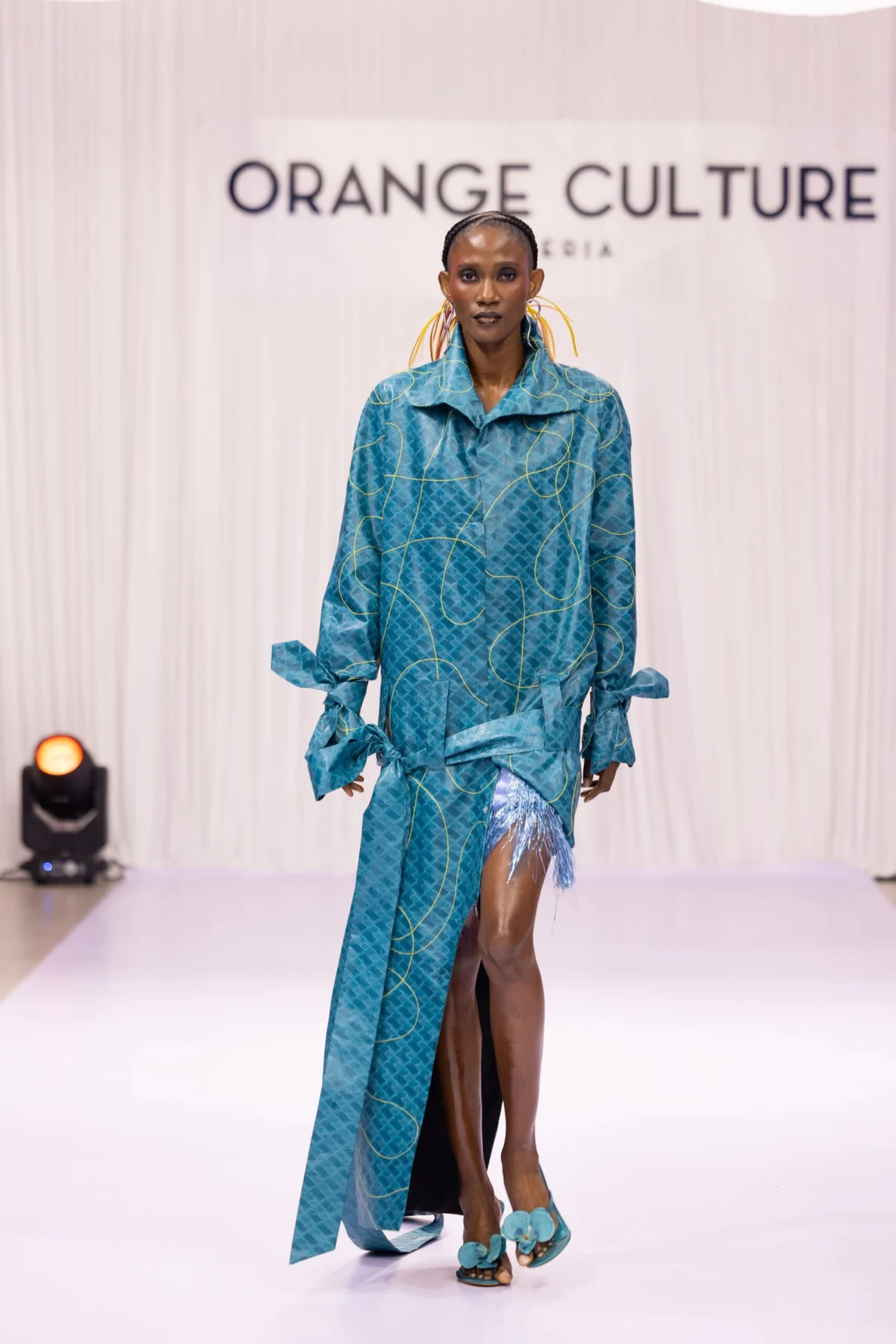
At the heart of the presentation was the Pre-Fall 2027 collection itself, appropriately titled The In Between. The collection served as a thoughtful exploration of longing in its myriad forms, touching upon both romantic yearning and deep platonic connections.
Stylistically, the collection danced delicately along the line between sensuality and softness. Throughout the presentation, a balance was struck between fanciful, avant-garde dresses and sharp, asymmetric sets that defied traditional tailoring. Among the standout looks was a striking red-and-black dress featuring an exaggerated, deep side cut-out that commanded visual attention without sacrificing elegance. Another crowd favorite was a soft pink and butter yellow chiffon set, engineered to sway effortlessly with the model’s movement, capturing a fluid, ethereal quality.
Beyond silhouette and color theory, Oke-Lawal introduced innovative textile developments. The designer debuted a series of new crochet pieces alongside custom prints designed to mimic the exact tiling of his childhood home—a deeply personal memory, given that the house was tragically destroyed in a fire. By weaving architectural memories of his youth into modern garments, Oke-Lawal transformed personal loss into enduring wearable art.
Challenging Boundaries: The Evolution of Genderless Fashion
While the aesthetics of the collection drew widespread acclaim, the structural philosophy behind the garments remained one of Orange Culture’s most defining contributions to global fashion: the complete dismantling of gender binaries.
Since its inception, Orange Culture has pioneered genderless fashion on the African continent and beyond. The Pre-Fall 2027 collection served as a living testament to this ethos. In a striking demonstration of garment versatility, a red crocheted top that was originally worn by a woman in the brand’s previous collection was completely reimagined and styled as menswear for this runway presentation.
“Everybody should be able to wear anything, and that’s the dream Orange Culture likes to sell,” Oke-Lawal stated, articulating the socio-political mission of his label. “It’s a very important freedom we’ve always offered to our customers.” This philosophy not only aligns with shifting global consumer preferences toward gender-fluid wardrobes but also challenges rigid sartorial expectations historically rooted in colonial and traditional Nigerian dress codes.
A Shift from Heavy Sorrow to Celebratory Resilience
The emotional undercurrents of the evening carried profound significance for the designer, marking a stark tonal shift from his previous Lagos presentation. Reflecting on the evolution of his runway narratives, Oke-Lawal noted the emotional weight of his past shows.
“The last season we had in Lagos was very heavy,” he shared, referencing a collection that served as a direct and emotional ode to his late mother. Coincidentally, the Pre-Fall 2027 show fell precisely on the anniversary of her passing. However, rather than leaning into public mourning, Oke-Lawal consciously chose to pivot toward light, joy, and celebration.
“I want it to be a more joyous and celebratory experience even though it’s a really tough day,” he explained. The absence of tears in the crowd, replaced instead by palpable warmth and enthusiastic applause, signaled a collective healing process—not just for the designer, but for an audience deeply invested in his personal and professional journey.
Background Context: The Rise of Lagos Fashion Week
To fully understand the impact of Orange Culture’s Pre-Fall 2027 presentation, it is essential to examine the broader ecosystem of Lagos Fashion Week (LFW). Founded in 2011 by Omoyemi Akerele, Lagos Fashion Week has evolved from a nascent regional showcase into one of the most influential fashion platforms on the global calendar. It serves as a vital incubator for African design talent, drawing international buyers, media, and critics to Nigeria’s commercial capital.
In recent years, LFW has championed sustainability, ethical manufacturing, and narrative-driven design. Brands like Orange Culture have been instrumental in putting African contemporary fashion on the global map, securing international stockists, high-profile collaborations, and critical acclaim from publications spanning Paris, New York, and London. Oke-Lawal’s ability to anchor international luxury standards in deeply localized, vulnerable storytelling has made him a torchbearer for a new generation of African creatives.
Fact-Based Analysis: Implications for the African Fashion Industry
The presentation of The In Between carries several important implications for the trajectory of contemporary African fashion and the global market at large:
- Economic Growth and Artisan Collaboration: By utilizing complex techniques such as custom printing and intricate crochet work, Orange Culture continues to invest in local craftsmanship. The economic implications of scaling such production methods support regional textile artisans and preserve traditional skill sets within Nigeria.
- Market Adaptation to Gender-Fluid Retail: As global luxury markets increasingly pivot toward gender-neutral collections—driven largely by Gen Z and Millennial consumer demands—Orange Culture’s longstanding commitment to non-binary clothing positions it as an authentic leader rather than a late adopter. This gives the brand a distinct competitive advantage in international e-commerce markets.
- The Power of Vulnerable Branding: In modern fashion, authenticity is a primary currency. Oke-Lawal’s willingness to embed personal grief, childhood memory, and psychological healing into his collections fosters intense brand loyalty. Consumers today do not just buy clothes; they buy narratives and shared human experiences. Orange Culture’s masterclass in emotional transparency sets a new benchmark for how fashion brands can communicate with their audiences.
Conclusion: A Legacy Forged in Color and Conscience
As Lagos Fashion Week progresses, the shadow cast by Orange Culture’s opening night remains formidable. The In Between successfully demonstrated that fashion can simultaneously be commercially viable, technically innovative, and emotionally transcendent.
By translating personal grief into public joy, memorializing his childhood through textile design, and fiercely advocating for sartorial freedom, Adebayo Oke-Lawal has once again proven why Orange Culture is not merely a clothing label, but a vital cultural movement. As the brand looks toward the global rollout of its Pre-Fall 2027 collection, it carries with it the hopes of a continent redefining its narrative—one stitch, one memory, and one liberated silhouette at a time.