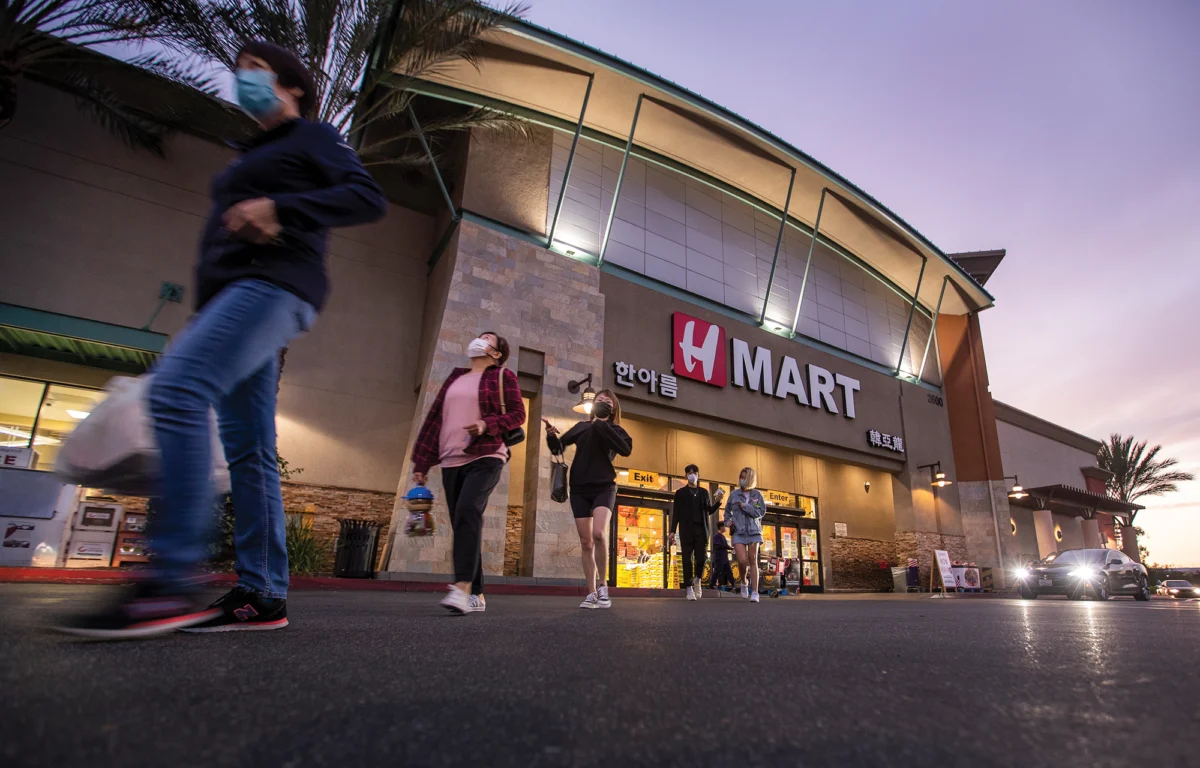
The digital landscape of social media has long been dominated by "shopping hauls," a genre of content where influencers showcase expensive fashion purchases or luxury beauty products to millions of viewers. However, a significant shift in consumer culture is currently unfolding across platforms like TikTok and Instagram. Instead of unboxing designer handbags, Gen Z creators are increasingly turning their cameras toward the aisles of H Mart, a specialized Asian supermarket chain that has evolved from a local immigrant resource into a premier destination for global food trends. This transformation reflects broader shifts in American demographics, the rising economic power of Asian American households, and the mainstreaming of East Asian pop culture.
In early 2024, the "H Mart haul" became a bona fide viral trend. Influencers such as Linda Vo have shared clips of themselves exploring the store’s diverse offerings, highlighting items like Korean salt bread, triangle kimbap, and oversized Korean pears. For many younger consumers, these grocery trips are more than just errands; they are "treasure hunts" for viral snacks and authentic ingredients. Ari Kytsya, another prominent TikTok creator, recently captured the attention of millions by documenting her tasting of cooked baby octopus paired with Sriracha mayo and yogurt drinks packaged in containers resembling baby bottles. The visceral, sensory appeal of these products—often characterized by unique textures and vibrant packaging—has turned H Mart into a content goldmine.
From Woodside to a Multi-Billion Dollar Empire
The origins of H Mart are humble, rooted in the immigrant experience of the early 1980s. In 1982, South Korean immigrant Il Yeon Kwon established a small corner store in Woodside, Queens. He named the business "Han Ah Reum," a Korean phrase that translates roughly to "an armful of groceries." At its inception, the store served a very specific purpose: providing essential Asian staples—such as kimchi, short-grain rice, and specific cuts of meat—to the rapidly growing Korean immigrant population in New York City.
Throughout the 1980s and 1990s, the company followed a disciplined growth strategy, opening approximately 10 stores in neighborhoods with high concentrations of Asian American residents. By 1997, the chain ventured outside the Tri-State area, opening its first location in the Washington, D.C. metropolitan area. This expansion marked the beginning of H Mart’s transition from a local neighborhood grocer to a regional powerhouse.
Today, H Mart is a formidable player in the highly competitive North American grocery industry. The chain operates more than 100 locations across the United States and Canada, generating an estimated $2 billion in annual sales. While other specialty grocers have struggled to maintain a foothold in the face of competition from giants like Walmart and Amazon, H Mart has thrived by leaning into its identity as a "cultural bridge."
The Real Estate Strategy: Adapting to the Urban and Suburban Divide
One of the key factors behind H Mart’s longevity and success is its sophisticated approach to real estate. In the early 2000s, as upscale grocers like Whole Foods and Trader Joe’s began to dominate the Manhattan market, H Mart carved out a niche by occupying smaller, more affordable storefronts that other major chains overlooked.
Jeffrey Rosen, vice chairman and founding partner of Newmark’s retail division, notes that New York City was historically "grocery-challenged," with many residents forced to shop in cramped, unappealing spaces with low ceilings. H Mart distinguished itself by maintaining clean, well-organized environments even in smaller footprints. Its ability to adapt to different architectural configurations allowed it to permeate dense urban environments where large-scale supermarkets were difficult to build.
Conversely, as the chain has expanded into the Sun Belt and Western United States, it has embraced a "mega-store" format. These newer locations often exceed 50,000 square feet and serve as anchors for larger retail developments. For instance, the company’s recently announced Fremont, California, location is set to occupy a former Kohl’s department store. This site will function more like a lifestyle mall than a traditional grocery store, featuring extensive food halls, sit-down restaurants, bars, and entertainment options.
The Economic Engine: Rising Asian American Purchasing Power
H Mart’s rapid expansion is closely aligned with the shifting demographics of the United States. According to the New York City "Newest New Yorkers" report, Chinese immigrants became the city’s largest foreign-born population in 2023, surpassing the Dominican population for the first time. Similar demographic shifts are occurring in states like Texas, Florida, and Nevada, where Asian American communities are among the fastest-growing populations.
Beyond sheer numbers, the economic profile of the Asian American consumer has changed dramatically. Data indicates that the median household income for Asian Americans grew by 57 percent between 2017 and 2024, rising from approximately $99,000 to $155,000. During this same period, total household spending by this demographic jumped from $453 billion to $735 billion—a 62 percent increase.
Chase Welles, executive vice president at SCG Retail, points out that second-generation Asian Americans are driving much of the current market demand. Unlike the first generation of immigrants who may have shopped at H Mart primarily for survival and tradition, the second generation is more affluent, highly educated, and seeks out "sophisticated" or "premium" versions of the foods they grew up with. This has allowed H Mart to diversify its inventory, offering high-end skincare, premium meats like Wagyu beef, and expensive imported fruits alongside basic staples.
Cultural Crossover and the "Cool" Factor
While H Mart remains an essential resource for Asian American families, its customer base has broadened significantly. Brian Kwon, the president of H Mart, recently noted that nearly one-third of the chain’s customers are now non-Asian. This crossover is the result of several intersecting cultural trends, often referred to as the "Hallyu" or Korean Wave.
The global success of K-Pop groups like BTS and Blackpink, the critical acclaim of films like Parasite, and the popularity of Netflix series like Squid Game have created a massive appetite for Korean culture. This cultural curiosity naturally extends to food. Fans of Korean dramas often see their favorite characters eating ramyun or tteokbokki, leading them to H Mart to find the exact ingredients to replicate those meals at home.
The 2021 memoir Crying in H Mart by Michelle Zauner, the lead singer of the indie pop band Japanese Breakfast, further solidified the store’s place in the American cultural zeitgeist. The book, which explores Zauner’s grief following the death of her mother and her connection to her Korean heritage through food, spent months on the New York Times bestseller list. It transformed H Mart from a simple supermarket into a symbol of identity, memory, and emotional connection.
Strategic Expansion into the Sun Belt
In recent years, H Mart has aggressively targeted the Sun Belt, following the migration of both Asian American families and the general population toward states with lower costs of living and growing tech sectors. The timeline of their recent and upcoming openings highlights this ambitious trajectory:
- Summer 2023: H Mart opened its first-ever Nevada location, a 54,500-square-foot branch in Las Vegas.
- Fall 2023: The company launched a 100,000-square-foot store in Orlando, Florida—one of the largest H Marts in the country.
- Late 2023: A fourth market was established in Houston, Texas, alongside a 70,000-square-foot market and food hall in Orange County, California.
- 2024-2025: Construction is currently underway for a 46,000-square-foot store in Tampa Bay, Florida, and a second market in Austin, Texas.
These new locations are designed to be "destinations." By incorporating food halls that feature a variety of vendors—selling everything from Korean corn dogs and bubble tea to elaborate sushi platters—H Mart is positioning itself as a community hub rather than just a place to buy milk and eggs.
Analysis: The Future of Specialty Retail
The success of H Mart offers a blueprint for the future of specialty retail in a post-pandemic world. As e-commerce continues to take a bite out of traditional retail, H Mart has thrived by offering an "experience" that cannot be replicated online. The sensory nature of the store—the smell of the bakery, the sight of the live seafood tanks, and the opportunity to sample new snacks—creates a level of engagement that keeps customers returning.
Furthermore, H Mart’s reliance on user-generated content (UGC) has allowed it to bypass traditional, expensive advertising. As Cynthia Yeh of F&T Group noted, customers have essentially become "brand ambassadors." Every time a teenager posts a video of themselves trying a "viral" Korean snack, they are providing H Mart with authentic, free marketing that resonates more deeply with Gen Z than a traditional television commercial ever could.
However, the rapid expansion also brings challenges. As H Mart enters more mainstream suburban markets, it faces increased competition from traditional grocers like Kroger and Publix, which are expanding their "international" aisles. To maintain its dominance, H Mart must continue to balance its role as a provider of authentic, hard-to-find ingredients while remaining accessible and welcoming to its burgeoning non-Asian customer base.
As it stands, H Mart is no longer just a "specialty market." It is a multi-billion dollar cultural institution that reflects the diverse, interconnected reality of modern North America. From a single corner store in Queens to a coast-to-coast empire, H Mart’s journey is a testament to the power of food to bridge cultures and the enduring appeal of a retail experience that offers a genuine taste of home—even for those who are thousands of miles away from it.