WASHINGTON — In a sweeping and unprecedented escalation of hostilities between the executive branch and the American media, President Donald Trump announced on Friday that his administration is barring CNN, MS NOW, and Politico from the White House complex. The decision, revealed via social media and subsequently defended by the president in the Oval Office, marks one of the most severe restrictions on press access in modern American history and immediately triggered swift condemnations, warnings of imminent litigation, and profound constitutional concerns from legal scholars and journalistic organizations alike.
The announcement, posted to Truth Social on Friday afternoon, singled out the three outlets by name, accusing them of sustained dishonesty and publishing what the president characterized as fictitious narratives.
"I am proud to announce that, effective immediately, I am banning Fake News CNN, MSNOW … and Politico … from the White House as a result of their constant ‘reporting’ FAKE NEWS!" Trump wrote on the platform. "Media Outlets shouldn’t be able to constantly write or report FICTION and LIES when they’re covering the President of the United States, the Trump Administration, or the United States of America. Other Fake News Media Outlets to follow."
The move immediately destabilized the operational routines of reporters stationed at the executive mansion. Although the presidential decree was issued mid-afternoon, journalists and correspondents from the targeted publications remained on White House grounds as administrative officials scrambled to interpret the scope and enforcement mechanisms of the ban.
Defending the Ban in the Oval Office
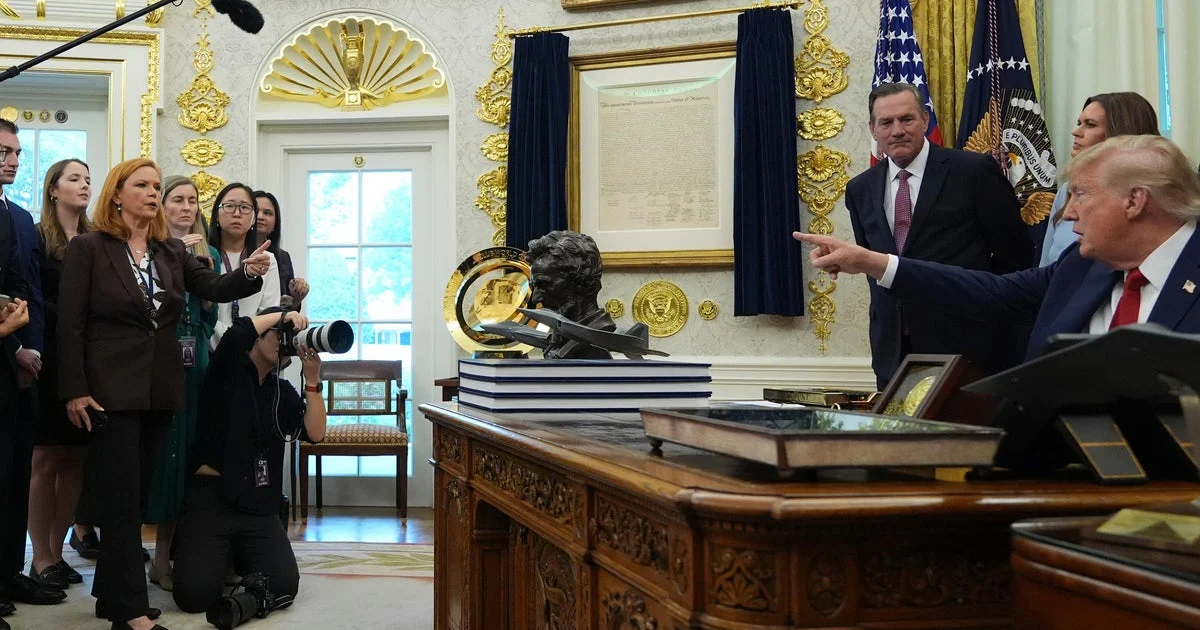
Moments after the announcement, President Trump faced a barrage of questions from reporters during a scheduled healthcare event in the Oval Office. When pressed by a journalist on how he could justify barring news organizations given his constitutional oath to uphold the First Amendment, the president offered a direct and blunt rationale.
"Because they’re fake news," Trump responded. "I get so tired of reading and seeing fake news."
Asked whether there was a specific catalyst for the decision, the president conceded there was no singular inciting incident, describing the action as the culmination of grievances built up over years of coverage.
"It’s really just cumulative stories of the last two years," Trump said. "You get sick of it."
When another reporter suggested that the ban was designed to intimidate the press and deter journalists from aggressively scrutinizing his administration, the president rejected the premise outright. "No, no, no, no," he said, before adding, "I dislike dishonest press, like you. I think you’re terrible."
While the president asserted that he did not want representatives from CNN, MS NOW, or Politico inside his primary office space—the Oval Office—the broader operational implications regarding access to the White House press briefing room, workspace areas, and presidential travel pools remained undefined as administration officials declined to provide further clarification.
Legal Pushback and First Amendment Outcry
The administration’s directive was met with immediate, fierce resistance from the targeted news organizations and prominent constitutional law experts, who warned that the ban violates foundational principles of American democracy.
In a sharply worded official statement, CNN condemned the president’s action as an intolerable government overreach. "CNN stands fully behind our White House team and their fair and accurate reporting," the network stated. "We have a right under the U.S. Constitution to do that reporting without hindrance or interference from the government. Should the ban which President Trump threatened go ahead, it would be an illegal assault on that fundamental and constitutionally-protected right."
Legal scholars echoed these concerns, emphasizing that the executive branch cannot selectively punish media outlets based on editorial viewpoints or critical coverage.
Jameel Jaffer, executive director of the Knight First Amendment Institute at Columbia University, issued a comprehensive critique of the administration’s policy, categorizing it as blatantly unconstitutional.
"The First Amendment prohibits the president from punishing journalists because he doesn’t like their coverage, just as it prohibits him from punishing universities because he doesn’t like the courses they offer, or from punishing law firms because he doesn’t like the clients they represent," Jaffer stated. He added a crucial legal distinction regarding physical access spaces: "… If President Trump means to expel these news organizations from the White House press pool, his action is doubly unconstitutional because the press pool is a ‘public forum’ under the First Amendment, which means the president can’t exclude journalists from it on the basis of their viewpoints."
A Chronology of Escalating Press Tensions
Friday’s ban is not an isolated incident, but rather the continuation of an ongoing, years-long struggle between the Trump administration and the mainstream press corps over physical access, credentialing, and coverage protocols. The friction dates back to both his first and second terms in office, establishing a clear pattern of executive action aimed at restricting uncooperative outlets.
During Trump’s first term in office, the administration famously attempted to revoke the press credentials of then-CNN senior White House correspondent Jim Acosta following a contentious and heated back-and-forth during a post-midterm election news conference in November 2018. CNN immediately filed a federal lawsuit against Trump and top administration officials. A federal district judge ruled in the network’s favor, ordering the immediate restoration of Acosta’s press pass. Rather than continuing a protracted legal battle, the White House capitulated, restored the credential, and formalized rules governing press decorum.
Tensions flared again last year when the administration escalated its tactics by barring the Associated Press (AP) from exclusive White House coverage areas, including portions of the Oval Office and Air Force One press pool rotations. The restriction was levied after the AP declined to adopt the administration’s preferred nomenclature, refusing to refer to the Gulf of Mexico as the "Gulf of America" in its style guide.
The AP responded by filing a federal lawsuit alleging violations of the First and Fifth Amendments. In April 2025, a federal judge ruled that the White House was legally obligated to restore the AP’s access to presidential spaces. However, a federal appeals court subsequently granted a partial stay, allowing the administration to temporarily block the AP from smaller, restricted operational spaces while the broader legal merits of the case wind their way through the judicial system. That litigation remains active and unresolved, serving as a legal precursor to the current dispute involving CNN, MS NOW, and Politico.
Broader Implications for American Democracy and Governance
The exclusion of accredited media outlets from the executive mansion carries profound implications for the nature of public accountability and transparency in the United States. For decades, the White House press corps has served as an institutional check on executive power, functioning as an independent proxy for the American public to question, challenge, and report on the actions of the commander-in-chief.
When access to the seat of executive power is granted or revoked based on political favorability or ideological alignment, it fundamentally alters the dynamic between the governed and the government. Media analysts and political scientists point out that restrictions of this nature risk creating a state-sanctioned media ecosystem, wherein only outlets that offer favorable or uncritical coverage are permitted proximity to federal decision-makers.
Furthermore, the administrative ambiguity surrounding Friday’s announcement creates significant operational hurdles for working journalists. By leaving the precise enforcement mechanisms vague—such as whether badges will be physically deactivated or entry checkpoints instructed to turn reporters away—the administration generates a climate of uncertainty that can exert a chilling effect on investigative journalism.
Path Forward and Anticipated Legal Battles
As legal teams at CNN, MS NOW, Politico, and various civil liberties organizations review the executive directive, courtrooms in Washington, D.C., are widely expected to become the primary battleground for determining the legality of the ban.
Previous judicial precedents—specifically regarding public forum doctrines and the equal protection of credentialed journalists—suggest that the administration faces a steep uphill battle in defending the policy before independent federal judges. However, the ongoing litigation involving the Associated Press demonstrates that the executive branch is willing to utilize appellate procedures and procedural delays to test the boundaries of presidential authority over federal property and press access.
For the public and the broader press corps, the immediate future promises a tense standoff inside the White House briefing room. As the administration weighs further actions against additional news organizations, the fundamental question of whether a sitting president can legally dictate who gets to report on the presidency remains central to the preservation of a free and unfettered American press.