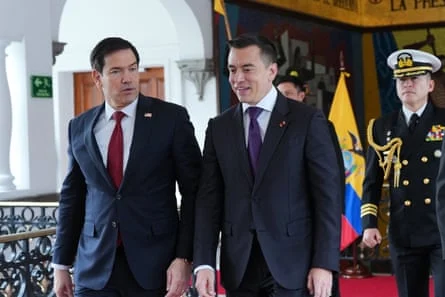
The United States government has officially designated Los Tiguerones—an infamous Ecuadorian criminal organization responsible for storming a television station during a live broadcast—as a foreign terrorist organization. The declaration was announced by US Secretary of State Marco Rubio during a high-level diplomatic visit to Quito, where he met with Ecuadorian President Daniel Noboa. This move represents a major escalation in the Trump administration’s expanding regional campaign against transnational narcotics trafficking, which Washington argues is destabilizing the political and economic landscape of Latin America.
Secretary Rubio’s announcement in Ecuador is part of a broader three-nation diplomatic tour aimed at reinforcing ties with a newly emerged bloc of right-wing leaders across South America. By rebranding select organized crime syndicates as terrorist entities, the US administration aims to unlock enhanced military cooperation, intelligence sharing, and targeted financial sanctions. This aggressive posture underscores a distinct shift in hemispheric policy, relying heavily on the newly formed "Shield of the Americas" security coalition to counter both illicit drug networks and illegal migration.
A Legacy of Violence: The Evolution of Los Tiguerones
Los Tiguerones have long operated as one of the most ruthless criminal factions inside Ecuador, evolving from a local street gang into a formidable transnational cartel affiliate. The syndicate’s notoriety reached a global scale in January 2024, when heavily armed members brazenly stormed the studios of TC Televisión in Guayaquil during a live midday news broadcast.
The dramatic footage, which quickly went viral, captured masked gunmen wielding pistols, shotguns, machine guns, grenades, and sticks of dynamite as they held studio employees hostage on live television. This brazen assault served as a chilling catalyst for the South American nation, instantly transforming the public perception of the country’s surging security crisis. In response to the broadcast siege and concurrent coordinated prison riots across the nation, President Noboa issued a historic decree acknowledging an "internal armed conflict," deploying the military to restore order and officially categorizing several domestic gangs as belligerent terrorist groups.
According to US and Ecuadorian intelligence, Los Tiguerones are deeply entrenched in international cocaine trafficking, extortion, contract killings, and targeted assaults against civilians, law enforcement officers, and investigative journalists. During his address in Quito, Secretary Rubio emphasized the existential threat posed by these groups.
"We are not talking about an ordinary mafia, nor are we talking about common criminals," Rubio stated. "We are talking about terrorists who, in many cases, possess weapons and equipment resembling the national armies of certain countries."
The "Shield of the Americas" and Regional Rightward Shift
The terrorist designation of Los Tiguerones coincides with a profound political realignment across Latin America, characterized by the electoral victories of a new generation of conservative, security-minded leaders. The Trump administration has capitalized on this ideological shift by forming the "Shield of the Americas" coalition, a regional security framework designed to streamline anti-narcotics operations, tighten border controls, and foster deeper bilateral military commitments.
Secretary Rubio’s current diplomatic itinerary highlights this strategic pivot. Beginning his tour in Colombia, Rubio met with recently inaugurated President Abelardo De La Espriella, who narrowly defeated leftist candidate Gustavo Petro in a bitterly contested June election. The transition in Bogotá has warmly welcomed renewed counter-narcotics cooperation, a stark departure from the tense relations that characterized the previous Colombian administration. During their meetings, Rubio and De La Espriella discussed comprehensive security strategies and finalized memorandums of understanding regarding critical minerals and nuclear energy cooperation.

Praising Ecuador as the Trump administration’s most "aggressive" military partner in the region, Rubio commended President Noboa’s administration for its unwavering stance against drug cartels. However, this aggressive security posture has not been without controversy. Washington and Quito have closely coordinated on high-seas interdiction operations, including controversial kinetic strikes against suspected drug-smuggling vessels in the Caribbean and Pacific. Critics and human rights organizations have raised concerns over these operations, noting that similar US military strikes have resulted in at least 227 fatalities under the broad designation of suspected narcotics traffickers, often without the public presentation of verifiable judicial evidence.
Financial Commitments and Joint Military Operations
To substantiate the newly expanded anti-terrorist campaign, Secretary Rubio announced that the US executive branch will seek an additional $45 million in congressional appropriations aimed explicitly at dismantling designated criminal networks in the Andean region. While specific operational details of the funding allocation remain classified, Rubio underscored the unprecedented nature of current bilateral efforts.
"Elite forces from both countries are working jointly on a day-to-day basis in a way that has no precedent in order to try to dismantle these terrorist organisations," Rubio told reporters in Quito.
The infusion of capital and intelligence is expected to bolster Ecuador’s domestic security apparatus, which has struggled to regain control over overcrowded and corrupt prison systems that historically served as the command centers for cartels like Los Tiguerones and Los Choneros. Control over crucial logistical corridors—particularly the transit of raw coca paste originating from neighboring Colombia and Peru through Ecuadorian ports en route to North America and Europe—remains the primary driver of the cartel-fuelled bloodshed.
Expanding the Doctrine: Next Stops on the Diplomatic Tour
Following his successful engagements in Colombia and Ecuador, Secretary Rubio is scheduled to travel to Peru to meet with newly elected President Keiko Fujimori. Fujimori secured a narrow victory over her left-wing rival by a margin of just 50,000 votes in a polarized runoff election in July. Capitalizing on widespread public exhaustion with rampant street crime and extortion, Fujimori has promised an "iron fist" approach to governance, signaling an intention to adopt controversial security policies modeled after El Salvador’s aggressive mass-incarceration model.
El Salvador, under the administration of President Nayib Bukele, has served as a primary blueprint for the Trump administration’s hemispheric security doctrine, demonstrating that sweeping suspensions of civil liberties and unprecedented crackdowns on gang infrastructure can drastically reduce homicide rates, albeit amidst sustained international criticism regarding due process and human rights abuses.
Broader Implications for Global Security and Trade
The designation of Los Tiguerones as a foreign terrorist organization carries significant legal and economic ramifications. Beyond enabling direct military assistance and intelligence sharing under counterterrorism statutes, the designation allows the US Department of the Treasury’s Office of Foreign Assets Control (OFAC) to freeze assets, block financial transactions, and penalize international entities or financial institutions that provide material support to the gang.
Analysts note that while these measures starve transnational syndicates of illicit capital, they also risk pushing criminal networks deeper into underground financial systems, including cryptocurrency laundering and complex trade-based schemes. Furthermore, as South American nations increasingly militarize their domestic law enforcement responses to organized crime, questions persist regarding the long-term sustainability of the "war on drugs" approach, particularly concerning judicial transparency, institutional corruption, and the protection of civil liberties in fragile democracies.
As the Trump administration continues to consolidate its "Shield of the Americas" coalition, the coming months will test whether intensified militarization and high-profile terrorist designations can sustainably dismantle deeply entrenched criminal syndicates like Los Tiguerones, or if they will merely fracture these organizations into more elusive, decentralized cells operating across porous Andean borders.