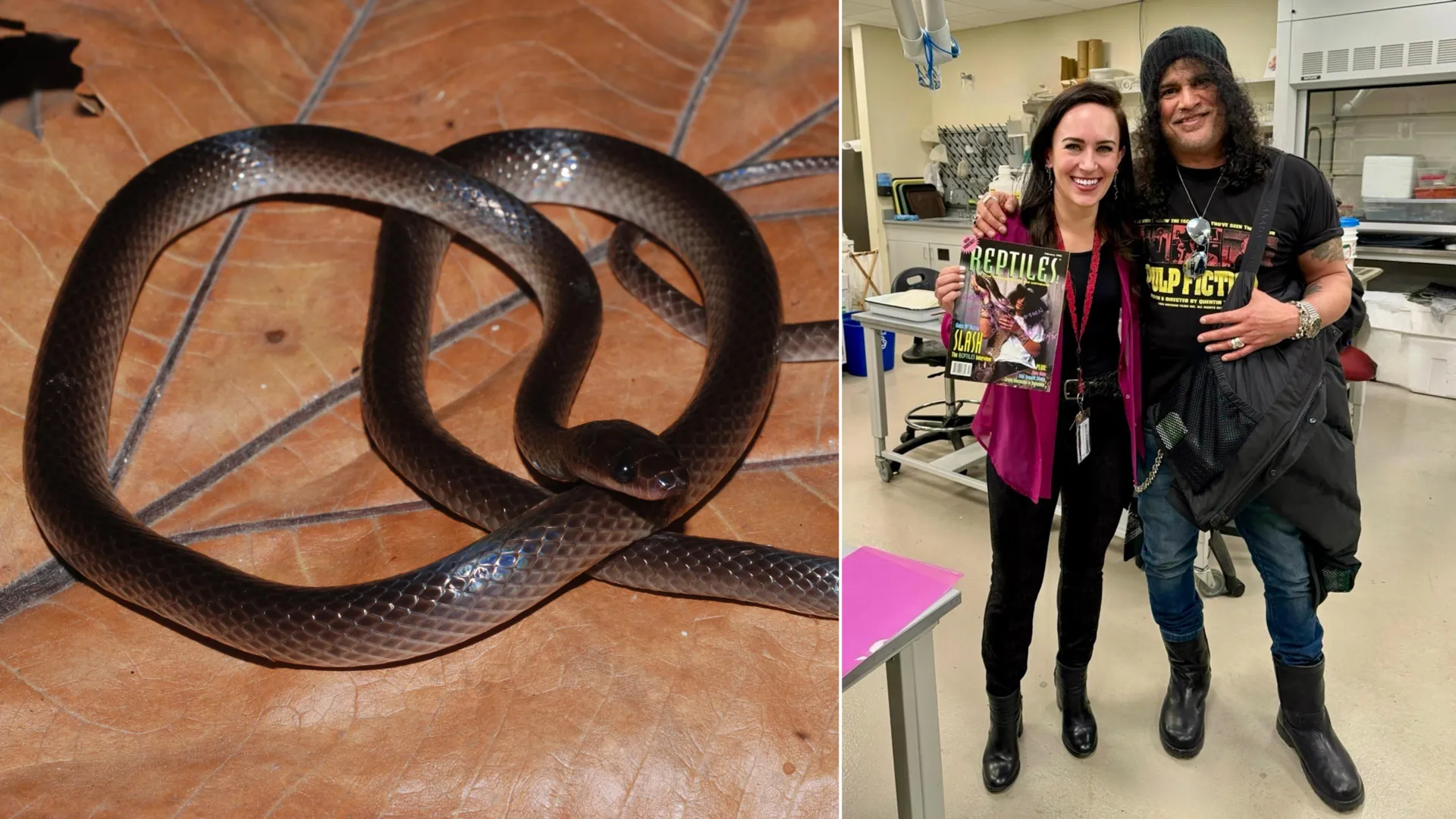
Saul Hudson, globally recognized by his stage name Slash, has carved his legacy into the annals of rock and roll history as the lead guitarist for the iconic band Guns N’ Roses. Yet, beyond the distortion-heavy riffs and the top hat that have defined his public persona for over three decades, Hudson has long maintained a profound, private devotion to the natural world. This intersection of rock stardom and biological curiosity reached an unexpected zenith this month as an international team of scientists officially named a newly identified reptile species Lielaphis slashi, or Slash’s groundsnake, in his honor.
The discovery, published in the peer-reviewed journal Zootaxa, marks the culmination of nearly two decades of research into the elusive, biodiversity-rich ecosystems of New Guinea. For the lead researchers involved, the naming serves as a tribute to both the musician’s lifelong advocacy for zoological preservation and the personal inspiration he provided to a generation of young scientists.
A Chronology of Discovery
The journey of Lielaphis slashi began long before its formal taxonomic description. In 2006, Dr. Chris Austin, a professor and curator of herpetology at the Louisiana State University Museum of Natural Science, was conducting nocturnal field research in the dense, tropical forests of New Guinea. The island, the second largest in the world, remains a frontier for biological discovery, with much of its high-altitude and lowland rainforest terrain still largely undocumented.
During a night survey, Dr. Austin encountered a snake that defied easy classification. New Guinea’s herpetofauna is notoriously complex, characterized by a high number of endemic species and a dangerous mimicry system where non-venomous snakes often evolve to resemble their highly toxic counterparts to ward off predators. Recognizing the specimen as something distinct, Dr. Austin collected the necessary data and samples for further analysis.
It was not until 2016, when Dr. Sara Ruane, then a postdoctoral researcher at Louisiana State University, began collaborating with Dr. Austin, that the full significance of the 2006 find began to emerge. The two scientists initiated a long-term investigation into the genus Lielaphis, utilizing advanced genetic sequencing and morphological analysis to parse out the differences between established species and potential new ones. The process, which spanned several years, involved rigorous comparisons of scale counts, dental morphology, and ecological niche modeling.
The Genetic Signature of a New Species
The confirmation of Lielaphis slashi as a distinct species relied on a multi-disciplinary approach. Dr. Tianqi Huang, the study’s first author and a researcher at the Field Museum, spearheaded the genetic component of the investigation. By employing cutting-edge genomic sequencing, the team identified significant divergences in the DNA of the 2006 specimen compared to other known groundsnakes in the region.
"The genetic evidence was the smoking gun," Dr. Huang noted. "When we combined that with the morphological data—specifically the unique scale arrangements—it became clear that we were looking at a lineage that had evolved independently from its closest relatives. Ecological modeling further solidified this, showing that the snake occupies a distinct environmental niche that differentiates it from other members of the Lielaphis genus."
The snake itself is a slender, reddish-brown reptile measuring approximately 28 inches in length. Its physical characteristics, while subtle to the untrained eye, provide crucial data points for biologists attempting to map the evolutionary history of New Guinea’s reptiles.
A Personal Connection: From Reptile Magazine to Research
For Dr. Sara Ruane, now an Associate Curator of Herpetology at the Field Museum, the naming of the snake was more than a professional decision; it was a nod to the influence the musician had on her own career trajectory.
"I was in fifth grade when I told my teacher I wanted to be a herpetologist," Dr. Ruane recalled. "That same year, I picked up a copy of Reptiles Magazine and saw Slash on the cover holding his pet reticulated python. For a twelve-year-old girl with an interest in snakes, seeing a rock icon treat reptiles with such respect was incredibly validating."
When the opportunity arose to name the new species, Dr. Ruane revisited interviews from the musician’s past, noting his long-standing support for zoos and museums. "He spoke about his childhood, wandering outside to look for snakes, and his genuine fascination with natural history. It was a perfect fit. He has been a long-time herpetophile, and it felt right to honor that."
Upon learning of the honor, Slash expressed both surprise and humility. "As a long-time herpetophile, I am extremely honored and humbled to have Lielaphis slashi from New Guinea named after me," he said in a statement. "It is really exciting; I never would have imagined this moment would arrive."
Ecology, Behavior, and the "Dangerous" Misconception
Despite the "dangerous" reputation of the band that bears his name, Lielaphis slashi is harmless to humans. It does not possess the venomous capabilities found in many of the other species sharing its habitat. Its anatomy, however, reveals a specialized predator.
Researchers believe the snake utilizes large, recurved teeth at the back of its mouth to capture and manipulate slippery prey, such as small lizards and reptile eggs. Unlike constrictors, which subdue prey through pressure, this groundsnake relies on its bite and swift reflexes to secure a meal. Observing these behaviors remains a significant challenge, as the species is nocturnal and highly elusive, frequently retreating into the undergrowth or the bases of large trees at the first sign of human presence.
The Broader Implications for Biodiversity and Conservation
The formal identification of Lielaphis slashi serves as a critical case study in the broader need for biological documentation in New Guinea. The island’s forests are currently facing mounting pressure from industrial activities, including coffee plantation expansion and large-scale mining operations.
"We cannot conserve what we do not know exists," Dr. Ruane emphasized. The classification of this snake is not merely an academic exercise; it is an essential step in identifying high-priority areas for conservation. By cataloging the biodiversity of the region, scientists can provide policymakers with the empirical evidence needed to argue for habitat protection.
The study, which included contributions from an international team of experts from institutions such as the Papua New Guinea National Museum and Art Gallery, the American Museum of Natural History, and the University of Kentucky, highlights the importance of collaborative, cross-border research.
As climate change and human encroachment continue to alter the landscapes of the tropics, the window for discovering and documenting species like Lielaphis slashi is narrowing. The naming of the snake after a globally recognized figure like Slash serves to bring much-needed public attention to these conservation efforts. It bridges the gap between pop culture and scientific endeavor, reminding the public that behind every discovery is a team of dedicated researchers working to catalog the fragile, interconnected web of life on Earth.
Ultimately, Lielaphis slashi stands as a testament to the fact that scientific curiosity knows no bounds—whether it is found in the depths of a tropical forest or on the cover of a magazine. As the scientific community continues to analyze the implications of this find, the hope remains that the visibility of this new species will inspire a new generation of researchers to look closer at the world around them, ensuring that the hidden wonders of New Guinea are protected for years to come.