In a significant shift in fiscal policy, New York Governor Kathy Hochul has officially signaled her support for a recurring annual tax on high-value second homes in New York City. This legislative pivot marks a departure from her previous stance, which had prioritized market stability and avoided additional burdens on the real estate sector. The Governor’s endorsement of the so-called “pied-à-terre” tax reflects an evolving political landscape and an urgent need to address the mounting revenue gaps facing both the city and the state.
The proposed tax specifically targets affluent property owners who maintain secondary residences in the five boroughs without claiming them as primary domiciles. According to administration officials, the measure is designed to ensure that the ultra-wealthy, particularly those who utilize the city’s infrastructure and amenities part-time, contribute more substantially to the local economy. As New York City grapples with a looming multi-billion dollar budget shortfall, the tax has emerged as a focal point for lawmakers seeking sustainable revenue streams that do not place additional pressure on middle- and lower-income residents.
The Structure of the Proposed Pied-à-Terre Tax
The legislative framework for the pied-à-terre tax is structured as a tiered annual levy based on the assessed or market value of secondary residences. Unlike the existing "mansion tax," which is a one-time fee paid at the time of purchase, this proposal would function as an ongoing surcharge.
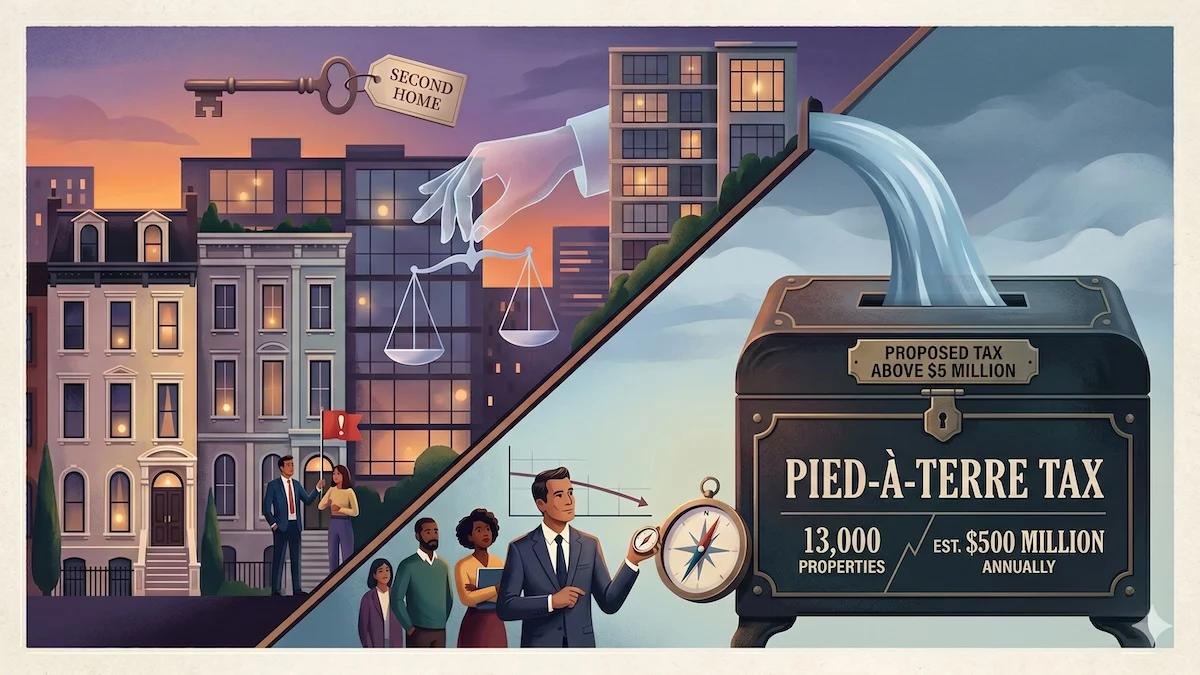
The tax would apply to residential properties valued at $5 million or more. Under the current draft of the proposal, the tax rates would escalate progressively for higher-value assets. Properties valued between $5 million and $15 million would face a baseline rate, while significantly higher percentages would be applied to ultra-luxury properties exceeding $15 million and $25 million.
State lawmakers estimate that the tax could generate approximately $500 million in annual revenue. Preliminary data suggests that the measure would impact roughly 13,000 properties across New York City—a small fraction of the total housing stock, yet representing a massive concentration of wealth. Proponents of the bill argue that these funds are essential for supporting public services, including the Metropolitan Transportation Authority (MTA) and affordable housing initiatives, which have seen their funding sources strained in the post-pandemic era.
A Chronology of the Pied-à-Terre Debate
The concept of a pied-à-terre tax is not new to Albany or City Hall, but its path to executive support has been fraught with legislative hurdles. The debate gained significant momentum in 2019 following the record-breaking $238 million purchase of a penthouse at 220 Central Park South by hedge fund billionaire Ken Griffin. The sale sparked a public outcry regarding the disparity between the city’s luxury real estate boom and its crumbling infrastructure.
In 2019 and 2020, progressive lawmakers pushed for a similar recurring tax, but the effort was ultimately sidelined. Critics at the time argued that the tax would be difficult to administer, particularly regarding the valuation of condominiums and the legal definition of a primary residence. As a compromise, the state legislature instead opted to increase the one-time mansion tax and the transfer tax on high-end sales.
The resurgence of the proposal in 2024 is driven by a different set of circumstances. The administration of New York City Mayor Eric Adams has been navigating a complex fiscal crisis characterized by the rising costs of the migrant crisis, the expiration of federal COVID-19 relief funds, and a sluggish return-to-office trend that has impacted commercial property tax revenues. Governor Hochul’s reversal is widely seen as a pragmatic response to these fiscal realities, acknowledging that traditional revenue sources may no longer be sufficient to cover the city’s projected budget gaps.
Market Analysis and the Resilience of Ultra-Luxury Real Estate
The endorsement of the tax comes at a paradoxical time for the New York City real estate market. While the broader housing market has faced headwinds due to fluctuating interest rates and limited inventory, the ultra-luxury segment has demonstrated remarkable resilience.
According to data recently analyzed by HousingWire, the ultra-luxury single-family segment—defined by a median price point of $4.3 million—has seen a surge in activity. Pending sales in this bracket jumped by 200% in the most recent weekly reporting period. Furthermore, the frequency of price cuts in this tier has dropped to 11.8%, significantly lower than the city’s long-term average of 17.9%. This data suggests that at the highest levels of the market, demand remains robust and buyers are increasingly willing to compete for a limited supply of premier properties.
However, the market below the $5 million threshold shows a different trajectory. New listings for luxury condos and townhomes with a $2 million median price fell by 17%, and the co-op sector experienced a 26% decline in new listings. This divergence highlights a "bifurcated market" where the ultra-wealthy continue to transact despite economic uncertainty, while the broader luxury market remains constrained by supply shortages and owner reluctance to sell.
Industry Pushback and Economic Concerns
The real estate industry has historically been the most vocal opponent of the pied-à-terre tax, and the current proposal is no exception. Industry groups, including the Real Estate Board of New York (REBNY), have warned that an annual surcharge could have a "chilling effect" on the city’s economic recovery.
Critics argue that the tax could lead to a decline in property values at the high end, which would, in turn, lower the overall property tax assessments that the city relies on for its general fund. There are also concerns regarding the impact on the construction and development sectors. If demand for ultra-luxury secondary homes wanes, developers may be less inclined to launch new high-end projects, potentially leading to a reduction in high-paying construction jobs and architectural services.
Bill Kowalczuk, a veteran real estate broker at Coldwell Banker Warburg, provided a nuanced perspective on the potential fallout. Speaking to HousingWire, Kowalczuk suggested that while the tax would likely cool the top tier of the market, it is unlikely to cause a total collapse.
“It would slightly reduce demand,” Kowalczuk noted. “The ultra-luxury market is strong due to limited inventory, but a new annual cost will give buyers a reason to pause or negotiate. It doesn’t break the market, but it takes some urgency out, especially for second-home buyers at this price point.”
Kowalczuk further observed that approximately 30% to 40% of ultra-luxury buyers in Manhattan are seeking second homes, many of whom are international investors or part-time residents. While these buyers are sensitive to costs, Kowalczuk believes the allure of New York City remains a powerful draw. “Most will negotiate harder on the price,” he said. “At this level, buyers won’t walk away from New York that easily, but they will absolutely adjust pricing to offset the new costs of ownership.”
Official Responses and Political Implications
The political reaction to Governor Hochul’s endorsement has been divided along predictable lines. Progressive legislators, who have long championed the tax as a matter of social equity, have lauded the move. They argue that in a city with a profound housing affordability crisis, it is only fair that those who can afford multi-million dollar "spare" apartments contribute more to the public coffers.
State Senator Brad Hoylman-Sigal, a long-time proponent of the measure, has previously argued that the tax is a common-sense solution to capture revenue from wealth that is currently "parked" in New York real estate. Supporters also point to other global cities, such as Paris, Singapore, and Vancouver, which have implemented similar taxes on non-resident owners or secondary homes to manage housing demand and generate revenue.
Conversely, some moderate Democrats and Republicans in the state legislature express concern about "wealth flight." They argue that cumulative tax burdens—including state income tax, city income tax, and now a recurring property surcharge—could incentivize the city’s highest earners to relocate their primary residences to low-tax jurisdictions like Florida or Texas.
The Governor’s office has countered these concerns by emphasizing the unique value proposition of New York City. Officials suggest that the city’s cultural, financial, and educational ecosystems are unparalleled, and that the proposed tax is calibrated to be significant enough to raise revenue but not so high as to drive away the global elite.
Broader Impact and Future Outlook
As the proposal moves toward the legislative finish line, several questions remain regarding its implementation. One of the primary challenges will be the mechanism for identifying which properties qualify as second homes. This would likely require a robust verification system linked to income tax filings and primary residency declarations.
Furthermore, the impact on the "co-op" market remains a point of contention. Unlike condominiums, co-op shareholders do not technically own their individual units but rather shares in a corporation. Applying a property-specific tax to co-ops presents unique legal and administrative hurdles that lawmakers will need to resolve in the final bill language.
The broader economic implications will also be closely watched. If the tax generates the projected $500 million, it could provide a vital cushion for the MTA as it seeks to modernize the subway system and maintain service levels. It could also fund the development of thousands of units of affordable housing, addressing one of the most persistent challenges facing the Adams administration.
However, if the real estate industry’s fears come to pass and the tax leads to a sustained downturn in luxury sales, the net gain to the city could be diminished by lower transfer tax receipts and a slowdown in new development.
The coming months will be critical as the details of the tax are negotiated in the state budget. With Governor Hochul’s support, the pied-à-terre tax has moved from a progressive talking point to a likely pillar of New York’s fiscal strategy. Whether it serves as a successful model for urban revenue generation or a cautionary tale of over-taxation will depend on the final calibration of the rates and the continued resilience of the world’s most exclusive real estate market.