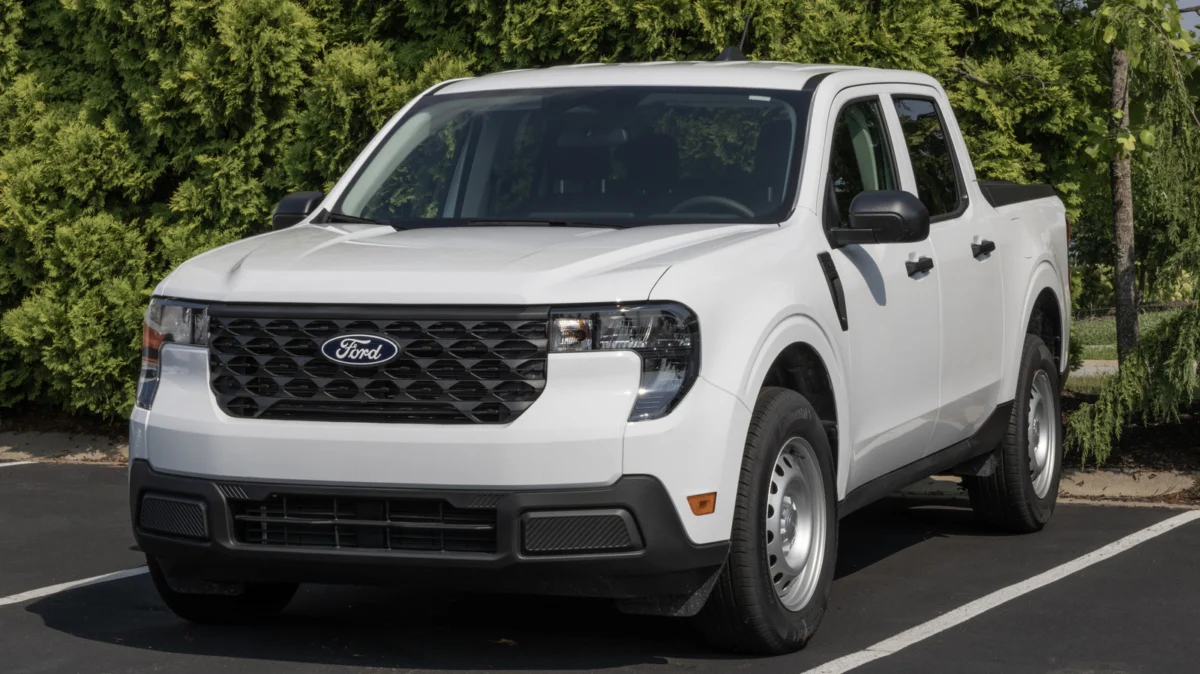
The automotive landscape in the United States has undergone a profound shift over recent years, driven largely by consumer demand for versatile, fuel-efficient, and affordably priced utility vehicles. Amidst this evolving market, the Ford Maverick has steadily claimed its position as the country’s best-selling compact truck. As Ford Motor Company prepares for the rollout of the 2027 model year, prospective buyers are faced with an increasingly diverse matrix of trims, powertrains, appearance packages, and capability options. Understanding what each specific trim level delivers—from the entry-level workhorse to specialized street-performance and off-road variants—is essential for consumers navigating dealership lots and online configurators.
The modern success of the Maverick is rooted in a segment that Detroit automakers largely abandoned decades ago: the genuinely compact, unibody pickup truck. When Ford reintroduced the nameplate, industry analysts questioned whether American buyers would embrace a smaller truck bed and a car-based platform. However, the combination of everyday urban maneuverability, fuel economy figures that rival traditional passenger sedans, and genuine utility captured a massive demographic ranging from urban dwellers to weekend DIYers. The 2027 lineup aims to cement this dominance by expanding specialized offerings while carefully segmenting its pricing and feature availability across five distinct trim configurations: XL, XLT, Lariat, Lobo, and Tremor.
Entry-Level Utility: The XL Trim
Your entry into the 2027 Ford Maverick lineup starts with the XL trim, which carries a starting MSRP of $28,990, a figure that includes the mandatory $1,845 destination and delivery fee. As standard equipment, the base trim is surprisingly well-equipped for a modern fleet-friendly or budget-conscious vehicle, featuring automatic LED headlights with an auto high-beam function, electronic cruise control, wireless Apple CarPlay, and Android Auto integration displayed on a spacious 13.2-inch touchscreen infotainment system.
Audio duties are handled by a six-speaker stereo supporting AM/FM radio, while cabin seating relies on durable, easy-to-clean cloth surfaces. Safety technology is anchored by a foundational, watered-down version of Ford’s Co-Pilot360 suite, which incorporates forward collision warning, lane-keeping assist, and automatic emergency braking. Buyers who require the full suite of Co-Pilot360 advanced safety features must pay an additional $795.
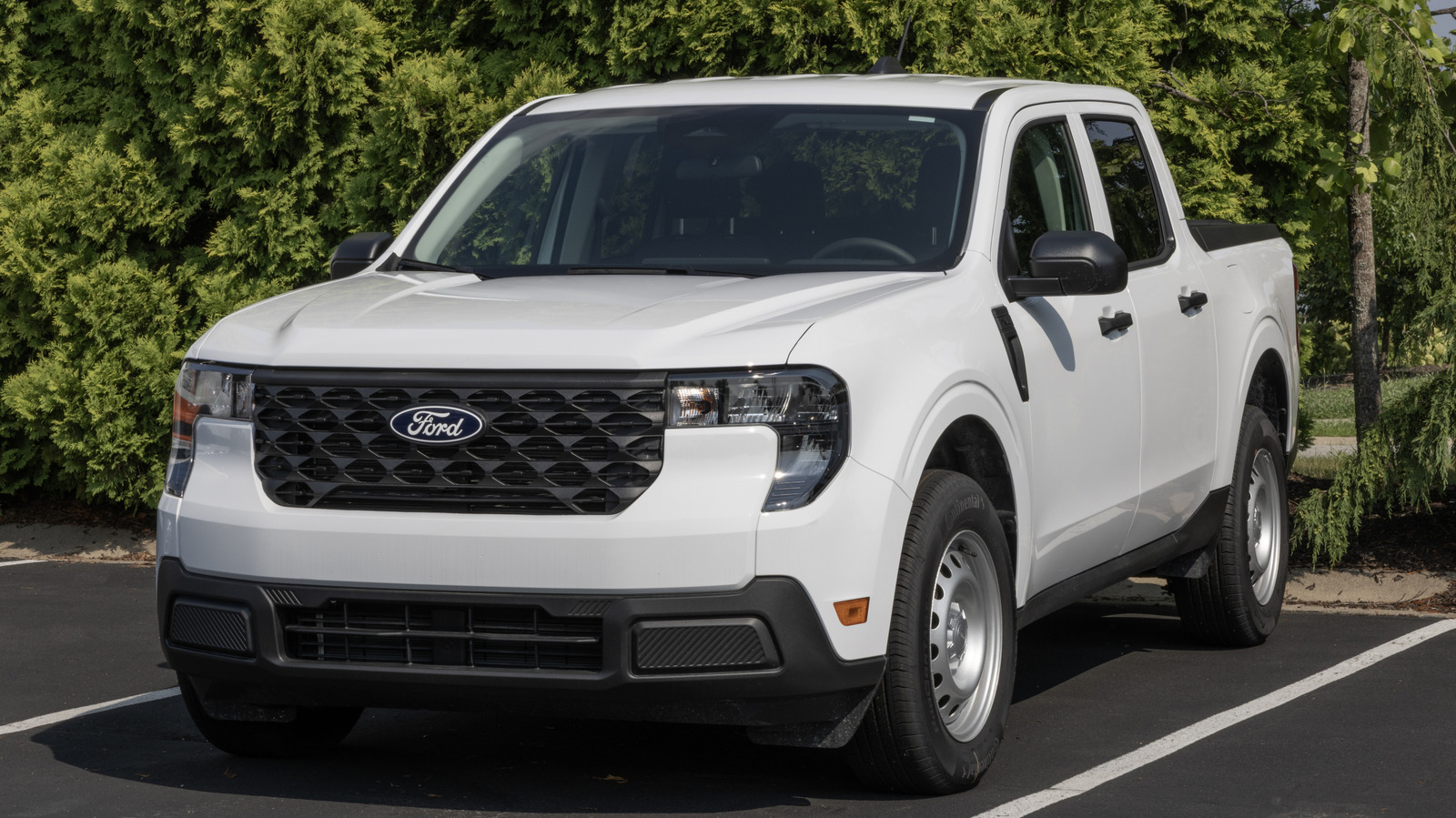
Under the skin, the base XL price point assumes the inclusion of the responsive 250-horsepower 2.0-liter EcoBoost turbocharged four-cylinder engine, paired with an eight-speed automatic transmission. For buyers prioritizing fuel economy over raw acceleration, Ford offers a 191-horsepower 2.5-liter hybrid powertrain for an additional $1,000. However, opting for all-wheel drive (AWD) introduces further financial considerations: AWD is exclusively reserved for the hybrid powertrain configuration, requiring an additional $2,220 outlay on top of the hybrid upgrade fee.
Furthermore, hauling and towing capabilities require careful option selection. The standard towing capacity is capped at 2,000 pounds, but ticking the $745 4K Tow Package doubles the maximum towing rating to 4,000 pounds. Industry observers note that while the hybrid powertrain is versatile, out of the entire Maverick catalog, only the XL, XLT, and Lariat trims offer the flexibility of choosing between front-wheel-drive internal combustion and hybrid setups.
Stepping Up: The XLT and Lariat Trims
Moving up the pricing and feature ladder brings buyers to the XLT trim, which starts at $31,490. Widely recommended by major automotive publications such as Edmunds and Car and Driver as the "sweet spot" of the Maverick lineup, the XLT enhances the base vehicle with upgraded interior materials, distinctive 17-inch alloy wheels, and critical day-to-day quality-of-life enhancements. These additions include keyless entry, a power tailgate lock, and a factory-installed trailer hitch receiver.
Customization remains a strong suit for the XLT. Equipping the cabin with heated front seats, remote engine start, and other cold-weather amenities requires optioning the $1,890 XLT Luxury Package. For aesthetic personalization, the $1,645 Black Appearance Package introduces 19-inch black-painted wheels, a black roof, color-matched exterior mirrors, and dark interior accents.
For buyers seeking mild off-road capability, the optional FX4 Off-Road Package introduces a performance-tuned suspension, protective skid plates, aggressive all-terrain tires, and specialized driving modes. However, Ford imposes strict mechanical boundaries: the FX4 package cannot be paired with the hybrid powertrain or front-wheel drive, meaning buyers must select the 2.0-liter EcoBoost engine. While AWD is no longer strictly hybrid-exclusive on the XLT, pairing the hybrid system with the rugged FX4 package remains structurally unsupported by the manufacturer. Additional packages, such as Technology and Utility bundles, mirror similar offerings found on the entry-level XL.
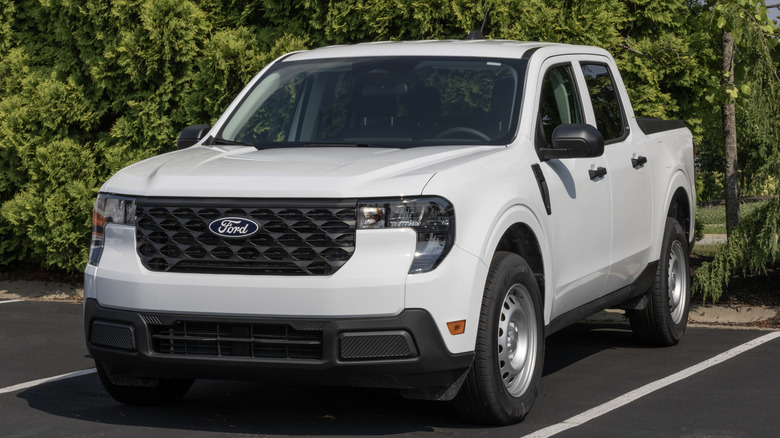
At the top of the traditional luxury hierarchy sits the Lariat trim, with pricing starting at $37,715 for the 2.0-liter EcoBoost model. The hybrid variant commands a $2,220 premium. Unlike lower trims, all-wheel drive comes standard across both powertrain options on the Lariat. The pricing reflects a comprehensive list of standard luxuries, bundling a 360-degree camera system, a premium eight-speaker Bang and Olufsen audio setup, adaptive cruise control, and virtually all components of the XLT Luxury Package into the base price. The 4K Tow Package and Black Appearance Package remain available as standalone options for buyers looking to further customize their Lariat.
Performance and Specialty Variants: Lobo and Tremor
Ford has carved out distinct enthusiast niches within the compact truck market by introducing dedicated performance and heavy-duty off-road variants: the Lobo and the Tremor.
Priced starting at $37,775, the Maverick Lobo is engineered specifically for street performance and urban agility. It features a uniquely tuned suspension, upgraded braking components, aggressive street-oriented styling cues, and striking 19-inch Turbofan wheels that evoke classic motorsport heritage. Buyers who step up to the Lobo High package—adding $5,495 to the sticker price—receive upscale cabin appointments including a power moonroof, heated front seats, a power-sliding rear window, and the premium audio architecture found in lesser luxury trims. Mechanically, while the Lobo utilizes the standard 2.0-liter EcoBoost engine, it gains an exclusive seven-speed automatic transmission equipped with steering-wheel-mounted paddle shifters, providing drivers with greater engagement.
Conversely, the Tremor is engineered for buyers whose adventures extend far beyond paved surfaces. Starting at $42,490, the Tremor shares advanced all-wheel-drive hardware with the Lobo but recalibrates its purpose entirely toward rugged off-roading. It features a locking rear differential, multiple terrain management modes, an off-road-tuned suspension system, protective steel skid plates, all-terrain rubber, and Trail Control—a low-speed cruise control system designed for navigating technical obstacles. Distinctive orange exterior and interior accents visually separate the Tremor from the rest of the Maverick family.
It is vital for consumers to note certain mechanical limitations associated with these halo trims. Much like the Lobo, the Tremor cannot be ordered with the fuel-efficient hybrid powertrain. Furthermore, Ford does not offer the heavy-duty 4K Tow Package for either the Lobo or the Tremor, as their specialized suspension tuning prioritizes dynamic handling or articulation over maximum trailer weight capacity.
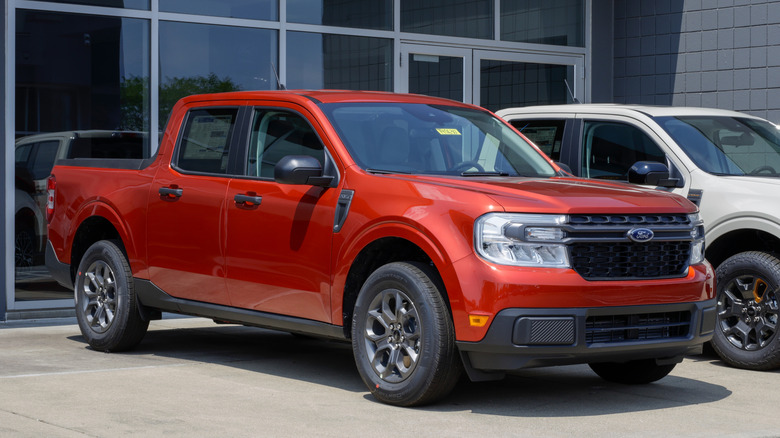
Market Context, Historical Evolution, and Industry Implications
The evolution of the Ford Maverick from its initial 2022 model-year launch to the 2027 iteration illustrates how quickly automakers can adapt to shifting consumer demands. When Ford first introduced the Maverick, assembly lines struggled to meet overwhelming demand, particularly for the high-mpg hybrid variant, which routinely faced extended wait times and dealer markups. Over subsequent model years, Ford adjusted production allocations, introduced all-wheel drive to the hybrid lineup, and expanded trim choices to capture segments ranging from budget-conscious commercial fleets to lifestyle-oriented weekend warriors.
Industry analysts emphasize that the pricing strategy for the 2027 Maverick reflects broader economic pressures, including rising supply chain costs, inflationary labor adjustments, and the integration of advanced mandatory safety systems. Despite incremental price increases across all tiers, the Maverick maintains its position as one of the most economically accessible entry points into the new vehicle market. The base XL starting price under $29,000 provides a stark contrast to full-size and mid-size truck segments, where average transaction prices frequently exceed $50,000.
The broader market impact of the Maverick’s continued success has forced competing domestic and international manufacturers to reevaluate their product portfolios. As traditional sedans vanish from showroom floors, compact unibody trucks have successfully filled the vacuum, offering the utility of an open bed combined with the driving dynamics, fuel efficiency, and interior ergonomics of a modern crossover SUV.
As dealership orders open for the 2027 model year, consumer behavior suggests that the delicate balance between the high-efficiency hybrid and the performance-oriented EcoBoost models will continue to dictate manufacturing priorities in Hermosillo, Mexico, where the truck is produced. Whether a buyer opts for the utilitarian baseline XL, the universally recommended XLT, or specialized halo models like the street-styled Lobo or trail-rated Tremor, Ford’s compact pickup remains a foundational pillar of modern American automotive utility.