For decades, the standard paradigm for detecting neutron star mergers has been anchored to the brief, blinding intensity of short gamma-ray bursts (GRBs). These high-energy phenomena, typically vanishing in less than two seconds, have served as the primary beacon for astronomers mapping the most energetic cataclysms in the universe. However, a groundbreaking study published in the journal Science Bulletin has fundamentally challenged this narrow view. New evidence indicates that these stellar collisions can produce prolonged, persistent X-ray emissions lasting for several minutes—a finding that promises to rewrite our understanding of how neutron stars die and what they leave behind.
The discovery centers on a mysterious event designated EP250704a/GRB 250704B, which occurred on July 4, 2025. Detected by a trio of advanced orbital observatories—the Einstein Probe (EP), the SVOM satellite, and the Hard X-ray Modulation Telescope (Insight-HXMT)—the event lasted a mere half-second in the gamma-ray spectrum, fitting the traditional profile of a neutron star merger. Yet, the Einstein Probe captured a startling anomaly: an X-ray glow that persisted for nearly ten minutes. This event represents the longest-lasting prompt X-ray flash ever recorded from a merger, providing an unprecedented "front-row seat" to the birth of a magnetar.
The Chronology of a Cosmic Collision
The detection of EP250704a triggered a rapid-response protocol that highlights the sophistication of modern multi-messenger astronomy. When the Einstein Probe alert arrived, the research team—led by scholars from an international collaboration including the University of Rome Tor Vergata and the Chinese Academy of Sciences—initiated a high-speed observation sequence.
Niccolò Passaleva, a graduate student who spearheaded the follow-up operations, recalls the logistical intensity of the mission. "I was traveling home by train when the notification arrived," Passaleva stated. "It was a race against time. I had to commandeer one of the world’s largest telescopes, the European Southern Observatory’s Very Large Telescope (VLT) in Chile, directly from my laptop while in transit."
The team’s immediate action allowed them to capture the event while the electromagnetic afterglow was still at peak intensity. By utilizing the VLT’s X-Shooter instrument, the researchers were able to perform spectroscopy on the fading light, breaking the signal into its component wavelengths. This allowed them to calculate a redshift of z=0.6610. By accounting for the expansion of the universe, this measurement places the source of the flash at a staggering distance of more than six billion light-years from Earth. Essentially, the light observed by the telescopes began its journey long before the formation of our own solar system.
Decoding the Magnetar Signature
Neutron stars represent the final, ultra-dense evolutionary stage of massive stars. When two such remnants collide, the resulting physics is governed by extreme gravity and magnetic fields. Historically, astronomers have debated whether the remnant of such a merger collapses immediately into a black hole or persists as a highly magnetized neutron star, known as a magnetar.
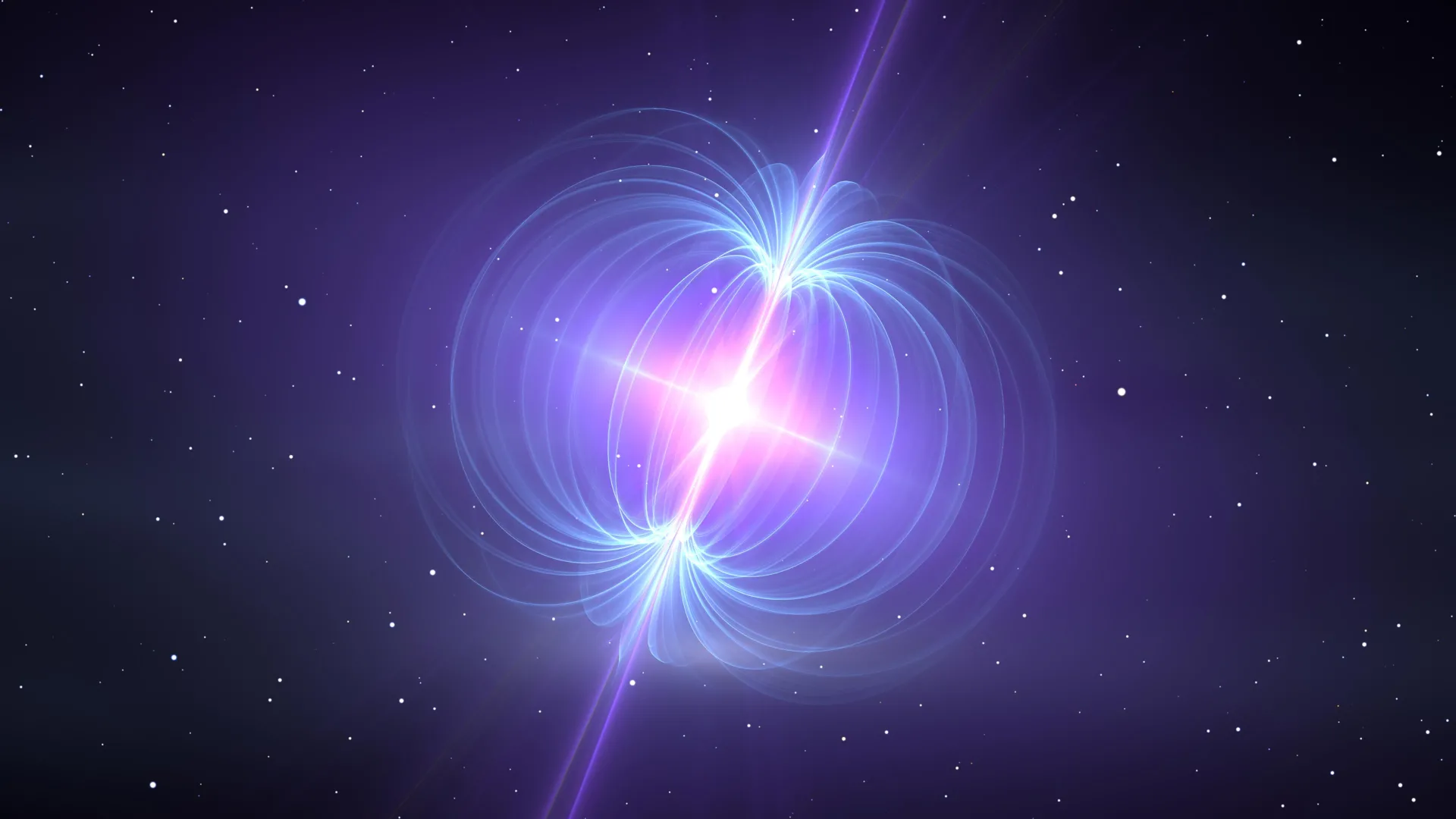
The data from EP250704a provide a compelling case for the latter. Magnetars are defined by their rapid rotation and magnetic fields of unfathomable intensity. As these objects spin down, they bleed off energy into the surrounding environment, a process that can sustain a high-energy glow far longer than a standard, fleeting merger event.
"If the remnant is a magnetar, it keeps bursting for longer," explains Professor Eleonora Troja, a lead researcher and co-corresponding author of the paper. "When I saw the X-ray data, I realized something significant was occurring. The magnetar damps its magnetic power into the surroundings, effectively making the explosion both brighter and longer-lived than what we see in a standard, short-lived gamma-ray burst."
To confirm that the X-ray flash was indeed the product of a merger rather than the collapse of a singular massive star—which also produces long-duration high-energy signals—the team utilized the VLT’s FORS2 instrument to search for a supernova signature. A supernova is the hallmark of a massive star’s death, but none was detected at the coordinates of EP250704a. The combination of the event’s extreme distance, the absence of a supernova, and the specific spectral properties of the flash led the team to conclude that they had witnessed the merger of two binary neutron stars.
Bridging the Gap in Fast X-ray Transients
Since the launch of the Einstein Probe in January 2024, astronomers have been inundated with data. The satellite has detected hundreds of "fast X-ray transients"—brief, bright flashes of high-energy light that defy easy categorization. While some of these events are attributed to the deaths of massive stars or other stellar activity, a significant portion has remained unexplained, largely because researchers often lacked the ability to determine the distance or energy output of the events.
The study in Science Bulletin provides a roadmap for future investigations. By successfully identifying the source of EP250704a, the team has proven that these unexplained X-ray transients may actually be a primary, yet previously overlooked, indicator of neutron star mergers. This realization expands the "search space" for astronomers; instead of looking only for the sub-second gamma-ray spikes, they can now use the more visible, longer-lasting X-ray flashes to identify mergers.
Scientific Implications and Future Directions
The implications of this research are profound for the field of gravitational wave physics. Gravitational waves are the ripples in spacetime generated by the merger of dense objects, but detecting them requires sensitive, ground-based interferometers like LIGO, Virgo, or KAGRA. The ability to identify potential merger candidates via X-ray flashes provides a critical target for these observatories.
"Finding more of these X-ray flashes could help reveal how often neutron star mergers create magnetars," says Passaleva. "I am incredibly excited for the next run of gravitational wave observations. The goal is to finally pair an X-ray flash with a simultaneous burst of gravitational waves from the same source."
Such a pairing would represent the "holy grail" of multi-messenger astronomy. By combining the data from gravitational waves—which provide information on the mass and motion of the colliding objects—with the electromagnetic data from X-ray flashes—which provide information on the high-energy environment and the nature of the remnant—scientists could perform "astrophysical forensics" with unprecedented precision.
Furthermore, this discovery underscores the efficacy of international collaboration. The research was a massive effort involving a global network of institutions, including Beijing Normal University, the Chinese Academy of Sciences, the University of Hong Kong, and the University of Rome Tor Vergata. The use of the VLT’s large program "QUEENB: a QUEst for Elusive Neutron star and Black hole mergers" demonstrates how targeted, resource-intensive observations can turn a fleeting moment in the sky into a foundational discovery.
As the Einstein Probe continues its survey of the heavens, the catalog of fast X-ray transients will only grow. Astronomers are now tasked with the challenge of filtering this influx of data to find more events like EP250704a. Each new event will serve as a laboratory for testing the limits of physics, offering insights into the formation of magnetars, the mechanics of stellar death, and the evolution of the heavy elements that are forged in the aftermath of these cosmic collisions.
The era of short-duration GRB supremacy in merger detection is clearly evolving. By looking for the "echo" of the collision—the ten-minute X-ray flash—astronomers are gaining a more complete, nuanced, and detailed view of the universe’s most violent events. The discovery of EP250704a is not merely a single data point; it is the beginning of a new chapter in our quest to understand the invisible forces that shape the cosmos.