For generations, the prevailing consensus in planetary science held that Earth was a dry, desolate rock in its infancy, only becoming a "Blue Marble" through the fortuitous bombardment of icy comets and carbonaceous chondrite meteorites from the outer reaches of the solar system. This "late veneer" theory suggested that water was an imported commodity, delivered like a cosmic cargo. However, a groundbreaking study published in the journal Nature Geoscience by researchers at The University of New Mexico challenges this foundational narrative, proposing that Earth may have been its own primary manufacturer of water.
The research, led by graduate student Susmita Garai under the guidance of Professor Zachary Sharp and researcher Peter Olson, posits that the planet’s early atmosphere—thick with hydrogen—interacted with the iron-rich rocky material accumulating during Earth’s formation to trigger a chemical synthesis of water. This finding not only redefines our understanding of Earth’s geological history but also suggests that the ingredients for life may be an inherent byproduct of the planetary formation process itself.
A Reevaluation of Planetary Genesis
The timeline of Earth’s formation dates back approximately 4.5 billion years. During the Hadean Eon, the young planet was a chaotic, molten environment characterized by extreme heat and intense bombardment. Scientists have long struggled to reconcile the isotopic signatures of Earth’s water with the water found in the various types of meteorites that populate the solar system. While cometary ice is often rich in deuterium—a heavy isotope of hydrogen—Earth’s ocean water displays a different isotopic ratio, leading to ongoing debates about whether the "delivery" theory is sufficient to explain the sheer volume of water currently sequestered in the Earth’s mantle and crust.
By shifting the focus from external delivery to internal synthesis, the University of New Mexico team provides a mechanism that bypasses the logistical hurdles of the bombardment theory. The study highlights that if the early Earth possessed a hydrogen-rich atmosphere—which is highly probable for a growing terrestrial planet—the interaction between falling rocky "pebbles" and atmospheric gases would have been inevitable.
The Mechanism of Atmospheric Synthesis
The researchers utilized a series of high-temperature experiments to simulate the conditions of the early Earth. By exposing silicate rocks, which were representative of the planet’s building blocks, to hydrogen gas at temperatures between 1,200 and 1,400 degrees Celsius, the team observed a rapid chemical reduction process.
In these extreme environments, the iron oxide within the silicate rocks reacted with the hydrogen in the atmosphere. The hydrogen acted as a reducing agent, stripping the oxygen from the iron oxide to form metallic iron and releasing water vapor as a byproduct. The reaction was remarkably efficient, with nearly 80% of the iron oxide transforming into metallic iron within minutes.
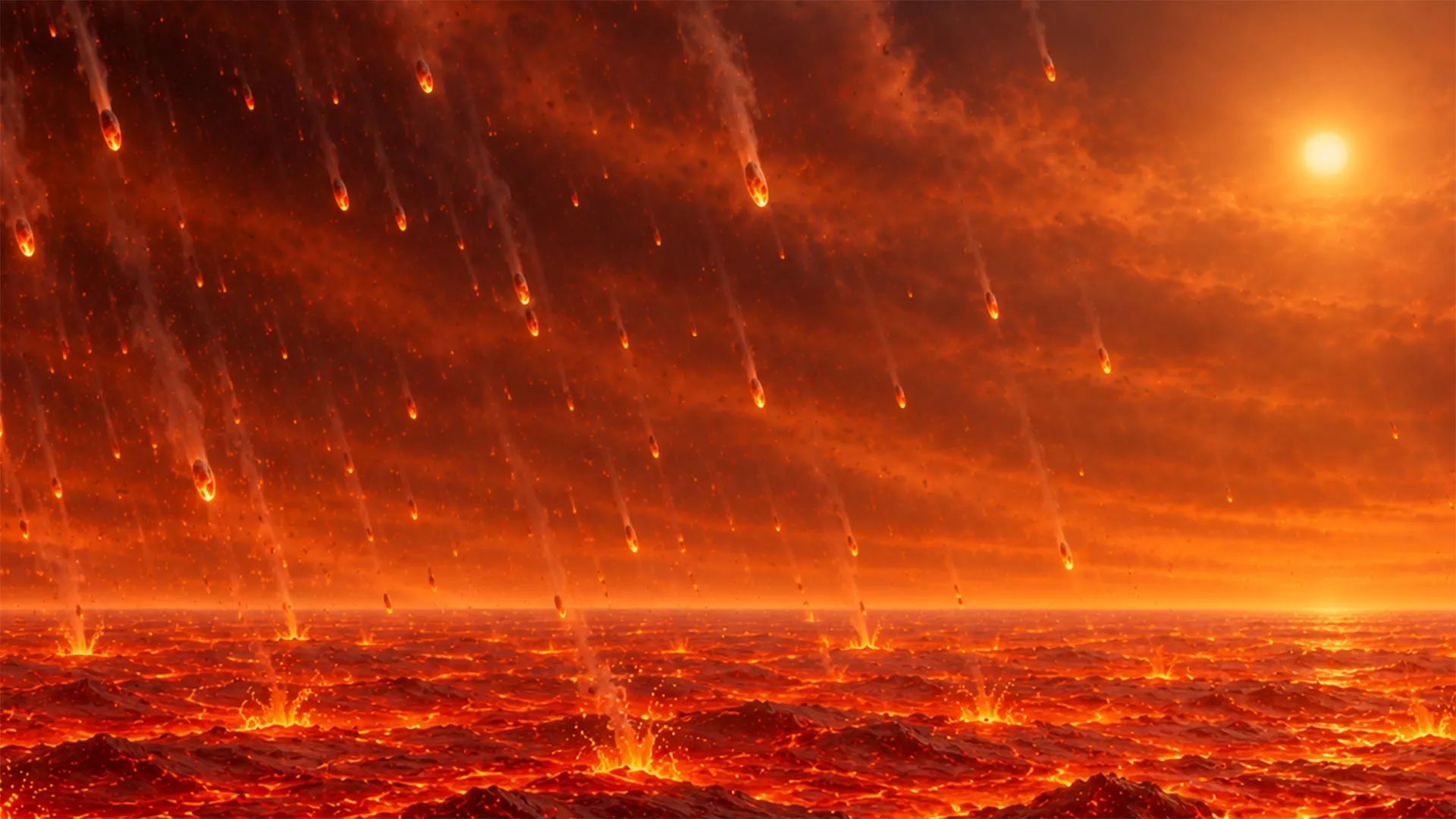
This process, termed "pebble accretion," describes how Earth grew in mass by sweeping up small, rocky particles. As these pebbles descended through a dense, hydrogen-rich primitive atmosphere, the frictional heat combined with the chemical reactivity of the atmosphere created a "rain" of water vapor. The scale of this process is staggering; when extrapolated to the mass of the early Earth, the researchers estimate that this mechanism could have generated hundreds of oceans’ worth of water, far exceeding the volume of water currently present on the planet’s surface.
Experimental Methodology and Validation
To ensure the validity of these findings, the team implemented a rigorous control group. In parallel experiments, silicate rocks were exposed to helium gas under identical thermal conditions. Because helium is an inert gas, no chemical reaction occurred, and no water was produced. This clear distinction between the hydrogen-exposed samples and the helium-exposed samples provided the empirical backbone for the team’s conclusion: the presence of hydrogen is the critical variable in the synthesis of planetary water.
The experimental duration, ranging from 15 minutes to three hours, demonstrated that the reaction is not only possible but kinetically favorable. The speed of the production suggests that water synthesis was likely a continuous, massive-scale operation throughout the duration of Earth’s accretionary phase.
Broader Scientific Implications
The academic community has received these findings with significant interest, as they provide a solution to several "missing link" problems in current planetary science models. The traditional model of cometary delivery has always faced criticism regarding the efficiency of transport and the chemical composition of the water delivered. If Earth generated its own water, the need to rely on the unlikely arrival of a precise number of icy bodies from the outer solar system is greatly reduced.
"Previous ideas about the source of water to Earth rely on an external source," Professor Zachary Sharp noted. "Here we show that virtually any Earth-sized planet should have water by this newly identified mechanism."
This paradigm shift has profound implications for the search for extraterrestrial life. If the production of water is a standard consequence of the accretion of rocky planets in hydrogen-rich environments, then habitable worlds may be significantly more common throughout the galaxy than previously assumed. It suggests that water is not an "accidental" addition to a planet, but a fundamental characteristic of the planet-building process.
Contextualizing the Future of Planetary Science
The theory of pebble accretion has gained traction over the last decade as a comprehensive model for planet formation. By integrating the chemical synthesis of water into this model, scientists now have a more cohesive framework to explain how terrestrial planets develop both their physical structure and their life-sustaining resources simultaneously.
However, the researchers remain cautious about overstating the current findings. While the experiments confirm the chemical feasibility of the process, they do not definitively quantify the total percentage of Earth’s modern water that originated from this internal synthesis versus that which was delivered by later impacts. Comets and meteorites undoubtedly contributed to the planet’s volatile inventory; the question now becomes how much of the water we rely on today is "native" and how much is "imported."
Future research will likely focus on comparing the isotopic "fingerprints" of water produced through this experimental reduction process with the isotopic signatures of deep-mantle water samples. If the signatures match, it would provide compelling evidence that a significant portion of our water is indeed as old as the planet itself.
Conclusion: A New View of Habitability
The discovery that Earth may have manufactured its own oceans from the fiery, hydrogen-rich crucible of its formation fundamentally alters the narrative of our origins. It paints a picture of a planet that was equipped for life from the very beginning, rather than waiting for a series of cosmic collisions to provide the necessary conditions.
As astronomers continue to discover exoplanets in the "habitable zones" of distant stars, this research provides a new set of criteria for assessing their potential. If the conditions for water production are inherent to the formation of Earth-sized planets, then the universe may be far more populated with water-rich worlds than our previous, more restrictive models allowed us to hope. The "Blue Marble" may not be a lucky outlier, but rather the result of a standard, universal process that turns barren rock and gas into a cradle for life.