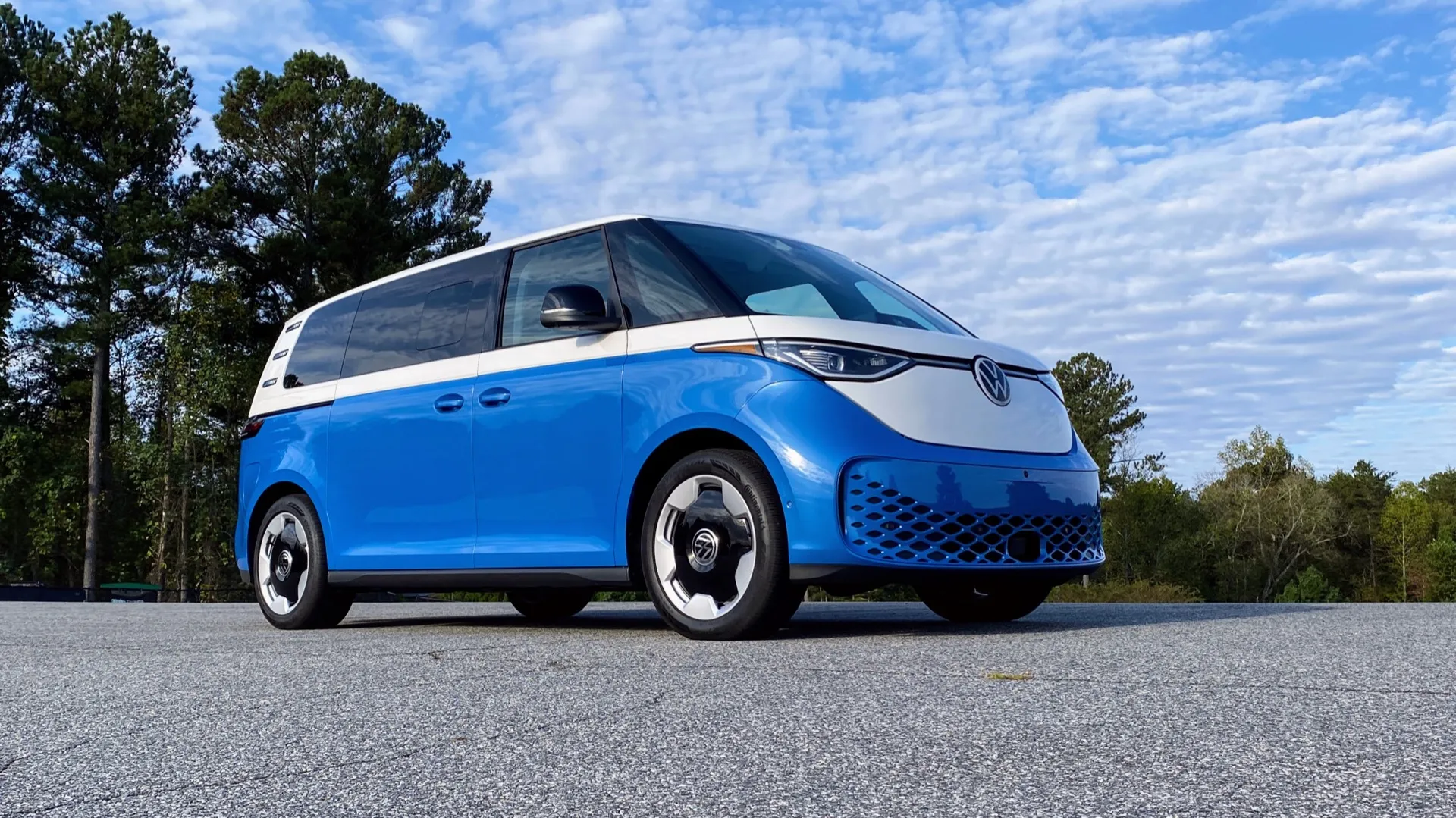
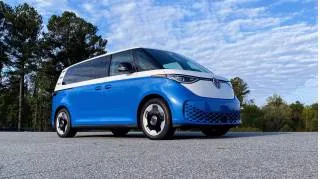
The long-anticipated arrival of the 2025 Volkswagen ID.Buzz on United States soil marks more than just the launch of another electric vehicle; it represents the culmination of decades of nostalgia, multiple concept car iterations, and a strategic pivot for Volkswagen’s North American lineup. After years of false starts and anticipation from enthusiasts, the modern, electrified successor to the legendary Type 2 Microbus is finally available for American consumers. Designed to bridge the gap between a storied counterculture past and a sustainable automotive future, the ID.Buzz enters a market currently dominated by three-row SUVs, offering a distinct alternative that prioritizes personality, interior volume, and the inherent advantages of a dedicated electric vehicle platform.

While the European market has enjoyed a short-wheelbase version of the ID.Buzz for nearly two years, Volkswagen determined that the North American market required a more robust configuration. Consequently, the U.S. version arrives exclusively in a long-wheelbase format, featuring three rows of seating and a larger battery pack. This decision reflects the specific demands of American families and long-distance travelers, positioning the ID.Buzz not merely as a novelty vehicle but as a functional tool for mass-market consumption. Recent test drives conducted across the diverse terrain of north Georgia—ranging from rural backroads to suburban centers—reveal a vehicle that garners universal attention, transcending political and cultural divides to evoke a rare sense of collective appreciation.
A Chronology of the Microbus Revival
The path to the 2025 ID.Buzz was neither short nor direct. The original Volkswagen Microbus, introduced in the 1950s, became an indelible symbol of the 1960s counterculture, prized for its simplicity, affordability, and utility. However, as safety regulations and consumer preferences evolved, the air-cooled, rear-engine van eventually disappeared from the U.S. market, leaving a void that Volkswagen struggled to fill for decades.
The revival effort began in earnest at the 2001 North American International Auto Show in Detroit with the unveiling of the "Microbus Concept." Despite overwhelming public interest, the project was shelved due to high production costs and shifting corporate priorities. Over the following fifteen years, several other concepts followed, including the 2011 Bulli and the 2016 Budd-e, each attempting to capture the spirit of the original in a modern package. It was not until the 2017 North American International Auto Show that the ID.Buzz concept was revealed, built upon the company’s Modular Electric Drive Matrix (MEB) platform. This provided the technical foundation necessary to make the vehicle a production reality.

The two-year delay between the European launch and the U.S. arrival was utilized to refine the vehicle for North American tastes. This included stretching the chassis by approximately 10 inches, integrating a more powerful rear motor, and upgrading the infotainment hardware to a newer generation.
Technical Specifications and Powertrain Architecture
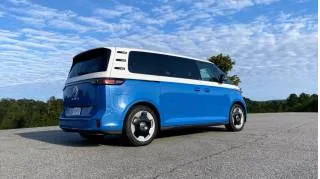
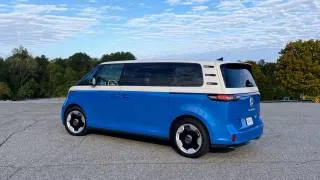
The U.S.-spec ID.Buzz is a significant departure from its European sibling in terms of sheer scale and performance. Riding on a 127.5-inch wheelbase with an overall length of 195.4 inches, the vehicle is designed to accommodate up to seven passengers comfortably. It stands 76.2 inches tall—roughly 10 inches taller than the Volkswagen ID.4 crossover—while maintaining a ground clearance of 6.1 inches.
Underpinning the vehicle is a 91-kWh (gross) lithium-ion battery pack. The base configuration features a rear-mounted permanent magnet synchronous motor (internally designated as the AP550), which produces 282 horsepower and 413 lb-ft of torque. For consumers requiring more traction or performance, an 4Motion all-wheel-drive (AWD) version is available. This setup adds an induction motor to the front axle, bringing the total system output to 335 horsepower.
Performance metrics for a vehicle of this size are respectable. Volkswagen estimates a 0-60 mph sprint in approximately 7.5 seconds for rear-wheel-drive models, while the AWD versions can complete the task in just 6.0 seconds. The vehicle’s top speed has been electronically increased to 99 mph for the U.S. market, up from the 90 mph limit found on early European models. For those intending to use the van for recreation, it offers a maximum towing capacity of 2,600 pounds for braked trailers.

Interior Versatility and Design Philosophy
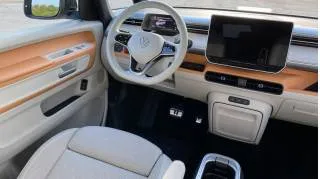
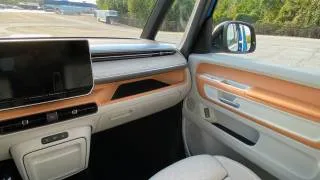
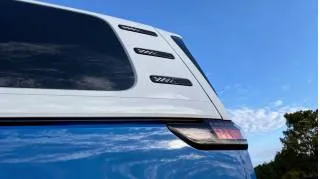
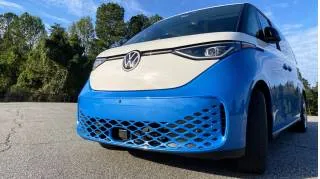
The design of the ID.Buzz successfully avoids the pitfalls of "retro-futurism" by balancing heritage cues with modern functionality. While the exterior features the iconic "V" shape on the front and available two-tone paint schemes, the interior is a masterclass in space utilization. The flat-floor architecture of the MEB platform allows for a cavernous cabin that Volkswagen claims offers best-in-class third-row legroom.
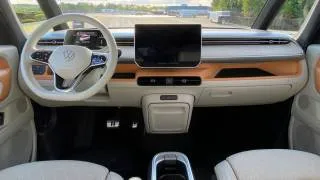
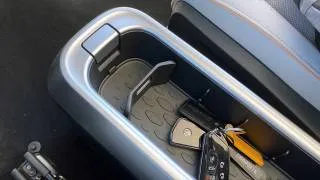
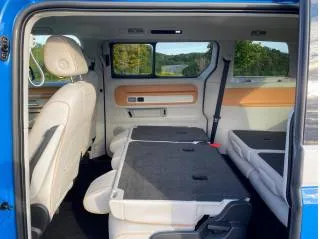
Flexibility is a core tenet of the ID.Buzz interior. The center console, known as the "Buzz Box," is fully removable and features multiple storage compartments and drawers. The vehicle is equipped with eight USB-C ports, ensuring that every passenger has access to charging. Standard features include heated, ventilated, and power-adjustable front seats with massage functions, as well as heated outboard seats in the second row.
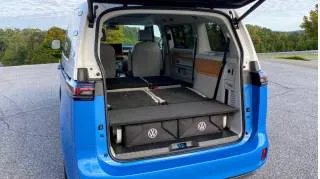
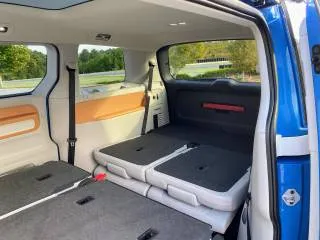
Seating configurations vary by trim. The standard Pro S model offers a second-row bench for a seven-passenger total, while the Pro S Plus and 1st Edition trims offer the option of second-row captain’s chairs, reducing capacity to six but increasing comfort and ease of access to the rear. The cargo area includes a "Flexboard" system that creates a flat load floor when the rear seats are folded, though the seats themselves are heavy and require significant effort to remove entirely for maximum cargo volume.
Driving Dynamics and Road Manners
On the road, the ID.Buzz betrays its substantial mass. With a curb weight approaching 6,000 pounds (5,968 lbs for RWD and 6,197 lbs for AWD), the vehicle feels heavy and is softly sprung to prioritize ride comfort over cornering prowess. However, the low center of gravity—a result of the floor-mounted battery—prevents the van from feeling unstable.
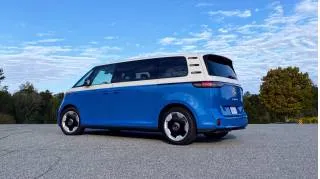
One of the most notable attributes of the ID.Buzz is its maneuverability. Despite its length, the rear-wheel-drive model boasts an impressive turning circle of 37.4 feet, making it surprisingly easy to navigate in tight urban environments. The AWD version, hampered by the front motor assembly, sees this figure increase to 42.7 feet. Visibility is another high point; the expansive glasshouse provides an old-fashioned, command-style view of the road that modern, high-beltline SUVs often lack.
The braking system uses a combination of regenerative braking and traditional friction brakes. While Volkswagen does not offer a true "one-pedal" driving mode, the ‘B’ mode on the shifter increases regeneration for a more EV-centric feel. The transition between regenerative and hydraulic braking is seamless and progressive, instilling confidence during heavy deceleration.

Range, Efficiency, and Charging Infrastructure
Range remains a critical metric for American EV buyers. The Environmental Protection Agency (EPA) has rated the rear-wheel-drive ID.Buzz at 234 miles of range, with the AWD version slightly lower at 231 miles. In real-world testing across hilly terrain and highway speeds, the vehicle demonstrates an efficiency of approximately 2.4 to 2.6 miles per kWh.

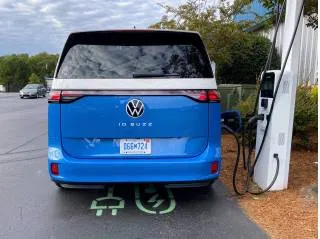
Charging capabilities are competitive with current industry standards. The ID.Buzz features an 11-kW onboard charger for Level 2 AC charging. For long-distance travel, it supports DC fast charging at rates of up to 200 kW. According to Volkswagen, this allows the battery to charge from 10% to 80% in approximately 26 minutes under ideal conditions. The vehicle also includes a battery preconditioning feature, which can be activated manually or automatically via the integrated navigation system when a charging stop is planned, ensuring optimal charging speeds upon arrival.
Market Positioning and Economic Implications
The primary challenge facing the ID.Buzz is its pricing structure. With a starting MSRP of $61,545 (including destination fees), the vehicle is positioned as a premium product rather than the "people’s car" its ancestor once was. Top-tier 1st Edition AWD models can exceed $71,000. When adjusted for inflation, the 1965 Microbus—which cost roughly $2,550—would be valued at approximately $25,400 today. By pricing the ID.Buzz at more than double that inflation-adjusted figure, Volkswagen has signaled that this is a niche, lifestyle-oriented vehicle rather than a high-volume budget van.

Furthermore, because the ID.Buzz is currently manufactured in Hanover, Germany, it does not qualify for the $7,500 federal EV tax credit for outright purchases under current U.S. law. However, consumers may be able to take advantage of this incentive through lease programs via a commercial clean vehicle credit "loophole."
Industry analysts suggest that the ID.Buzz occupies a unique market segment with very little direct competition. While the Kia EV9 offers three rows of electric seating, it adheres to a traditional SUV silhouette. The ID.Buzz, conversely, appeals to consumers who desire the utility of a minivan but reject the "soccer mom" stigma associated with the segment.
Conclusion and Future Outlook
The 2025 Volkswagen ID.Buzz is a bold experiment in brand equity and platform versatility. It successfully translates the emotional appeal of a classic icon into a sophisticated, albeit heavy, modern electric vehicle. While its high entry price and lack of domestic production may limit its volume in the short term, its role as a "halo" vehicle for the Volkswagen ID. sub-brand cannot be understated.
The success of the ID.Buzz will likely depend on whether the American public’s affection for the Microbus legacy is strong enough to overcome the practical hurdles of its premium price point and moderate range figures. As Volkswagen continues to expand its EV portfolio, the ID.Buzz stands as a testament to the idea that the transition to electric mobility does not have to come at the expense of character and heritage. Whether it remains a niche collector’s item or evolves into a staple of the American suburban landscape will be determined as the first units reach dealerships later this year.