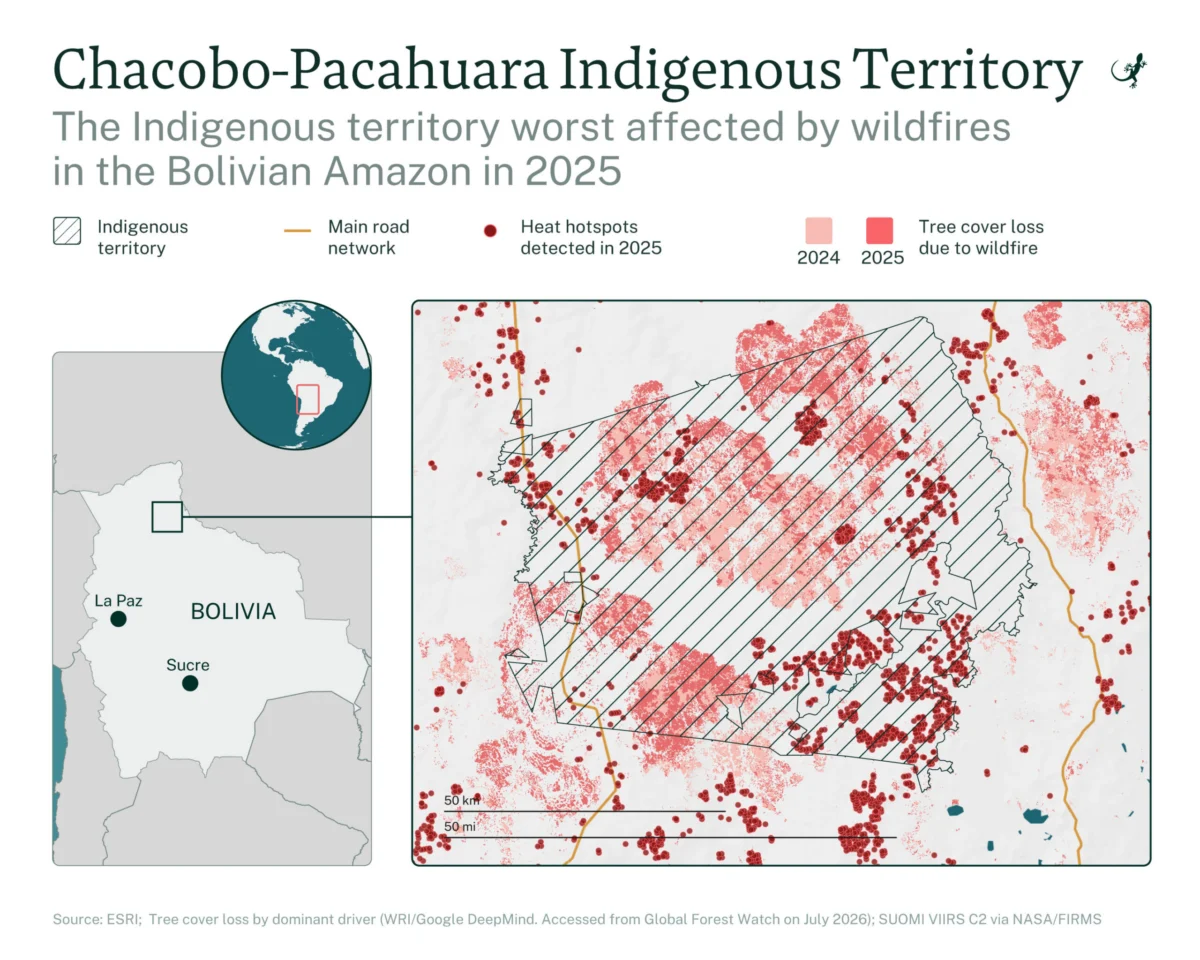
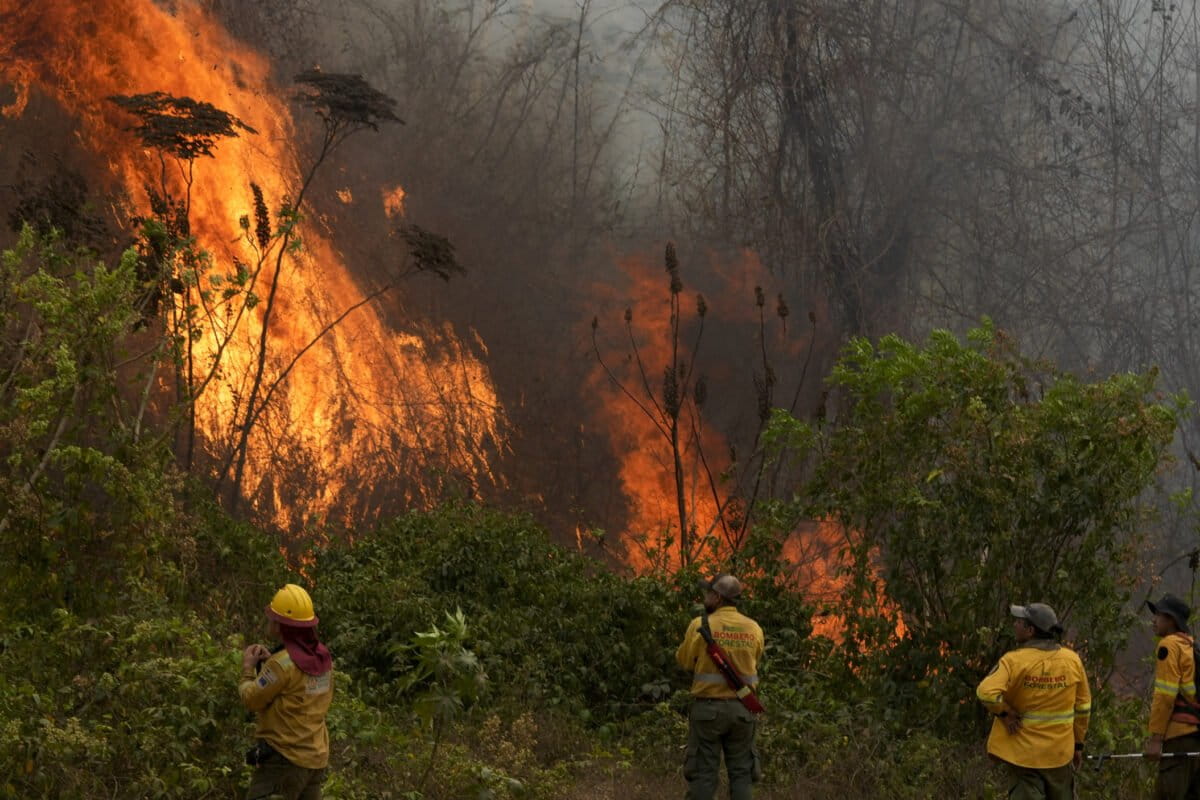
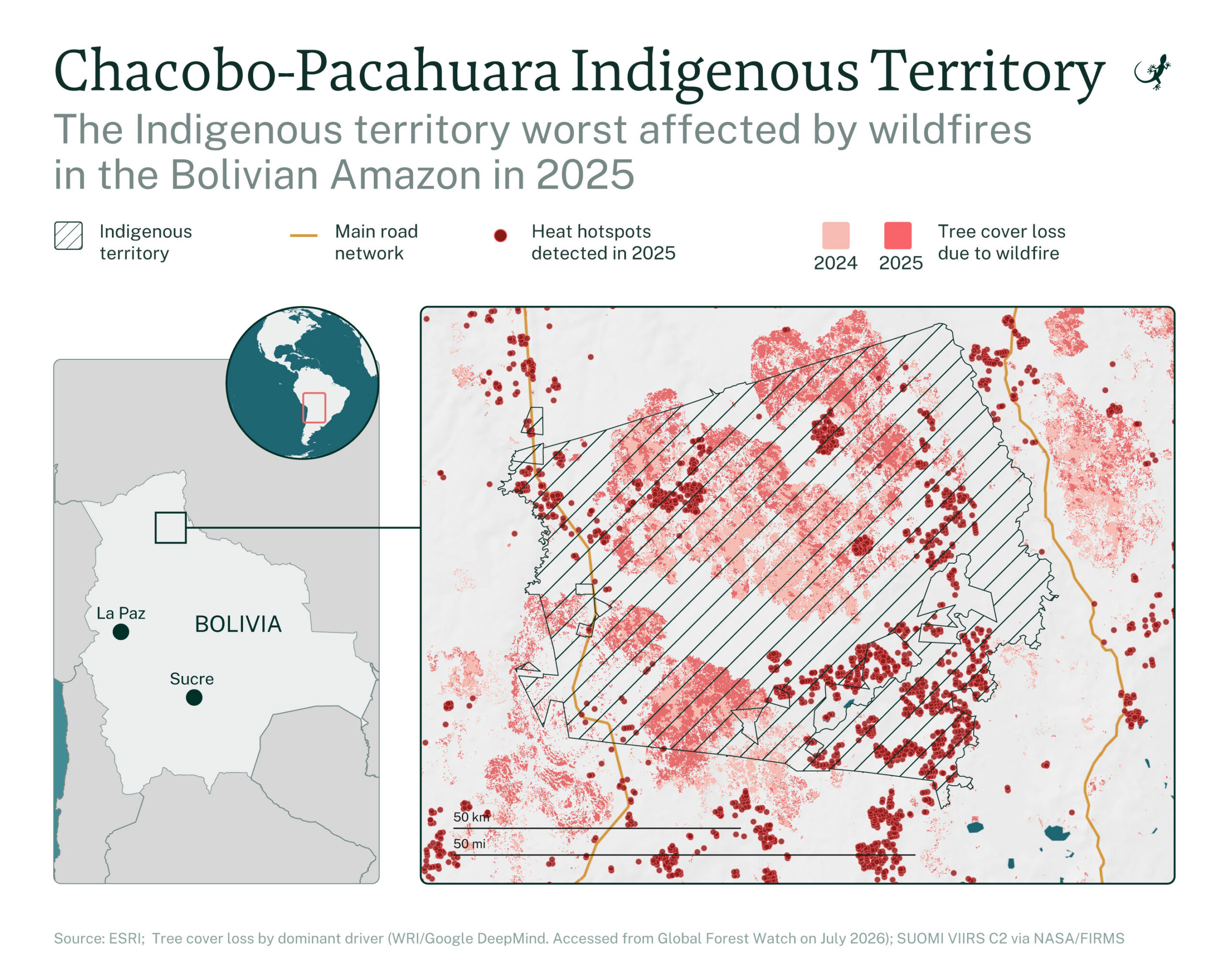
The Chacobo-Pacahuara Indigenous territory, located in the Beni department of northern Bolivia, has been pushed to the brink of an ecological and humanitarian catastrophe following a series of massive wildfires that have decimated thousands of hectares of primary forest and savanna. According to the latest satellite imagery and reports from community leaders on the ground, the fires, which intensified throughout September and October 2025, are the result of illegal "slash-and-burn" practices in cattle pastures surrounding the protected Indigenous land. This marks the third consecutive year that the territory has faced unusually high levels of fire activity, signaling a dangerous trend of environmental degradation and a systemic failure to protect one of the Amazon’s most vulnerable regions.
Data released by Global Forest Watch, an international platform that utilizes high-resolution satellite data to monitor forest loss, confirms that the fire activity in 2025 has surpassed previous records in terms of frequency and intensity. The flames have not only destroyed the local biodiversity but have also struck a direct blow to the livelihoods of the Chácobo and Pacahuara peoples, consuming subsistence crops and leveling family homes. Beyond the immediate physical destruction, there is a growing and desperate concern for the safety of Indigenous groups living in voluntary isolation within the territory, whose traditional habitats have been turned into ash.
The Human Cost and the Threat to Isolated Peoples
For the Indigenous communities of the Beni, the forest is not merely a landscape but a vital source of food, shelter, and cultural identity. Constantino Toledo Ortiz, a prominent leader of the Chácobo people, described the situation as a "serious ordeal" in a series of communications. He reported that the fires moved with such speed and ferocity that residents were unable to save their primary food sources. Subsistence fields, known locally as "chacos," which contained essential staples such as cassava, banana, corn, and rice, were completely incinerated.
"The forest provides our food," Ortiz stated, emphasizing the total loss of food security for his people. "The animals also burned. The monkeys, wild pigs, tapirs, and birds were burned." The loss of local wildlife represents a long-term blow to the community’s ability to hunt and sustain themselves, potentially leading to a nutritional crisis in the months to come.
Perhaps the most harrowing aspect of the 2025 fire season is the unknown fate of the Pacahuara people living in voluntary isolation. These groups shun contact with modern society and rely entirely on the deep forest and "forest islands"—elevated patches of woodland within the savanna—for survival. As these islands have been consumed by fire, Indigenous leaders fear the isolated groups have been forced to flee their ancestral lands. Ortiz suggested that they may have been driven across the border into Brazil in a desperate attempt to escape the smoke and flames, though without formal contact, their status remains a haunting mystery.
A Chronology of Escalating Destruction
The 2025 crisis is the culmination of a multi-year upward trend in fire alerts within the Chacobo-Pacahuara territory. Historically, the region maintained a stable and relatively low fire profile, with Indigenous land management practices preventing large-scale conflagrations. However, this stability broke down in 2023, and the situation has worsened exponentially since then.
- 2022: Fire activity was recorded within normal historical parameters, with satellite data showing minimal encroachment from surrounding agricultural zones.
- 2023: Fire alerts nearly doubled compared to the previous year. This spike was attributed to an intensifying El Niño cycle and the expansion of the agricultural frontier in the Beni department.
- 2024: A record-breaking year at the time, where the Center for Legal Studies and Social Research (CEJIS) reported that 47% of the territory—approximately 228,348 hectares (564,260 acres)—was burned between January and October.
- 2025: The current year has seen a further escalation. Between January 1 and September 12, CEJIS recorded 1,141 heat hotspots. This was followed by a sharp spike of 845 additional hotspots in just an 18-day window between September 29 and October 16, coinciding with the peak of the Amazonian dry season.
The rapid increase in hotspots during the latter half of 2025 aligns with the typical fire season in the Bolivian Amazon, which usually peaks in August and September. However, the sheer density of fires within the Chacobo-Pacahuara borders has made it the most affected Indigenous territory in the entire Bolivian Amazon this year.
Statistical Analysis and Environmental Impact
The Chacobo-Pacahuara territory spans approximately 485,260 hectares (1.2 million acres). The loss of nearly half of this land in 2024, followed by the intensive burning of 2025, suggests that a significant portion of the territory’s old-growth forest may be permanently altered. When tropical forests burn repeatedly, they lose their ability to regenerate, often transitioning into a degraded savanna state that is even more susceptible to future fires.
The 1,986 heat hotspots recorded through mid-October 2025 represent a critical density of fire that the local ecosystem cannot sustain. These hotspots are detected by MODIS and VIIRS satellite sensors, which identify thermal anomalies on the earth’s surface. In the context of the Beni, these anomalies almost exclusively represent active fires. The concentration of these fires along the borders of the territory supports the testimony of Indigenous leaders that the blazes are originating in external cattle pastures.
The ecological fallout extends to the global climate. The Amazon serves as one of the world’s most significant carbon sinks. The burning of the Chacobo-Pacahuara forests releases vast amounts of stored carbon dioxide into the atmosphere, contributing to the very warming cycles that make the dry seasons in Bolivia longer and more severe.
The Role of Illegal Agriculture and "Chaqueo"
The root cause of the devastation is widely identified as the "chaqueo" system—the practice of clearing land for agriculture or pasture through fire. While traditional small-scale chaqueo has been practiced for centuries, the current scale of burning is driven by large-scale cattle ranching interests.
In the Beni department, the expansion of the "frontier of production" has led to the clearing of land surrounding protected Indigenous territories. These fires are often set during the height of the dry season to clear scrubland for new grass. However, due to high winds and a lack of containment measures, these fires frequently jump the borders into Indigenous lands.
Under Bolivian law, there are specific regulations governing when and how fires can be set, and the Forest and Land Control and Social Authority (ABT) is tasked with issuing permits and penalizing illegal burns. However, Indigenous leaders and environmental advocates argue that enforcement is virtually non-existent in remote regions like the northern Beni. The "fire amnesties" and laws passed in recent years to encourage agricultural exports have, according to critics, created a culture of impunity for those who use fire to expand their holdings.
Lack of Official Response and Government Silence
Despite the scale of the emergency, the response from the Bolivian government and local authorities has been characterized by Indigenous leaders as negligent. Constantino Toledo Ortiz noted that while the impacts were reported to municipal leaders in Riberalta and the governor of the Beni department, no substantial assistance has been provided to the affected communities.
"We have not received any assistance," Ortiz stated, highlighting the isolation of Indigenous communities not just geographically, but politically. The lack of firefighting equipment, emergency food aid, and medical support for those suffering from smoke inhalation has left the Chácobo and Pacahuara to fend for themselves against a disaster they did not create.
Inquiries made to the Beni departmental government, the Riberalta municipal government, and the ABT have gone unanswered. This silence from official channels exacerbates the sense of abandonment felt by the Indigenous populations. Without government intervention to provide relief and, more importantly, to stop the illegal fires at their source, the cycle of destruction is expected to continue.
Broader Implications for Indigenous Sovereignty and Biodiversity
The crisis in the Chacobo-Pacahuara territory is a microcosm of a larger struggle across the Amazon basin. As global demand for beef and soy rises, the pressure on Indigenous lands increases. The burning of these territories is not just an environmental issue; it is a direct threat to the sovereignty and survival of Indigenous nations.

The Chácobo and Pacahuara are the recognized owners of their land, yet they find themselves unable to protect their borders from the external pressure of the agricultural industry. This raises significant questions regarding the effectiveness of Indigenous Land Titles (TCOs) in Bolivia if the state does not provide the legal and physical protection necessary to maintain them.
Furthermore, the potential displacement of isolated tribes into Brazil creates a cross-border human rights issue. Brazil and Bolivia share a responsibility to protect these "uncontacted" groups under international law, yet the destruction of their habitat continues unabated.
As the 2025 fire season draws to a close, the focus turns to the long-term recovery of the Beni. Without a fundamental shift in how the Bolivian state manages its agricultural expansion and a renewed commitment to enforcing environmental laws, the Chacobo-Pacahuara territory remains at risk of becoming a permanent casualty of the "fire frontier." The international community, satellite monitoring agencies, and human rights organizations continue to watch the region, but for the Chácobo and Pacahuara, the damage already done may take generations to heal.