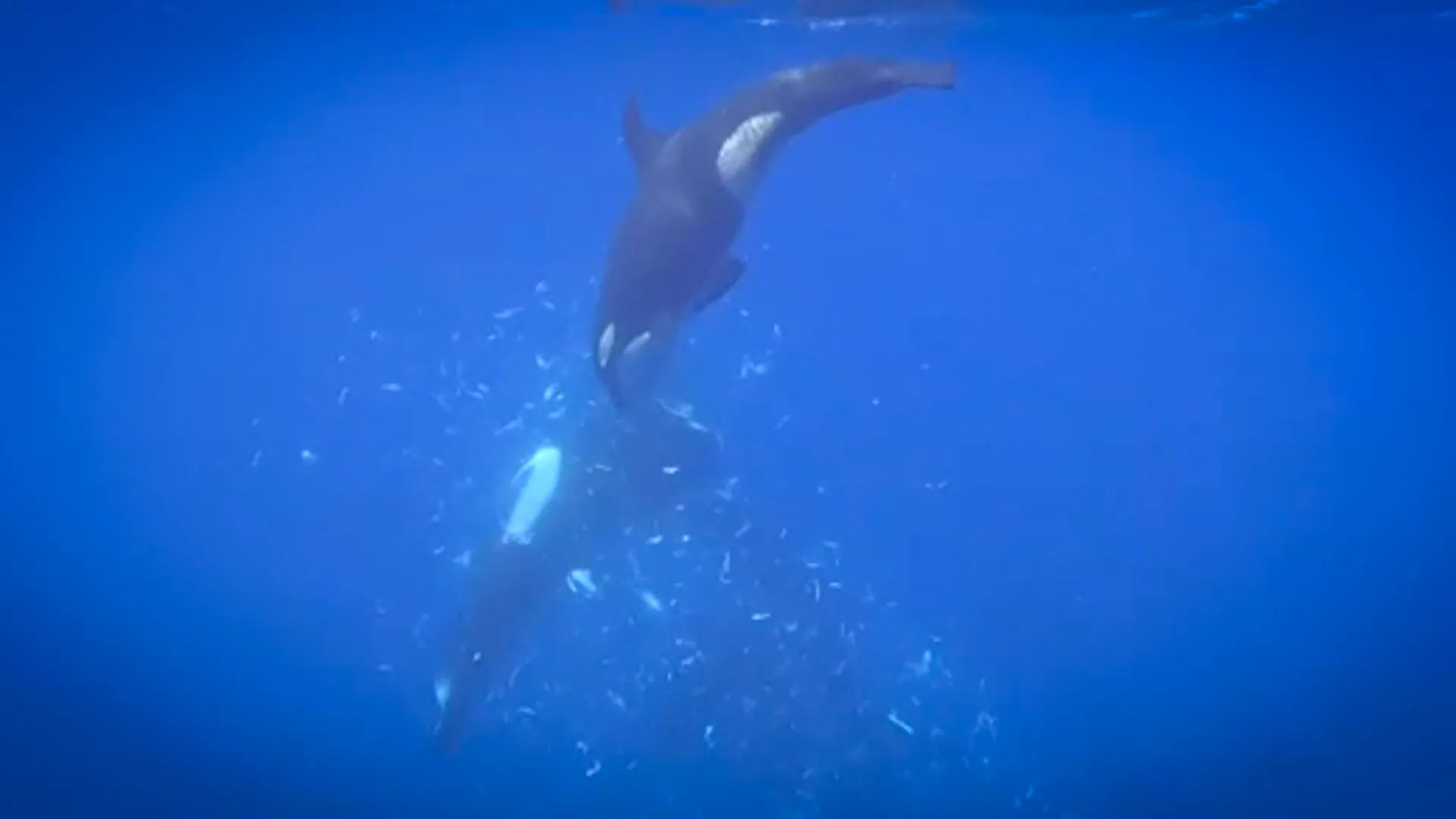
In a groundbreaking discovery shedding new light on the sophisticated hunting strategies of apex predators, researchers in the Gulf of California have documented a never-before-observed behavior among orcas: the deliberate high-speed ramming of prey to break it apart. This remarkable feeding technique, detailed in a recent publication in the journal Frontiers in Ethology, showcases the remarkable intelligence and adaptability of these marine mammals, revealing a complex method of food processing that may serve multiple purposes, from facilitating easier consumption for younger individuals to potentially offering symbiotic benefits.
The study, spearheaded by Dr. Kathryn Ayres, a scientist at the non-profit organization Beneath The Waves, which champions ocean health, meticulously describes how one orca holds a sunfish carcass, releasing it moments before another orca delivers a high-speed impact. This forceful collision causes the sunfish’s flesh to shatter into thousands of minute fragments. "We document how one orca holds the sunfish and lets go just before another orca hits it at high speed, causing the tissue to break apart into thousands of pieces," stated Dr. Ayres, the lead author of the study. "We think this may help younger orcas feed more easily or it could also just be for fun. Orcas are known for playing with their food." This observation adds a significant new dimension to our understanding of orca predation, extending beyond mere physical force to intricate coordinated actions aimed at optimizing prey consumption.
A Glimpse into a Predatory Innovation
The events that led to this significant scientific revelation unfolded over a period of just over a year in the nutrient-rich waters of the Gulf of California, a region known for its diverse marine life and frequent orca activity. Sunfish, scientifically known as Molidae, are among the largest and most formidable bony fish in the ocean, with some species exceeding three meters in length and weighing up to 2,000 kilograms. Despite their immense size, these pelagic giants are known to ascend to the ocean’s surface for various reasons, including thermoregulation, resting periods, or to have ectoparasites removed by smaller fish. This behavior, unfortunately, renders them vulnerable to predation by the ocean’s most intelligent predators.
Within the Gulf of California, sunfish represent a frequently targeted food source for orca populations. The newly documented ramming behavior was observed during two distinct encounters, providing researchers with compelling evidence of its consistent application.
The initial observation occurred in July 2024. Dr. Ayres and her team were observing a pod of orcas, which included a juvenile, interacting with a deceased sharp-tail sunfish that they had already managed to kill. The dynamics of the interaction were striking: a female orca secured a firm grip on the sunfish’s large tail fin, a maneuver that provided a stable anchor. Concurrently, a male orca, positioned nearby, began to accelerate, building momentum for a powerful charge.
As the male orca approached at high velocity, the female orca released her hold on the sunfish. The sheer force of the collision, delivered with pinpoint accuracy, caused the sunfish’s tissues to rupture and disperse into countless fragments that drifted through the surrounding water column. The juvenile orca then readily consumed the smaller pieces, while the adult orcas focused on the remaining larger portions of the carcass, leaving the scattered fragments behind. This intricate sequence highlights a deliberate and coordinated effort within the pod.
A second, corroborating incident was captured on film by Héctor Franz in September 2025. This footage mirrored the exact sequence of events: the deliberate holding of the prey, the precise release, the high-speed ramming, and the subsequent feeding. The consistent nature of these observations across two separate instances, separated by more than a year, strongly suggests that this is not an isolated or accidental occurrence but rather a learned and replicated predatory strategy.
Deciphering the Purpose: More Than Just a Meal?
Researchers are analyzing the multifaceted implications of this newly identified food processing strategy. The forceful impacts clearly serve to break down the sunfish’s considerable mass. While ramming is a known tactic in some predator-prey interactions, its specific application as a method for processing prey, rather than solely for subduing it, has not been previously documented in orcas.
In both observed instances, the coordinated effort was evident. The act of one orca stabilizing the carcass enabled the other to execute the ramming attack with enhanced precision. Given that the sunfish were already deceased, the researchers posit that these impacts were primarily employed to prepare the prey for consumption, rather than to kill it.
Sunfish possess a unique outer layer, known as a capsule, which is rich in diverse microbial communities. Both this gelatinous layer and the overlying skin host a distinct microbiome. The fragmentation of the sunfish’s tissues through ramming would invariably lead to the widespread dispersal of these microbial taxa into the surrounding seawater. This dispersal has the potential to significantly alter the local nutrient composition of the water.
This fragmentation phenomenon could also foster increased interaction between the sunfish’s microbiome and the orcas’ own gut microbiota. Scientists hypothesize that such cross-microbial exposure might confer nutritional advantages, potentially aiding in nutrient absorption or even contributing to immune regulation within the orcas. This concept aligns with ongoing research into the complex symbiotic relationships between marine animals and their microbial inhabitants.
A Boon for Young Orcas: Facilitating Feeding and Development
One of the most compelling hypotheses regarding this behavior is its role as a form of parental investment. By breaking down the large sunfish carcass into smaller, more manageable pieces, the orcas effectively make it easier for their calves and juveniles to feed. This interpretation is consistent with a wealth of previously documented orca behaviors, which often involve cooperative hunting and prey sharing.
"Orcas often tear apart prey and share it with other members of the group, including calves and juveniles," Dr. Ayres explained. This act of providing pre-processed food ensures that younger orcas, who may not yet possess the full hunting prowess of adults, can still access vital nutrition.
However, the researchers are careful not to limit the explanation solely to feeding efficiency. The interactions could also hold significant social functions. The act of coordinated hunting and prey manipulation might serve as an opportunity for social bonding within the pod, reinforcing group cohesion. Furthermore, given the known playful nature of orcas, it is also plausible that these energetic displays are, at least in part, a form of recreation or play. Orcas are renowned for their intelligence and complex social structures, and such behaviors often serve multiple purposes simultaneously.
Unraveling the Secrets of the Sharp-Tail Sunfish
The discovery of this ramming technique may also offer intriguing insights into the specific characteristics of the sharp-tail sunfish (Masturus lanceolatus). To date, this particular form of tissue fragmentation in response to forceful impacts has only been observed in this species.
The researchers propose that the tissue composition of the sharp-tail sunfish may respond to powerful collisions in a uniquely distinctive manner. In contrast, larger sunfish species, such as the ocean sunfish (Mola mola), might possess a more robust or resilient tissue structure, making them less susceptible to breaking apart so readily under similar conditions. Further comparative studies on the tissue properties of different sunfish species could shed more light on this aspect.
Future Research and Identification Challenges
A critical question that remains unanswered is whether the same pod of orcas was involved in both observed events. Identifying individual orcas is crucial for tracking behavior patterns and understanding social dynamics. This identification relies heavily on high-quality photographic evidence, particularly clear images of dorsal fins and distinctive eye patches, which serve as unique identifiers.
"Collecting good identification photographs whenever possible is key: we are still seeing new techniques of how orcas hunt and process their prey," Dr. Ayres emphasized. "They’re one of the most iconic marine predators in the world, yet they continue to surprise us." The challenges of obtaining such detailed imagery in the open ocean are considerable, but vital for advancing our knowledge of these elusive and intelligent creatures.
Broader Implications for Marine Ecology and Conservation
The documentation of this novel orca hunting strategy has far-reaching implications. It underscores the dynamic and evolving nature of predator-prey relationships in marine ecosystems. As environmental conditions shift, apex predators like orcas demonstrate remarkable plasticity in their hunting methods, adapting to exploit available resources efficiently.
This discovery also highlights the importance of continued research in under-explored regions like the Gulf of California, which serves as a crucial habitat for numerous marine species, including migratory whales and dolphins. Understanding the intricate ecological interactions within these environments is paramount for effective conservation efforts.
Furthermore, the potential link between prey fragmentation and microbial exchange opens new avenues for research into marine animal health and nutrition. The complex interplay between diet, gut microbiota, and overall well-being is a growing field of study, and this orca behavior could provide a unique model for investigating these relationships in a natural setting.
The continued observation of such sophisticated behaviors in orcas reinforces their status as keystone species, playing a vital role in maintaining the health and balance of marine food webs. As our understanding of their intelligence and behavioral repertoire expands, so too does our appreciation for the need to protect their habitats and ensure the continued survival of these magnificent creatures. The Gulf of California, with its rich biodiversity and ongoing scientific discoveries, serves as a powerful reminder of the vast mysteries that still lie beneath the ocean’s surface.