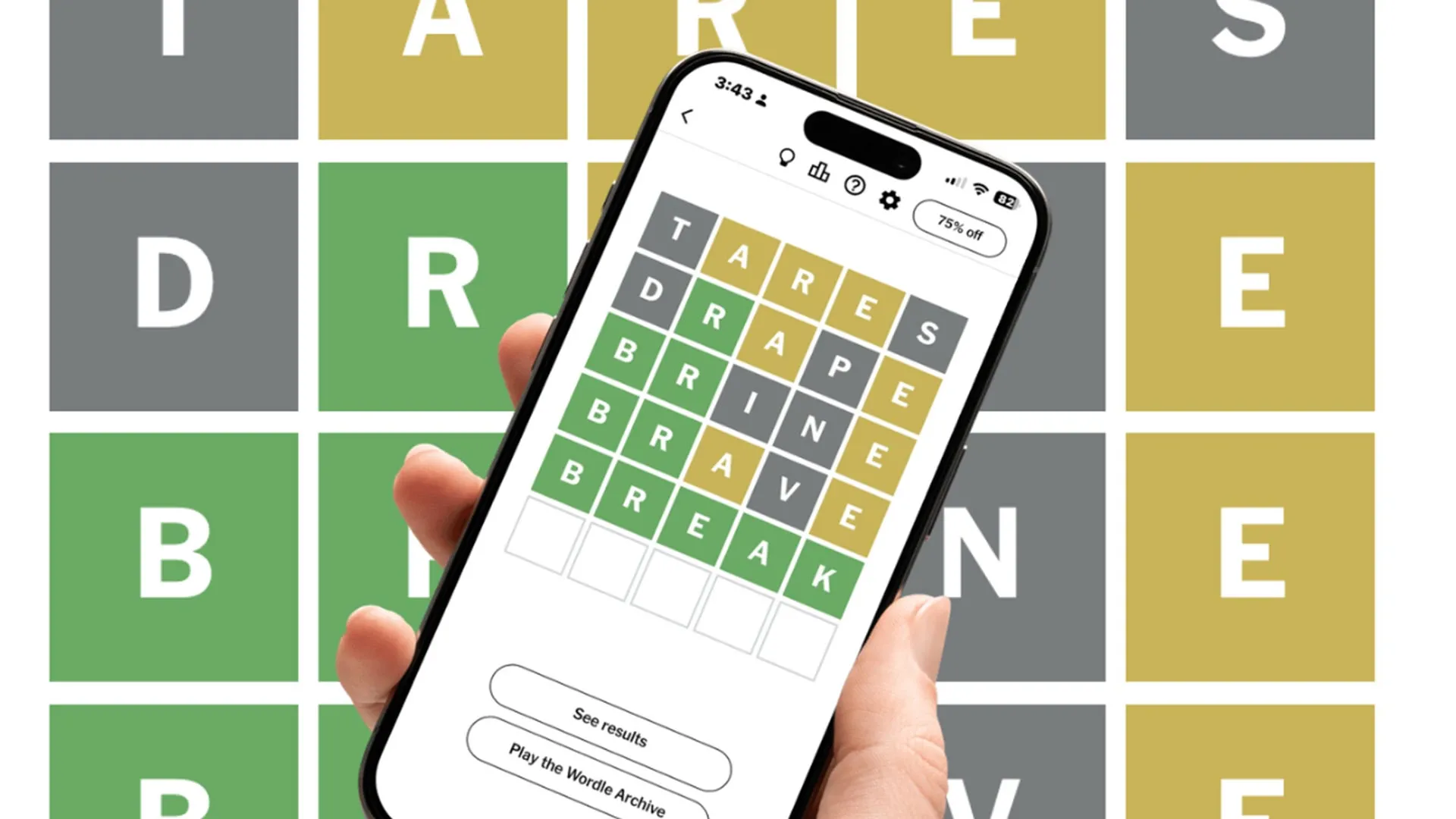
Millions of people around the world log on each day to face the same digital challenge: a minimalist interface featuring a grid of empty squares and the daunting task of identifying a secret five-letter word within six attempts. While the game, known as Wordle, has become a global cultural phenomenon, its mechanics have recently caught the attention of academic researchers. A team at Binghamton University, State University of New York, has successfully demonstrated that human intuition is no match for the rigor of information theory. By applying mathematical frameworks, the researchers developed an algorithmic strategy capable of solving 99% of all possible Wordle puzzles in simulated environments, fundamentally changing how we understand the process of deductive reasoning in games of chance and skill.
The research, led by Assistant Professor Congyu "Peter" Wu of the Thomas J. Watson College of Engineering and Applied Science, represents a sophisticated marriage between recreational gaming and formal systems science. The team’s findings, published in the Northeast Journal of Complex Systems, move beyond the standard heuristic of guessing common letters, suggesting that the path to victory lies in maximizing the reduction of uncertainty rather than chasing the answer itself.
The Origins of the Wordle Phenomenon
To understand the magnitude of this breakthrough, one must look at the game’s rapid ascent. Created by software engineer Josh Wardle, the game was initially developed as a gift for his partner before being released to the public in late 2021. Its simplicity—a single daily puzzle, no intrusive advertisements, and an easily shareable grid of colored squares—propelled it into the mainstream. The New York Times acquired the game in early 2022, cementing its status as a staple of digital culture.
Despite the game’s simplicity, it presents a complex combinatorial problem. With thousands of possible words in the English dictionary and millions of possible combinations, the game forces players to navigate a "search space." Traditional players often rely on "frequency lists," prioritizing letters like E, A, R, I, and O. While this strategy is effective for casual play, it lacks the mathematical efficiency required to guarantee success in the most difficult scenarios.
Decoding the Strategy: The Role of Shannon Entropy
The Binghamton University team shifted the paradigm by utilizing Shannon entropy, a foundational concept in information theory named after Claude Shannon. Shannon entropy serves as a measure of the unpredictability or "uncertainty" of a random variable. In the context of Wordle, the researchers treated every guess as an information-gathering operation.
"The goal is not to guess the word, but to harvest the most information," explained Donald Stephens, a doctoral student and co-author of the study. This represents a radical departure from the human tendency to prioritize "correctness." A player might be tempted to guess a word that they believe is the actual answer; however, the Binghamton strategy suggests that a word with a near-zero probability of being the solution may be the superior choice if it effectively splits the remaining pool of possibilities into smaller, more manageable subsets.
In technical terms, the researchers programmed an algorithm to calculate the expected information gain for every potential guess. By analyzing the color-coded feedback—green for correct placement, yellow for correct letter but wrong placement, and gray for incorrect—the model eliminates a massive percentage of the remaining candidate words. This process, often referred to in computing as a "binary search" or "decision tree optimization," ensures that by the second or third guess, the candidate pool is reduced to such a narrow margin that the final solution becomes statistically inevitable.
Chronology of the Research Project
The project did not begin in a high-stakes laboratory, but rather in a classroom at Binghamton University. During a systems science course, Assistant Professor Wu challenged his students to find a real-world application for information theory. The choice of Wordle was intentional, as it provided a controlled environment where the variables were limited and the feedback loop was immediate.
- Phase 1 (Academic Inception): Students were tasked with modeling the game’s mechanics using information theory as a framework for decision-making under uncertainty.
- Phase 2 (Simulation Development): The team built a simulation environment that mirrored the Wordle dictionary, allowing them to run thousands of test games to determine the "information gain" of various word sequences.
- Phase 3 (Strategy Refinement): Researchers compared the "Shannon entropy" approach against standard strategies, such as the "common letter" method, documenting the failure rates of each.
- Phase 4 (Validation and Publication): After confirming a 99% success rate in simulations, the team compiled their data and peer-reviewed methodology for publication in the Northeast Journal of Complex Systems.
Data-Driven Comparisons: Entropy vs. Intuition
The performance gap between the Binghamton strategy and conventional play is stark. In controlled simulations, the "Common Letter Strategy"—which emphasizes guessing words like "ARISE" or "STARE" to capture the most frequent vowels and consonants—achieved a success rate of approximately 90%. While respectable, this leaves a 10% failure rate, which is significant given the game’s strict limit of six guesses.
The Information Theory approach, however, pushed that success rate to 99%. The 9% difference in performance represents a massive reduction in the probability of failure. The data suggests that as the game progresses, the "entropy-maximized" strategy becomes exponentially more efficient at identifying the target word, as it accounts for the conditional probability of each letter’s position. Essentially, the computer is not just looking for letters; it is looking for the most efficient way to carve up the remaining lexicon.
The Human Element and Practical Implications
Critics might argue that using an algorithm to solve a word puzzle removes the "fun" of the game. However, the researchers emphasize that the project was never intended to ruin the user experience. Instead, it serves as a powerful demonstration of how abstract mathematical principles can be applied to practical, everyday problems.
"The courses here don’t just teach concepts; they push you to apply them in ways that have real, lasting impact," said Talal Aladaileh, a co-author of the paper. For students in the School of Systems Science and Industrial Engineering, the project served as a bridge between theoretical mathematics and engineering practice. By transforming a static measurement like Shannon entropy into a dynamic, interactive decision-making tool, the team demonstrated a level of ingenuity that extends beyond gaming.
From an industry perspective, the implications are vast. The same principles used to solve Wordle—optimizing decision-making under uncertainty—are currently being applied in fields ranging from logistics and supply chain management to artificial intelligence and cybersecurity. If a computer can "solve" the uncertainty of a five-letter word puzzle, the same logic can be applied to identifying bottlenecks in a manufacturing process or detecting patterns in large-scale data breaches.
Analysis of the Mathematical Shift
The success of the Binghamton study highlights a shift in how we approach problem-solving in the digital age. We have moved from an era of "brute force" computing to one of "intelligent optimization." The researchers proved that the most efficient solution is rarely the most obvious one. By prioritizing the "value of information" over the "probability of success," the team created a blueprint for navigating systems where information is incomplete or obscured.
This research also provides a fascinating look at the limitations of human cognition. Humans are prone to confirmation bias and are often overly focused on immediate gratification. When playing Wordle, a human player wants to see green squares as soon as possible. The algorithm, by contrast, is perfectly comfortable with gray squares, provided those gray squares offer the vital information required to narrow the search. It is a lesson in patience and long-term strategy: sometimes, to move forward, one must be willing to make a move that looks wrong in the short term to guarantee the correct result in the long term.
Broader Academic and Professional Impact
The publication of "Solving Wordle Using Information Theory" has garnered attention for its clarity and its ability to demystify complex systems theory for a general audience. The faculty and students involved have been praised for their ability to turn a classroom exercise into a rigorous, peer-reviewed contribution to the field of complex systems.
As AI and automated decision-making systems become more integrated into the global economy, the ability to effectively measure and utilize information becomes a critical skill. The Binghamton University team has successfully shown that whether you are playing a daily word game or managing a global logistical network, the underlying mathematics of uncertainty remains the same. The transition from a "classroom project" to a "published research paper" serves as a testament to the rigorous training provided by the Watson College, and it signals a promising trend in academic research: taking the small, seemingly trivial problems of our daily lives and using them as a lens to view the vast, complex machinery of the mathematical world.
In conclusion, the Wordle puzzle has provided more than just entertainment; it has provided a sandbox for intellectual discovery. The Binghamton University team’s 99% solution is not merely a "cheat code" for a game, but a profound demonstration of how information theory can optimize our decision-making, reduce our uncertainty, and lead us, with mathematical precision, to the right answer.