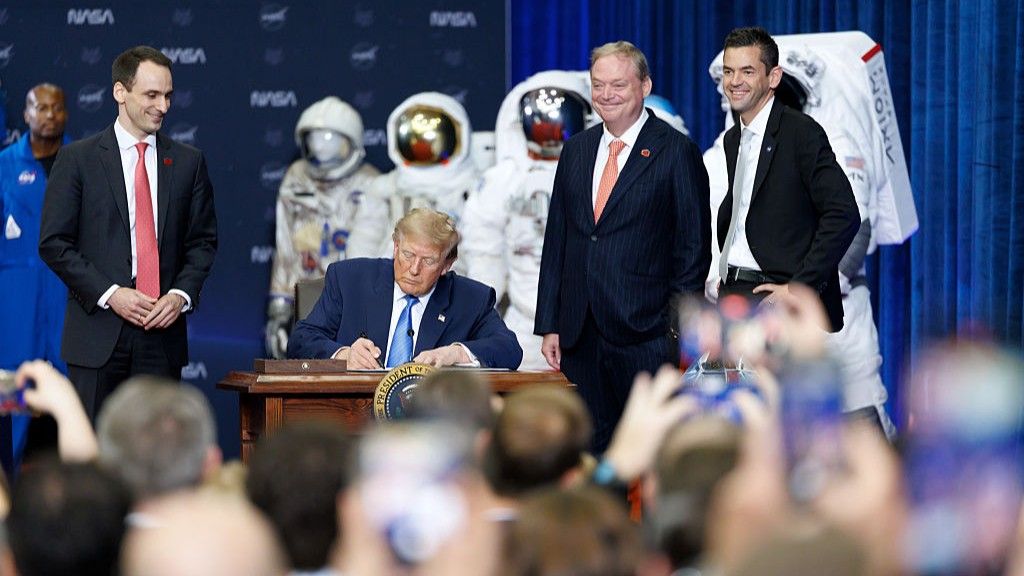
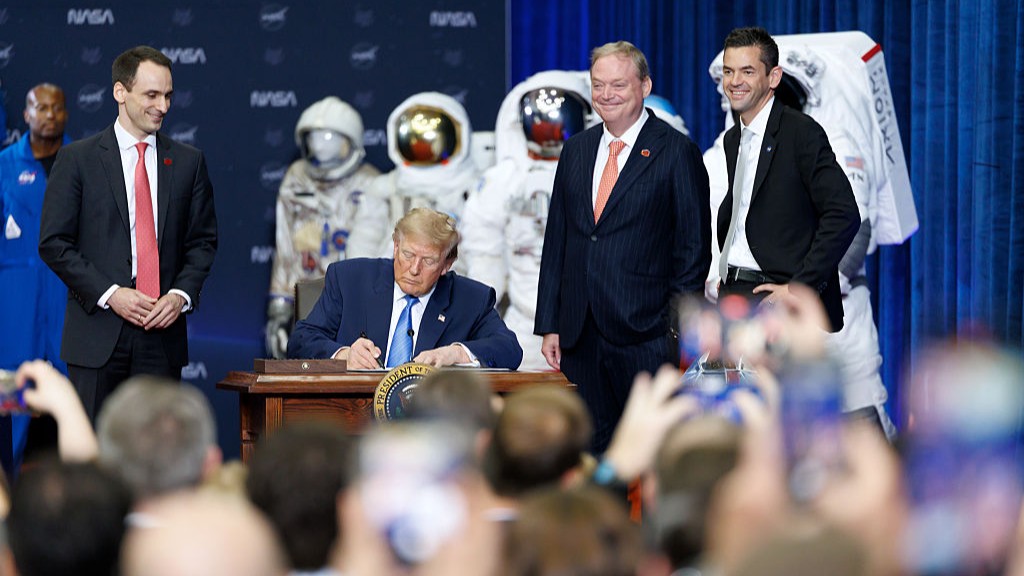
The landscape of American space policy entered a new phase of debate when President Donald Trump signed an executive order directing the creation of a United States Space Academy. Announced during a high-profile visit to NASA’s Johnson Space Center in Houston, Texas, the initiative aims to establish a specialized institution patterned after traditional military service academies like West Point, the U.S. Naval Academy, and the U.S. Air Force Academy. However, unlike its historical counterparts, this proposed academy is envisioned primarily as a NASA-led federal institution designed to train a professional corps of leaders for both civil space exploration and national security needs.
The proposal immediately ignited widespread discussion among space policy experts, former government officials, and lawmakers. At the heart of the debate is a fundamental question that has defined American space governance for more than six decades: how to balance and separate civilian space activities from military operations. While proponents argue that an elite training institution is necessary to meet the escalating demands of a rapidly expanding multi-sector space economy, critics point to profound ambiguities regarding funding, legal authority, and institutional identity.
Chronology and Evolution of U.S. Space Governance
To understand the weight of the current proposal, it is necessary to examine the evolution of United States space policy. Since the dawn of the space age in the late 1950s, American strategy has maintained a distinct firewall between civil and military space programs. Following the launch of Sputnik by the Soviet Union, the Eisenhower administration and Congress recognized the need to project peaceful intentions alongside defense capabilities.
This dual-track approach was institutionalized with the National Aeronautics and Space Act of 1958, which created NASA as a civilian agency dedicated to peaceful space exploration, scientific discovery, and aeronautics research. National security space activities, meanwhile, remained under the purview of the Department of Defense and the intelligence community. While this boundary has experienced moments of overlap—such as military astronauts flying on early space shuttle missions and joint defense-civilian technology transfers—the foundational separation has remained largely intact.
The landscape shifted significantly during Trump’s first term in office. In 2017, the administration formally established the Artemis program, designed to return American astronauts to the lunar surface and establish a sustainable presence on the Moon. Shortly thereafter, the administration championed the creation of an entirely new branch of the armed forces dedicated to operations beyond the atmosphere. This vision materialized in December 2019 with the signing of the National Defense Authorization Act, which officially birthed the United States Space Force—the first new branch of the U.S. Armed Forces since 1947.
Building upon this legacy during his second term, the administration’s executive order on the Space Academy represents a bridge between these traditionally separate domains, proposing an educational pipeline that serves both the military and civilian sectors.
The Mechanics of the Executive Order
Rather than instantaneously establishing a fully operational university, the executive order signed in Houston initiates a formal exploratory phase. It establishes a high-level presidential commission charged with studying the feasibility, curriculum, structural requirements, and legal framework of a U.S. Space Academy.
The commission is led by NASA Administrator Jared Isaacman, bringing a perspective rooted in modern commercial and private spaceflight experience. The panel also includes critical national security and budgetary stakeholders, notably the Secretary of Defense, the National Security Advisor, and the Director of the Office of Management and Budget. The commission has been given a 120-day window to deliver a comprehensive feasibility report to the White House.
According to administration statements, the proposed academy would "develop a professional corps of civically grounded leaders prepared to advance American interests within the space domain." It is intended to feed talent not only into the United States Space Force and NASA but also into the burgeoning commercial aerospace industry, which has grown exponentially over the past decade through public-private partnerships and private sector innovation.
Key Questions and Institutional Challenges
Despite the grand vision articulated by the administration, the proposal raises numerous operational and structural questions that the newly formed commission must address.
First and foremost is the inherent contradiction regarding the academy’s governance and institutional alignment. While the executive order describes the institution as NASA-led—making it the first non-military federal service academy of its kind—the administration’s public rhetoric frequently invokes traditional military models. Comparisons to West Point and justifications tied to the needs of the Space Force have generated confusion across Capitol Hill and within the aerospace community. Former NASA officials and members of Congress have questioned how an ostensibly civilian agency like NASA can manage an institution that trains military personnel without compromising its peaceful, scientific mandate.
Second, the question of curriculum remains entirely open. Military academies combine rigorous undergraduate academic degrees in engineering or social sciences with mandatory military training, officer commissioning, and post-graduation active-duty service obligations. It remains unclear what balance the U.S. Space Academy would strike. Would students be required to serve in the Space Force upon graduation, or would they have the flexibility to enter the civil service or the private sector? If military service is compulsory for all graduates, the institution would effectively function as a de facto military academy, further eroding the historical division between civil and defense sectors.
Third, budgetary hurdles present a formidable barrier. Establishing a federal service academy requires significant legislative action by Congress, which holds the constitutional power of the purse and is responsible for authorizing and funding new federal entities. While exact annual operating budgets for existing military academies are difficult to isolate precisely within defense appropriations, congressional estimates generally place the cost of running a single service academy at approximately $1 billion per year.
Creating a brand-new campus with specialized laboratories, flight simulators, and advanced research facilities would require substantial upfront capital investment. Furthermore, while the Department of Defense maintains mandatory baseline funding, NASA’s budget is discretionary and historically vulnerable to fiscal tightening and shifting political priorities. Funding a multi-billion-dollar academy through NASA’s budget could introduce severe resource strains on the agency’s core scientific missions, planetary exploration programs, and aeronautics research.
Broader Implications and Strategic Analysis
The debate over the U.S. Space Academy touches upon broader geopolitical and domestic implications. Proponents argue that the rapid acceleration of space activities demands a specialized educational pipeline. Today, low Earth orbit is crowded with thousands of commercial satellites, such as SpaceX’s Starlink constellation, providing global internet connectivity. Meanwhile, critical infrastructure—including financial markets, global positioning systems (GPS), weather forecasting, and power grids—relies entirely on space-based assets. Educating a new generation of engineers, scientists, and spacecraft operators who understand the complexities of orbital mechanics, policy, and operations is viewed by supporters as an urgent national priority.
However, international relations and security experts warn that blurring the lines between civil and military space programs could carry diplomatic risks. As geopolitical competition in Earth orbit and cislunar space intensifies between the United States and global rivals like China and Russia, maintaining transparent intentions is vital. Activities explicitly categorized as civilian and scientific—such as lunar exploration and Earth science—carry different legal and diplomatic connotations under international space law than national security and defense operations.
If the United States trains its civilian and military space leaders in the same institutional melting pot, foreign adversaries may increasingly view all U.S. space endeavors through a security lens. This perception could accelerate a security dilemma in orbit, increasing the risk of miscalculation, escalation, or hostile countermeasures in an environment already growing tense.
Path Forward
As Jared Isaacman and the newly formed presidential commission begin their 120-day evaluation, the proposal for a United States Space Academy remains an intriguing yet highly contentious concept. Whether the commission can successfully reconcile the competing demands of civilian exploration, commercial innovation, and national defense—while securing the necessary statutory approval and funding from a divided Congress—remains to be seen.
For now, the initiative has successfully reopened a vital national conversation about the future architecture of American space leadership. Whether the resulting institution resembles the fictional Starfleet Academy of science fiction lore or struggles under the practical realities of federal bureaucracy and inter-agency friction will depend heavily on the findings and recommendations delivered to the White House in the months ahead.