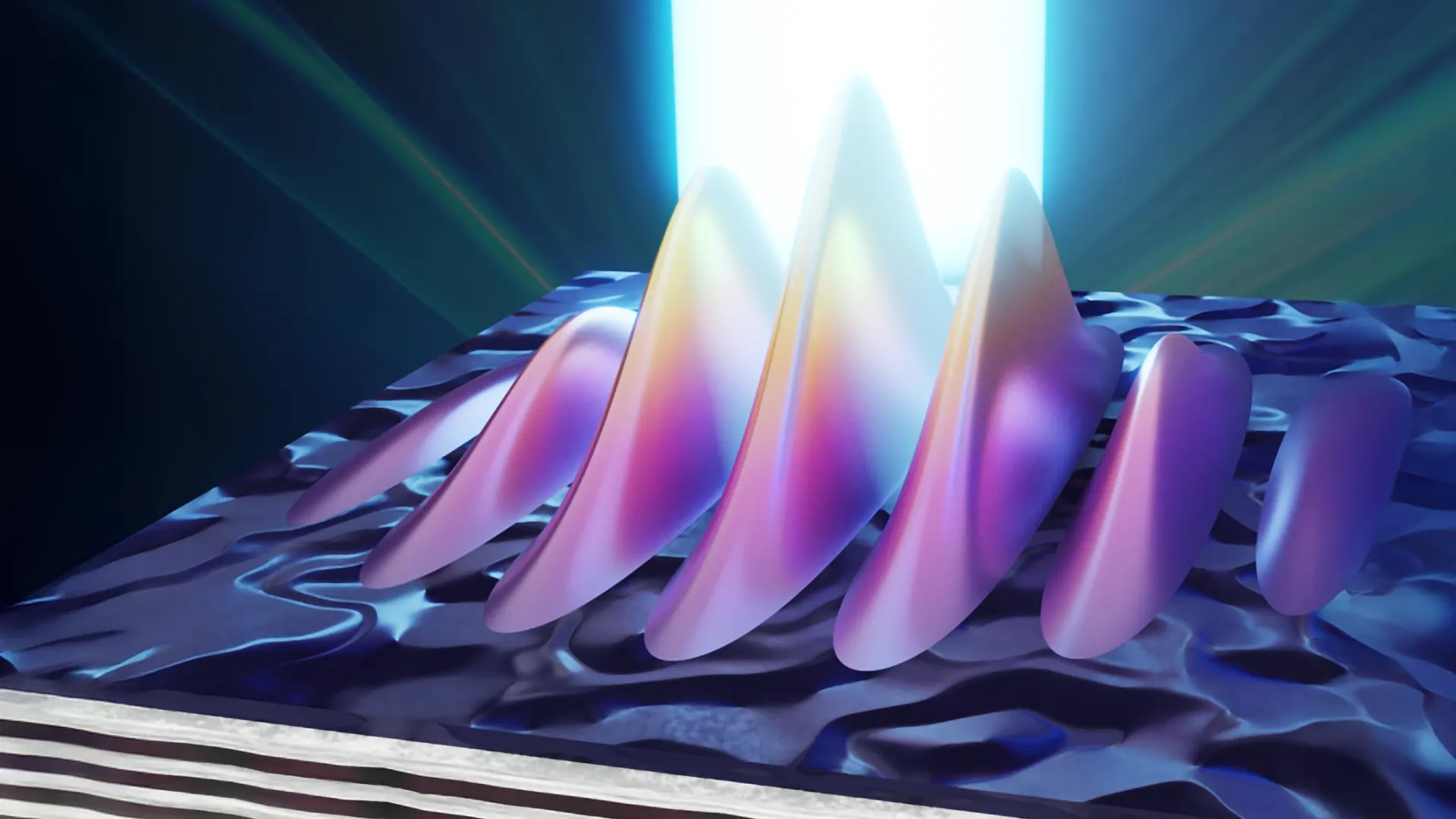
The research team, comprising experts from the Faculty of Physics at the University of Warsaw, the Military University of Technology in Poland, IBM Research Zurich, and the French National Centre for Scientific Research (CNRS), has effectively unlocked a new domain of quantum engineering. By utilizing light-matter coupling within a specialized microcavity, the scientists have demonstrated that exotic quantum phenomena are not exclusively reserved for deep-freeze laboratory environments, but can be induced and controlled at temperatures reaching as high as 60 degrees Celsius (140 degrees Fahrenheit).
The Historical Quest for Supersolidity
The concept of the supersolid originated in the 1960s, a decade defined by rapid advancements in the understanding of quantum fluids. Physicists such as Eugene Gross, T.M. Rice, and others theorized that if a superfluid—a liquid capable of flowing without viscosity—could spontaneously break spatial symmetry and develop a periodic structure, it would become a supersolid. For decades, this state remained a purely theoretical curiosity, as the physical requirements to force particles into such a configuration were deemed unattainable.
The first experimental confirmation of supersolidity did not occur until 2017, when researchers successfully observed the phenomenon in ultracold atomic Bose-Einstein condensates (BECs). In these experiments, atoms are cooled to temperatures within billionths of a degree above absolute zero. At these extremes, individual atoms lose their separate identities and merge into a single collective quantum state. While successful, these platforms were notoriously difficult to scale, requiring massive dilution refrigerators and complex laser-trapping arrays that made practical, real-world application virtually impossible.
Bridging Light and Matter: The Exciton-Polariton Breakthrough
The international TopoLight consortium chose to circumvent the thermal limitations of atomic physics by shifting their focus to quasiparticles known as exciton-polaritons. These particles are not fundamental; they are "hybrid" entities formed when photons (light particles) and excitons (electron-hole pairs in a semiconductor) interact within an optical microcavity. Because they are part light, these quasiparticles possess an incredibly small effective mass compared to atoms, which allows for the formation of quantum condensates at much higher temperatures.
The experimental setup involved a sophisticated optical microcavity layered with a specially engineered liquid crystal and an organic semiconductor, MeLPPP (methyl-substituted ladder-type poly(paraphenylene)). This material stack was developed through a collaborative effort between the Military University of Technology, which designed the liquid-crystal structures, and IBM Research Zurich, which provided the expertise in organic semiconductor integration.
The interaction between the light trapped within the microcavity and the semiconductor substrate creates a dense, rapidly evolving quantum fluid. Despite the fleeting lifespan of exciton-polaritons—which persist for only a few picoseconds—the researchers were able to capture evidence of a transition into the supersolid phase.
Chronology of the Experimental Challenge
The execution of this experiment was a race against time. Because the organic semiconductors used in the microcavities were chemically reactive with the liquid crystal layers, the lifespan of each fabricated sample was measured in hours. This necessitated a rigorous, pre-planned protocol.
- Fabrication (Month 1-3): Photonic structures and semiconductor layers were engineered and deposited at IBM Research Zurich and the Military University of Technology.
- Integration (Week 4): The components were assembled into the microcavity device.
- Measurement Window (4-6 hours): Upon final assembly, the sample was placed under an optical pump laser. The research team had to execute the full suite of diagnostic measurements before the chemical degradation of the interface rendered the sample non-functional.
- Data Acquisition: The researchers monitored the light emitted from the sample, looking for spatial interference patterns indicative of a crystal structure and polarization helices indicative of superfluidity.
Dr. Marcin Muszyński, the paper’s lead author, noted that the high-pressure nature of the experiment necessitated meticulous planning. "Repeating a measurement meant fabricating an entirely new sample," he remarked. This process reflects the high degree of precision required in modern quantum experimental science, where the success of a study often hinges on the reliability of material interfaces.
Identifying the Supersolid: Symmetry Breaking and Patterns
The presence of a supersolid state was confirmed by two distinct phenomena observed in the light emitted from the microcavity. The first was the appearance of regularly spaced bright fringes. In a standard liquid, the density is uniform; in a crystal, the density is periodic. The presence of these bright fringes indicated that the condensate had spontaneously organized into a repeating spatial pattern, effectively acting as a "quantum crystal."
The second, and perhaps more profound, observation was the phenomenon of "spontaneous symmetry breaking." The researchers observed that the fringes did not always form in the exact same location. Instead, each time the system was excited by a laser pulse, the pattern would "choose" a different equivalent configuration. This behavior is a textbook indicator of a phase transition where the system selects a specific state out of several equally valid, symmetric possibilities.
Furthermore, the condensate displayed a "persistent spin helix," a variation in the polarization of the light that confirms the existence of long-range order in the spin orientation of the particles. By demonstrating both spatial periodicity (the fringes) and superfluid-like phase coherence (the collective condensate behavior), the researchers provided robust evidence for the existence of a supersolid at room temperature.
Implications for Future Technologies
The ability to generate and manipulate a supersolid at room temperature is not merely a feat of physics; it is a catalyst for new technological paradigms. The primary barrier to the adoption of quantum materials has long been the "cryogenic tax"—the massive energy and financial costs associated with cooling systems. By operating at ambient temperatures, the TopoLight consortium’s platform opens the door to several key fields:
- Neuromorphic Computing: By mimicking the neural structures of the biological brain, neuromorphic devices could perform complex data processing tasks with a fraction of the energy consumed by current silicon-based chips. The unique properties of light-matter condensates allow for the high-speed switching and connectivity required for such architectures.
- Ultrafast Photonic Devices: Traditional computing relies on the movement of electrons, which face resistance and heat dissipation issues. Photonic computing uses light, which generates no heat and moves at the speed of light. The supersolid’s ability to be electrically tuned makes it an ideal candidate for high-speed light-routing in future optical computers.
- Quantum Sensing: Because the supersolid state is hypersensitive to external conditions, including changes in polarization and light intensity, these devices could serve as the foundation for a new generation of sensors. Such sensors would be capable of detecting electromagnetic interference or optical fluctuations at resolutions currently impossible with standard semiconductor sensors.
Official Perspective and Scientific Context
The project represents a milestone for the Faculty of Physics at the University of Warsaw, which has been at the forefront of European physics research since the early 19th century. The involvement of IBM Research Zurich further highlights the industry-academia collaboration necessary to translate fundamental quantum mechanics into reproducible, functional hardware.
Thilo Stöferle of IBM Research, who has studied the quantum properties of the MeLPPP semiconductor for many years, emphasized that the combination of this material with liquid-crystal microcavities was the missing piece of the puzzle. "This was the first time we combined it with a liquid-crystal microcavity," Stöferle stated, noting that the synergy between the two materials provided the necessary stability to maintain the condensate despite the thermal energy of the room-temperature environment.
From a broader analytical perspective, this research signifies a transition from the "discovery phase" of quantum matter to the "engineering phase." As laboratories move toward room-temperature, electrically tunable quantum systems, the focus will increasingly shift toward integrating these materials into existing CMOS (complementary metal-oxide-semiconductor) manufacturing processes.
Conclusion
The creation of a room-temperature supersolid using exciton-polaritons marks a definitive departure from the traditional constraints of condensed matter physics. By demonstrating that the dual properties of a solid and a liquid can coexist at 60 degrees Celsius, the international team has dismantled a significant experimental barrier. While the challenges of material longevity and scalability remain, the methodology established by this consortium provides a robust blueprint for the future of quantum photonics. As research progresses, the ability to control these exotic states of matter with simple electrical voltages may eventually pave the way for a new generation of high-speed, low-energy, and highly sensitive technological devices that were once considered the realm of science fiction.