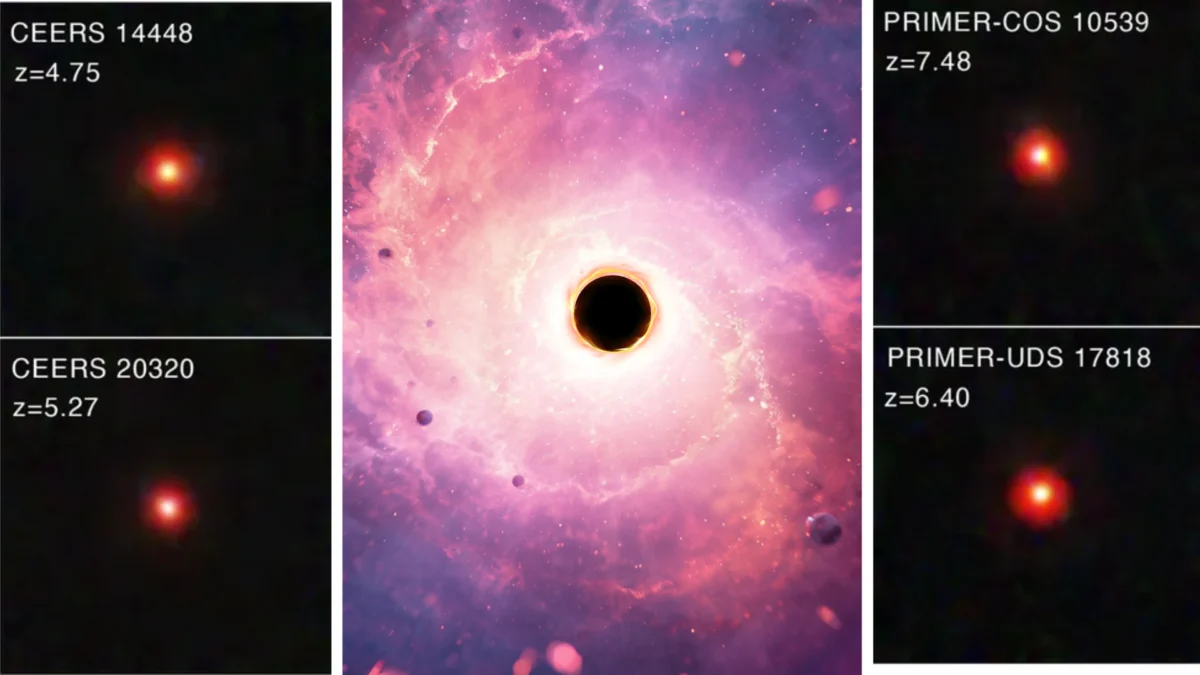
The James Webb Space Telescope (JWST) has fundamentally rewritten humanity’s understanding of the early cosmos since it began science operations in July 2022. Designed to peer further back in time than any previous observatory, the infrared telescope has consistently challenged established astrophysical models by uncovering galaxies and massive structures that appear far too developed for a universe in its infancy. Among the most perplexing discoveries are the so-called "Little Red Dots"—compact, heavily obscured objects that seem to vanish entirely from the cosmic record before the universe reached two billion years of age.
For years, astrophysicists have debated the true nature of these anomalous celestial bodies. Now, groundbreaking research published in Physical Review Letters suggests a radical answer: these Little Red Dots may not be traditional galaxies at all, but rather the direct manifestations of primordial black holes. Unlike conventional black holes that form from the catastrophic gravitational collapse of dying massive stars, primordial black holes are hypothesized to have been born out of extreme density fluctuations in the fraction of a second immediately following the Big Bang. If confirmed, this discovery would validate a decades-old theoretical physics hypothesis, offering humanity its first empirical window into the universe’s most violent and elusive epoch.
The Chronology of a Cosmic Mystery: From Hawking’s Theory to JWST
The theoretical framework underpinning primordial black holes dates back to the early 1970s, when legendary theoretical physicist Stephen Hawking and fellow physicist Bernard Carr first proposed that intense density variations in the primordial plasma of the early universe could have caused localized regions to collapse directly into black holes. During this era—characterized by cosmic inflation, a period of exponential spatial expansion—the universe was intensely hot, dense, and composed almost entirely of raw energy and the simplest elemental building blocks: hydrogen and helium.
Because these hypothetical black holes would have formed prior to the birth of the first stars, galactic dust clouds, and heavy elements, they represent an entirely different evolutionary pathway than stellar-mass or supermassive black holes observed in the modern universe. However, despite decades of theoretical modeling, finding definitive proof of their existence has remained an insurmountable challenge for astronomers. The primary obstacle has been observational degeneracy: distinguishing the spectral and structural signatures of a primordial black hole from an astrophysical black hole embedded within a dense stellar nursery has proven extraordinarily difficult.
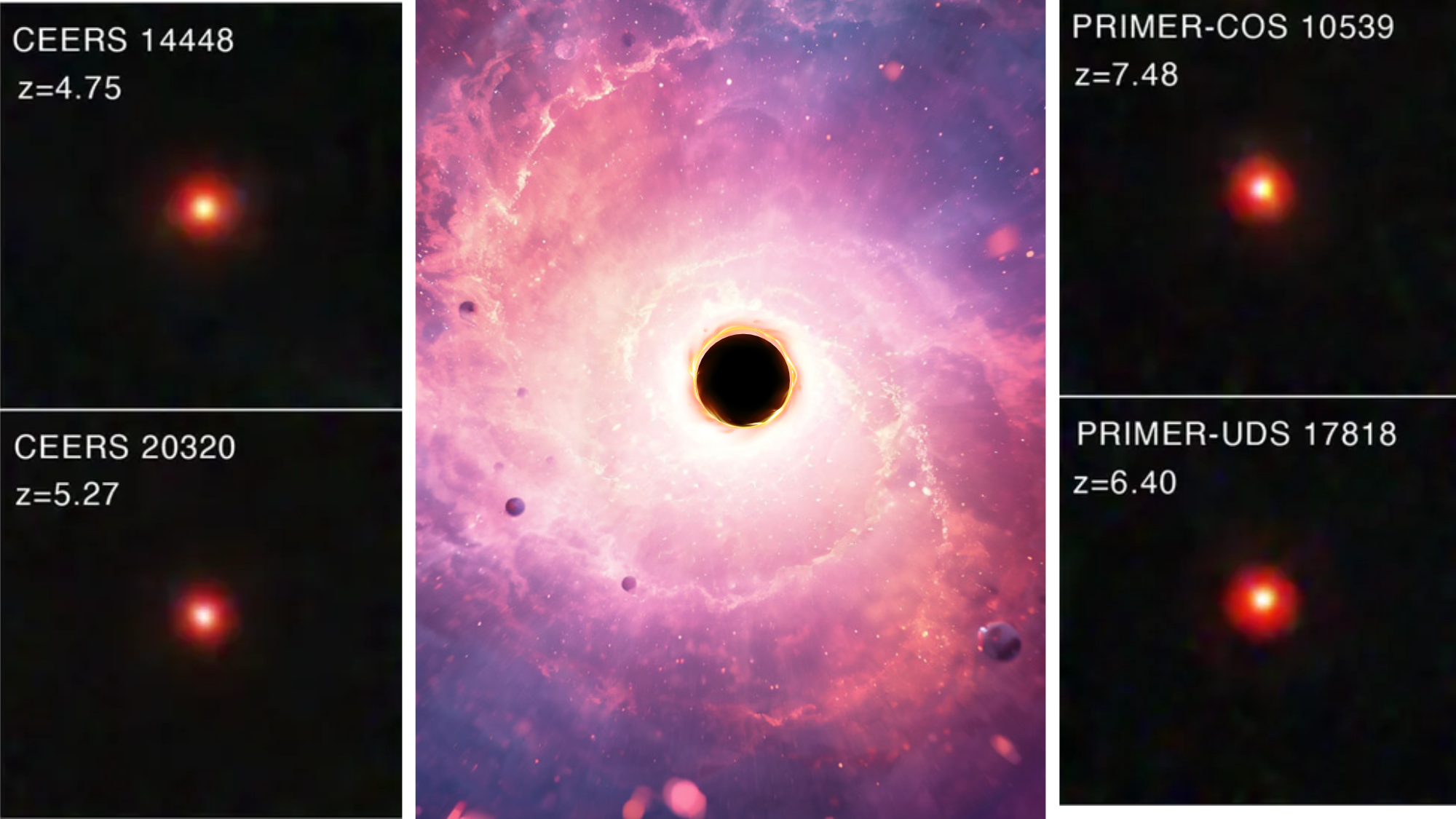
The landscape shifted dramatically with the deployment of JWST. Armed with its Near-Infrared Camera (NIRCam) and Near-Infrared Spectrograph (NIRSpec), the telescope began identifying hundreds of compact, luminous, reddish objects scattered across the high-redshift universe. These Little Red Dots exhibited peculiar characteristics—intense central emissions coupled with compact spatial profiles—sparking intense international debate regarding whether they housed rapidly growing supermassive black holes or anomalous, dust-obscured starburst galaxies.
Testing the Hypothesis: The Case of Abell 2744-QSO1
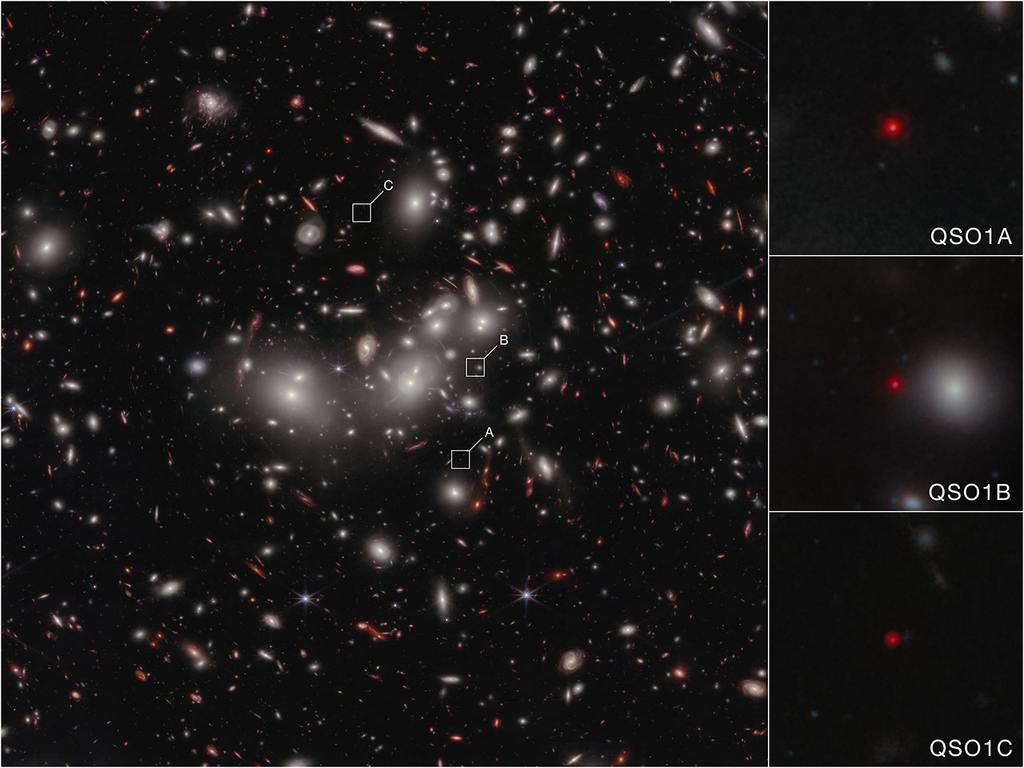
To determine whether these enigmatic objects could indeed be primordial black holes, a research team from the Department of Physics and Astronomy at Johns Hopkins University (JHU) focused their analytical efforts on a specific target: Abell 2744-QSO1, often referred to simply as QSO1. Located approximately 13.1 billion light-years from Earth, QSO1 is observed as it existed a mere 700 million years after the Big Bang.
What makes QSO1 a prime candidate for investigation is its chemical composition. Spectral analysis reveals that the object is composed almost entirely of pristine hydrogen and helium, containing virtually none of the heavier elements—such as carbon, nitrogen, and oxygen—that are typically forged inside stellar interiors over successive generations of star birth and death. This pristine chemical makeup strongly suggests that QSO1 is remarkably unspoiled, making it an ideal laboratory to test pre-galactic astrophysical models.
Valerio De Luca, a researcher at Johns Hopkins University and a co-author of the study, emphasized the fundamental distinction between the two classes of objects. "A black hole is an object born from the gravitational death of a star. Primordial black holes are a very different story," De Luca noted in a statement. "They come from the physics of the early universe that predates the first stars, when the universe was expanding exponentially in time and space. So the mechanisms for creating primordial black holes are different."
Modeling Early Universe Accretion Scenarios
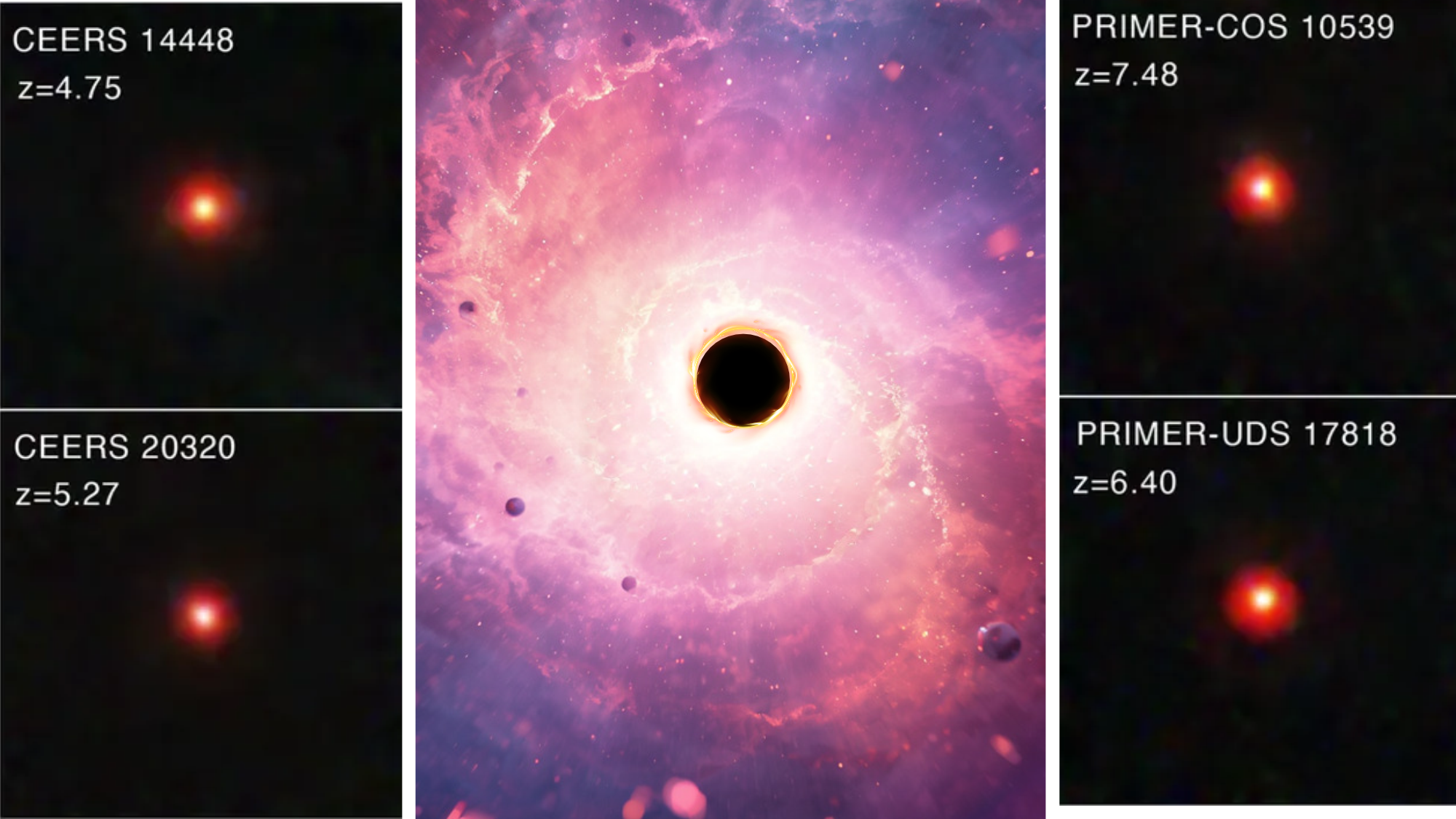
To test the viability of the primordial black hole hypothesis, De Luca and fellow researcher Loris Del Grosso constructed complex theoretical models to simulate how an object like QSO1 could evolve from a primordial seed. Because cosmological observations impose strict constraints on the abundance and distribution of primordial black holes—dictating that they cannot exist in arbitrarily dense concentrations without violating cosmic microwave background radiation measurements—the team had to carefully calculate permissible growth trajectories.
The researchers evaluated three distinct evolutionary scenarios. Their findings indicated that the most statistically robust and physically plausible pathway involves a relatively small primordial black hole acting as a gravitational anchor, rapidly accreting surrounding primordial gas and dark matter energy until it expanded to match the observed luminosity and mass profile of QSO1.
"The door was open on this theory—that Little Red Dots could be primordial black holes," Del Grosso said regarding the implications of the modeling work. "We’ve now cracked it open a little farther by showing some scenarios are more likely than others."
Broader Implications for Astrophysics and Cosmology
The implications of this research extend far beyond the classification of a single astronomical target. If subsequent observations confirm that Little Red Dots are indeed primordial black holes, the discovery will resolve several long-standing cosmological paradoxes, including the vexing puzzle of how supermassive black holes grew to billions of solar masses so rapidly in the early universe. Standard astrophysical accretion models struggle to explain how stellar-origin black holes could consume matter quickly enough to reach supermassive scales within the first few hundred million years of cosmic history. Primordial black holes, possessing pre-existing mass seeds from the Big Bang, bypass this timeline bottleneck entirely.
Furthermore, confirming the existence of primordial black holes would provide physicists with an unprecedented probe into the physics of inflation and the grand unification of fundamental forces. Because these objects were forged during the universe’s first fractions of a second, their mass distribution and spatial clustering carry a direct imprint of the quantum fluctuations that seeded all large-scale structures in the cosmos.
Next Steps in the Search for Ancient Relics
Armed with their refined theoretical models, Del Grosso, De Luca, and their collaborators are not stopping with QSO1. The research team has outlined plans to analyze the remaining population of approximately 100 Little Red Dots cataloged by the James Webb Space Telescope. By applying their accretion and growth models across this broader sample, the astronomers hope to determine the statistical prevalence of primordial black holes in the early universe.
While definitive proof remains the ultimate goal—and will likely require complementary data from future observatories such as the Laser Interferometer Space Antenna (LISA) gravitational-wave observatory—the current findings represent a crucial stepping stone. As observational capabilities continue to catch up with theoretical ambitions, humanity moves ever closer to unlocking the deepest secrets of cosmic dawn.
"We don’t have a clear understanding of what happens in the early universe right the after the Big Bang," De Luca concluded. "If primordial black holes do exist, then something had to happen to make them in the first place, which would be a groundbreaking discovery in physics."