Washington D.C. — The U.S. House of Representatives is set to deliver a significant, bipartisan rebuke to President Trump’s stringent immigration policies this Thursday, with a vote on legislation aimed at halting the administration’s efforts to terminate temporary deportation protections for hundreds of thousands of Haitian nationals residing in the United States. This rare legislative maneuver underscores deep divisions within Washington over the fate of vulnerable immigrant communities and the executive branch’s authority in immigration matters.
The Genesis of a Bipartisan Challenge
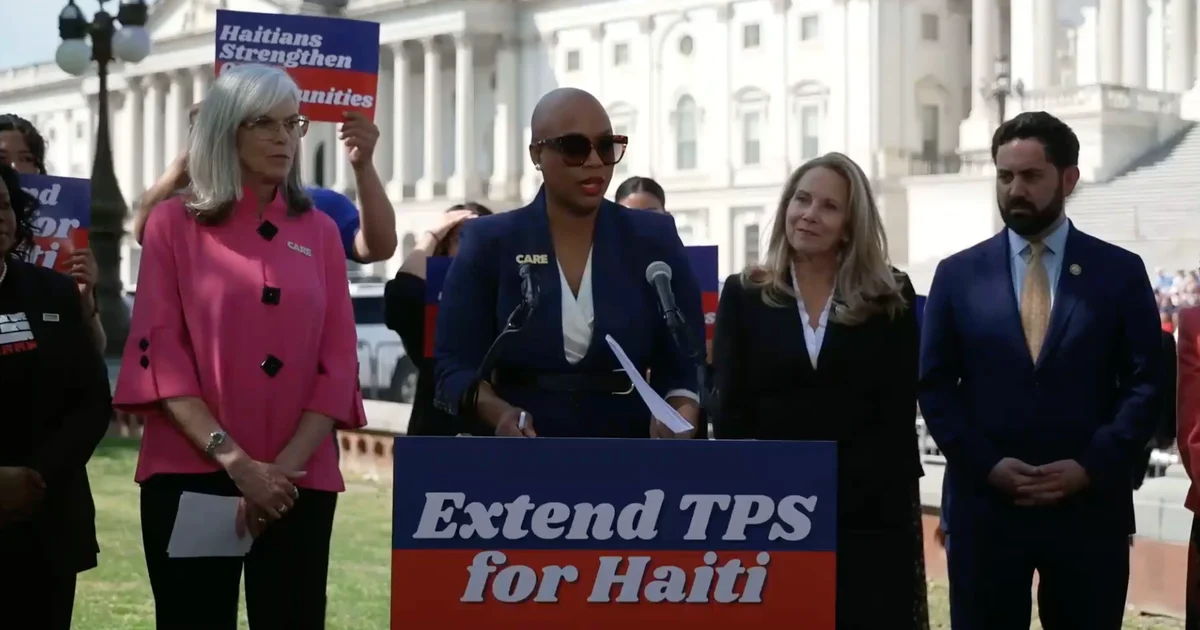
The extraordinary vote was propelled to the House floor through a procedural tool known as a discharge petition, spearheaded by Democratic Representative Ayanna Pressley of Massachusetts. The discharge petition, a mechanism allowing a bill to bypass committee review and leadership approval if it garners signatures from a majority of House members (218), successfully reached its threshold in late March 2026. This parliamentary tactic has seen increasing utilization and success in the current Congress, particularly under the fractured Republican majority, reflecting a willingness among some members to challenge party lines on critical issues.
The bipartisan nature of this effort was evident from the outset. Four Republicans – Representatives Maria Elvira Salazar of Florida, Brian Fitzpatrick of Pennsylvania, Mike Lawler of New York, and Don Bacon of Nebraska – joined all House Democrats in signing the initial discharge petition. Further bolstering this cross-party coalition, a procedural vote held on Wednesday saw additional Republican support from Representatives Nicole Malliotakis of New York, Carlos Gimenez of Florida, and Kevin Kiley of California, thereby paving the way for the underlying bill to advance to a full House floor vote. This confluence of support from across the aisle highlights a growing concern among certain Republican factions, particularly those representing districts with significant immigrant populations or humanitarian leanings, regarding the consequences of ending these protections.
Understanding Temporary Protected Status (TPS)
The legislative measure under consideration, H.R. 1689, was introduced last year by Democratic Representative Laura Gillen of New York, with Republican Representative Lawler notably co-sponsoring. The bill mandates that the Department of Homeland Security (DHS) extend Temporary Protected Status (TPS) for Haitian beneficiaries until 2029. This legislative initiative bears a striking resemblance to a bill championed by then-Senator Marco Rubio of Florida in 2019, indicating a consistent, albeit often challenged, bipartisan sentiment for Haitian TPS.
Temporary Protected Status is a humanitarian immigration program established by Congress through the Immigration Act of 1990. It allows eligible foreign nationals from designated countries to live and work legally in the U.S. without fear of deportation if their home country is deemed unsafe for return due to ongoing armed conflict, environmental disaster, or other extraordinary and temporary conditions. The Secretary of Homeland Security is responsible for making these designations, which are typically reviewed and either extended or terminated periodically. The program is designed to be temporary, but in practice, many designations have been extended for years, even decades, as conditions in some countries remain volatile.
Haiti’s Enduring Crisis and TPS History
Haiti’s designation for TPS dates back to the devastating earthquake of January 12, 2010. That catastrophic event claimed an estimated 220,000 to 300,000 lives, displaced millions, and crippled the nation’s already fragile infrastructure and economy. The international community, including the United States, responded with extensive aid, and the initial TPS designation was a critical component of the U.S. humanitarian response, preventing the forced return of Haitians to a country in ruins.
Since 2010, Haiti’s TPS designation has been extended multiple times by successive administrations, reflecting the nation’s protracted struggle to recover and achieve stability. While the immediate aftermath of the earthquake subsided, Haiti has grappled with a succession of profound challenges. These include a cholera epidemic, recurrent natural disasters such as hurricanes and tropical storms, profound political instability marked by assassinations, coups, and widespread corruption, and a pervasive economic crisis exacerbated by high inflation, food insecurity, and widespread poverty.
Most recently, in August 2024, the Biden administration extended Haiti’s TPS designation for an additional 18 months, citing the "extraordinary and temporary conditions" plaguing the Caribbean nation. The DHS cited a complex interplay of economic, security, political, and health crises, including rampant gang violence that has effectively destabilized vast swathes of the country, particularly the capital, Port-au-Prince. These criminal groups control critical infrastructure, impede humanitarian aid, and engage in widespread kidnapping, extortion, and violence, rendering daily life precarious for millions. The political vacuum following the assassination of President Jovenel Moïse in 2021 further exacerbated the breakdown of law and order, plunging Haiti into a state of near-anarchy. As of last year, over 330,000 Haitian nationals held TPS, a figure that does not include those who may also possess green cards or other lawful immigration statuses.
The Trump Administration’s Stance and Legal Battles
The current House vote comes against the backdrop of the Trump administration’s persistent efforts to roll back temporary deportation protections for hundreds of thousands of immigrants from Haiti, Syria, and several other countries. These efforts have ignited extensive legal battles, with the Supreme Court now poised to weigh in on the matter. In February 2026, a federal judge notably blocked the Trump administration from revoking TPS for Haiti, just one day before the protections were slated to expire. This decision was subsequently upheld when an appeals court panel declined to freeze the lower court’s ruling, allowing the protections to remain in place pending further legal review.
The Trump administration, in a termination notice issued in November 2025, articulated its position that Haiti’s TPS designation was "contrary to the U.S. national interest." The notice argued, "The United States cannot call for bold change on the ground while signaling doubt from afar. Our immigration policy must align with our foreign policy vision of a secure, sovereign, and self-reliant Haiti and not a country that Haitian citizens continue to leave in large numbers to seek opportunities in the United States." While acknowledging "the current situation in Haiti is concerning," the administration’s stance reflected a broader policy objective to transition away from what it viewed as indefinite temporary statuses and to encourage nations to rebuild internally, rather than relying on their citizens finding refuge abroad. Critics, however, viewed this as a punitive and unrealistic approach given the profound challenges Haiti faces.
Voices from Capitol Hill: Humanitarian Appeals and Economic Concerns
Lawmakers advocating for the TPS extension have been vocal in their condemnation of the administration’s termination efforts, framing the decision as morally indefensible and dangerously out of touch with realities on the ground. At a news conference on Wednesday, Representative Pressley declared, "The stakes could not be higher," asserting that the Trump administration’s decision was effectively "a death sentence" for many Haitian nationals who would be forced to return to an extremely perilous environment.
Representative Gillen echoed these sentiments, describing it as "cruel to expect Haitians to be forced to return to these deadly, dangerous conditions." Their arguments are rooted in the belief that the U.S. has a humanitarian obligation to protect individuals from countries experiencing severe instability, especially when U.S. foreign policy has historically played a role in the region’s dynamics.
Republican Representative Lawler, whose New York district is considered one of the most closely contested seats in the House, provided a pragmatic, yet equally passionate, defense of the extension. He argued that "sending people back to Haiti to unsafe conditions when they are currently here lawfully, is unjust and unwise." Lawler further highlighted a perceived inconsistency in U.S. government policy, noting, "The State Department itself says that Haiti is unsafe for Americans to travel to, which is in complete contradiction with the Department of Homeland Security saying that it is safe for Haitian immigrants to return to." This argument resonates with many, pointing to a cognitive dissonance between official travel advisories for U.S. citizens and deportation policies for Haitian residents.
Beyond humanitarian concerns, proponents of the extension also emphasize the significant economic contributions of Haitian TPS holders to the U.S. economy. According to a senior aide to Congresswoman Pressley, her pitch to sway reluctant Republicans and apprehensive Democrats has consistently highlighted the negative economic impacts, particularly on the caregiving workforce, should more than 300,000 Haitians be forced to leave the U.S. Haitian immigrants are integral to various sectors, including healthcare, hospitality, and agriculture, filling essential labor gaps and contributing billions in taxes and consumer spending annually. Their remittances also represent a crucial lifeline for families back in Haiti, injecting much-needed capital into an impoverished economy.
Advocacy groups and leaders within the Haitian-American community have amplified these legislative voices. "To deport these individuals now would not only tear apart families and disrupt communities across the U.S. but would also exacerbate an already catastrophic situation in Haiti," stated a representative from a prominent immigrant rights organization, who preferred to remain unnamed due to ongoing political sensitivities. "These are people who have built lives here, started businesses, raised families, and are deeply integrated into the fabric of American society. Their removal would be a profound loss, both human and economic."
A Divergence in Policy: State Department vs. Homeland Security
The argument regarding the discrepancy between the State Department’s travel advisories and DHS’s termination notices is particularly potent. The U.S. State Department maintains a Level 4 "Do Not Travel" advisory for Haiti, citing widespread kidnapping, crime, and civil unrest. This advisory explicitly warns U.S. citizens against travel to Haiti due to "widespread gang violence and civil unrest" and emphasizes the limited capacity of the U.S. government to provide emergency services. This stark warning stands in direct contrast to the notion that Haiti is sufficiently safe for the repatriation of hundreds of thousands of its citizens, many of whom have not lived there for over a decade and would lack support networks upon return. This perceived policy inconsistency underscores the complex bureaucratic and political pressures at play in immigration decisions.
The Path Ahead: Legislative Hurdles and Presidential Veto Threat
Despite the significant bipartisan momentum in the House, the journey for H.R. 1689 is far from over. Even if it successfully passes the House, the legislation faces an uncertain future in the Senate. The upper chamber, often characterized by its slower pace and higher threshold for legislative action, would need to take up the bill, and it is unclear how quickly, or even if, it would move forward. The Senate has historically been a graveyard for immigration legislation that lacks broad, bipartisan consensus.
Furthermore, the bill faces the formidable obstacle of a presidential veto from Mr. Trump. Given his administration’s stated policy goals regarding TPS and immigration enforcement, a veto is highly probable. Overriding a presidential veto requires a two-thirds majority vote in both the House and the Senate – a challenging benchmark to meet. Earlier this year, the House demonstrated its reluctance to override two presidential vetoes, even on legislation that had initially passed unanimously. This precedent suggests that while the current bill has garnered a notable level of bipartisan support, achieving a veto-proof majority would require an even greater, and perhaps unattainable, political alignment.
Broader Implications: Humanitarian, Economic, and Political Ramifications
The outcome of this legislative battle carries profound humanitarian, economic, and political ramifications. For the over 330,000 Haitian TPS holders and their families – many of whom have U.S.-born children – the uncertainty creates immense anxiety. A termination would force individuals to either return to a country facing unprecedented turmoil, go underground as undocumented immigrants in the U.S., or attempt to find alternative, often difficult, legal pathways to remain. This could lead to widespread family separations and a humanitarian crisis on both sides of the border.
Economically, the loss of this established workforce would ripple through various U.S. industries. The caregiving sector, in particular, which relies heavily on immigrant labor, could face significant shortages. The reduction in remittances would also further destabilize Haiti’s economy, potentially exacerbating the very conditions the Trump administration claims it wishes to see resolved.
Politically, the House vote represents a significant moment of bipartisan defiance against a president’s core immigration agenda. For the Republicans who have broken ranks, it could be a calculation to appeal to moderate voters, constituents in immigrant-heavy districts, or a genuine expression of humanitarian concern. Their willingness to challenge party leadership through a discharge petition signals a potential shift in the dynamics of immigration policy debates within the GOP, particularly in an election year.
Looking Forward: The Future of TPS and US Immigration Policy
Regardless of the immediate outcome of this specific vote, the debate over Haitian TPS highlights broader questions about the future of the Temporary Protected Status program and U.S. immigration policy. Critics of TPS argue that its "temporary" nature has often become de facto permanent, creating a shadow population and circumventing traditional immigration pathways. Proponents counter that the program is a vital tool for humanitarian protection and a pragmatic response to global crises, particularly when countries remain unstable for extended periods.
The legal battles, the legislative push, and the deeply divided political landscape underscore the urgent need for comprehensive immigration reform that addresses both border security and humanitarian concerns with long-term, sustainable solutions. As the Supreme Court deliberates and Congress continues its legislative maneuvers, the fate of hundreds of thousands of Haitian lives hangs in the balance, serving as a poignant reminder of the complex interplay between foreign policy, domestic politics, and human dignity in the American immigration system.