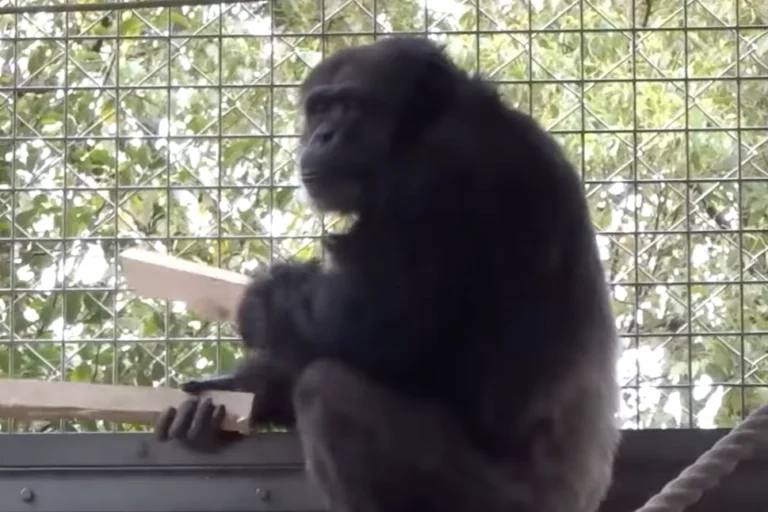
Researchers at Kyoto University’s Institute for the Evolutionary Origins of Human Behavior (EHUB) have documented a groundbreaking behavioral development in a 26-year-old male chimpanzee named Ayumu, who has been observed spontaneously prying floorboards from his enclosure to use as musical instruments. This behavior, characterized by structured rhythmic drumming accompanied by vocalizations, provides a rare window into the evolutionary roots of human musicality and tool-assisted emotional expression. Unlike previous reports of chimpanzees striking objects, Ayumu’s performances involve the deliberate "detachment" of materials to create tools for sound, a hallmark of early-stage tool manufacturing.
The study, led by primatologist Yuko Hattori and published in the Annals of the New York Academy of Sciences, meticulously tracked Ayumu’s musical displays over a two-year period beginning in February 2023. The research team recorded 89 distinct spontaneous performances across 37 days, revealing that the drumming was not a series of random strikes but a complex, rhythmically structured sequence that mirrors the natural vocal patterns of wild chimpanzees. This discovery challenges long-held assumptions regarding the exclusivity of human instrumental performance and suggests that the cognitive foundations for music—rhythm, tool use, and emotional externalization—are deeply embedded in the primate lineage.
A Legacy of Cognitive Excellence: The Background of Ayumu
To understand the significance of this drumming behavior, it is essential to consider the unique history of the subject. Ayumu is not an ordinary chimpanzee; he is a world-renowned figure in the field of animal cognition. Born in 2000 at the Primate Research Institute (now EHUB), Ayumu gained international fame for his extraordinary performance in short-term memory tasks. In studies conducted by Professor Tetsuro Matsuzawa, Ayumu consistently outperformed human university students in "numerical flash" tests, which required him to remember the locations of numbers on a screen after they appeared for only a fraction of a second.
This background in cognitive experimentation is a critical variable in Ayumu’s current behavior. Throughout his life, Ayumu has been exposed to complex environments, including interactions with electronic keyboards and exposure to diverse rhythmic sounds. Researchers believe this lifelong immersion in cognitively demanding tasks may have primed his brain for the sophisticated tool manipulation and rhythmic synchronization observed in his drumming displays. As the alpha male of his group, Ayumu also possesses the social status and confidence to engage in loud, prolonged displays that command the attention of his peers and human observers.
The Mechanics of Instrument Creation and Performance
The most striking aspect of Ayumu’s behavior is the process of "detachment." In the wild, chimpanzees are known to use tools for foraging—such as using sticks to "fish" for termites or stones to crack nuts. However, the use of tools to create sound for the sake of performance is far less documented. Ayumu specifically targeted the wooden floorboards of a walkway within his enclosure, prying them loose with significant physical effort. By detaching these boards, he effectively "manufactured" a drumstick or a percussion tool.

The performances themselves were found to incorporate up to 14 distinct behavioral components. These included tool-assisted drumming, where Ayumu struck surfaces with the floorboards; object dragging, creating a continuous scraping sound; and object throwing, which served as a punctuating finale.
The research team utilized statistical analysis to determine the order of these actions. They discovered a non-random transition pattern: Ayumu typically began with drumming, transitioned into dragging, and concluded with throwing. This progression—from slower, rhythmic beats to louder, chaotic sounds and a final climactic gesture—closely resembles the "pant-hoot" vocalization. The pant-hoot is a complex, four-phase call used by wild chimpanzees to communicate over long distances, building from introductory hoots to a high-pitched screaming climax. The fact that Ayumu’s drumming follows this same structural arc suggests that he is externalizing a vocal communication pattern through the use of physical tools.
Comparative Analysis: Wild Drumming vs. Ayumu’s Innovation
The study of Ayumu’s drumming exists within a broader context of primatological research. Wild chimpanzees (Pan troglodytes) have long been known to engage in drumming, primarily using the buttress roots of large trees. These roots act as natural resonators, producing low-frequency "booms" that can travel more than a kilometer through dense rainforest.
Supporting data from a 2025 study published in Current Biology, which analyzed more than 370 drumming bouts across 11 wild communities, indicates that drumming is a culturally varied behavior. Western chimpanzees tend to drum with evenly spaced, metronomic beats. In contrast, eastern chimpanzees utilize a more syncopated style, alternating between short and long intervals.
Ayumu’s drumming, however, represents a departure from these wild behaviors in two significant ways. First, his use of detached tools (the floorboards) provides a more stable and precise rhythm than the hand-and-foot drumming typically seen in the wild. Hattori’s team found that Ayumu’s tool-assisted beats were predominantly evenly spaced, mimicking a metronome. This aligns with human studies suggesting that the use of drumsticks allows for greater rhythmic stability than bare-handed percussion. Second, Ayumu’s performances were often accompanied by "play faces"—vocalizations and facial expressions that humans interpret as laughter—suggesting a level of personal enjoyment and emotional release not always present in the territorial or communicative drumming of wild populations.
Evolutionary Implications: From Voice to Instrument
The transition from vocal expression to instrumental music is a central question in evolutionary musicology. One leading hypothesis suggests that human music evolved as an extension of emotional vocalizations. As early humans developed more sophisticated tool-making abilities, they began to use external objects to mirror and amplify the emotions previously conveyed only through the voice.

"As far as I know, non-human animals are not known to use tools to express emotion in this way," Dr. Hattori noted. Ayumu’s behavior provides compelling evidence for this "vocal externalization" theory. By mapping the structure of a pant-hoot onto a rhythmic drumming performance, Ayumu is demonstrating a cognitive bridge between a biological impulse (the call) and a cultural innovation (the music).
This has profound implications for our understanding of the "musical brain." It suggests that the capacity for rhythm and the desire to produce sound through external media may have been present in the common ancestor of humans and chimpanzees approximately five to seven million years ago. The development of music may not have been a sudden human "invention" but rather a gradual externalization of primate social and emotional signals.
Social Responses and Future Research Directions
While Ayumu is currently the only individual in his group at EHUB to exhibit this specific floorboard-drumming behavior, his performances do not occur in a vacuum. As the alpha male, his displays are a central part of the group’s social dynamic. The research team has begun observing how other members of the troop react to these sessions. Preliminary findings suggest that some chimpanzees respond by swaying their bodies or adjusting their proximity to Ayumu during his performances.
This social aspect is the next frontier for Hattori’s research. The team plans to analyze these reactions in greater detail to determine if Ayumu’s drumming serves a specific communicative function, such as reinforcing social hierarchy, or if it acts as a form of social "contagion" where the rhythm influences the physical state of the group.
Valérie Dufour, an animal cognition biologist at the French national research agency CNRS, emphasized the importance of these observations to Science magazine, noting that studies of individual innovation are crucial for understanding the origins of musicality. While Ayumu’s behavior is currently unique to him, it demonstrates the latent potential within the chimpanzee species to innovate artistically when provided with the right environmental stimuli.
Limitations and Scientific Rigor
Despite the excitement surrounding these findings, the researchers maintain a cautious, objective stance. They acknowledge that the study is limited by its focus on a single subject. Ayumu’s status as a captive chimpanzee with a high degree of "enculturation"—having spent his life around humans and cognitive tests—means his behavior may not be representative of the species as a whole.

Life in captivity provides chimpanzees with a unique set of circumstances: a lack of predators, a consistent food supply, and an abundance of man-made objects. These factors afford Ayumu the "leisure time" necessary to engage in elaborate, minutes-long performances that might be too energetically costly or dangerous in the wild. Furthermore, the physical properties of the EHUB enclosure, specifically the resonant wooden walkways, provided an acoustic opportunity that is rarely found in the natural habitat of Pan troglodytes.
Conclusion: A New Lens on Primate Intelligence
The documentation of Ayumu’s drumming at Kyoto University marks a significant milestone in primatology. It highlights the intersection of tool use, rhythmic cognition, and emotional expression in our closest living relatives. By prying up the very floors of his environment to create a rhythmic voice, Ayumu has demonstrated that the line between human "art" and animal "display" is thinner than previously thought.
As researchers continue to study the EHUB troop, the focus will remain on whether this behavior spreads to other individuals and how it evolves over time. For now, Ayumu stands as a singular example of how a non-human primate can take the raw materials of his environment and transform them into a rhythmic, structured, and seemingly joyful expression of his internal state—a behavior that resonates deeply with the human experience of music.