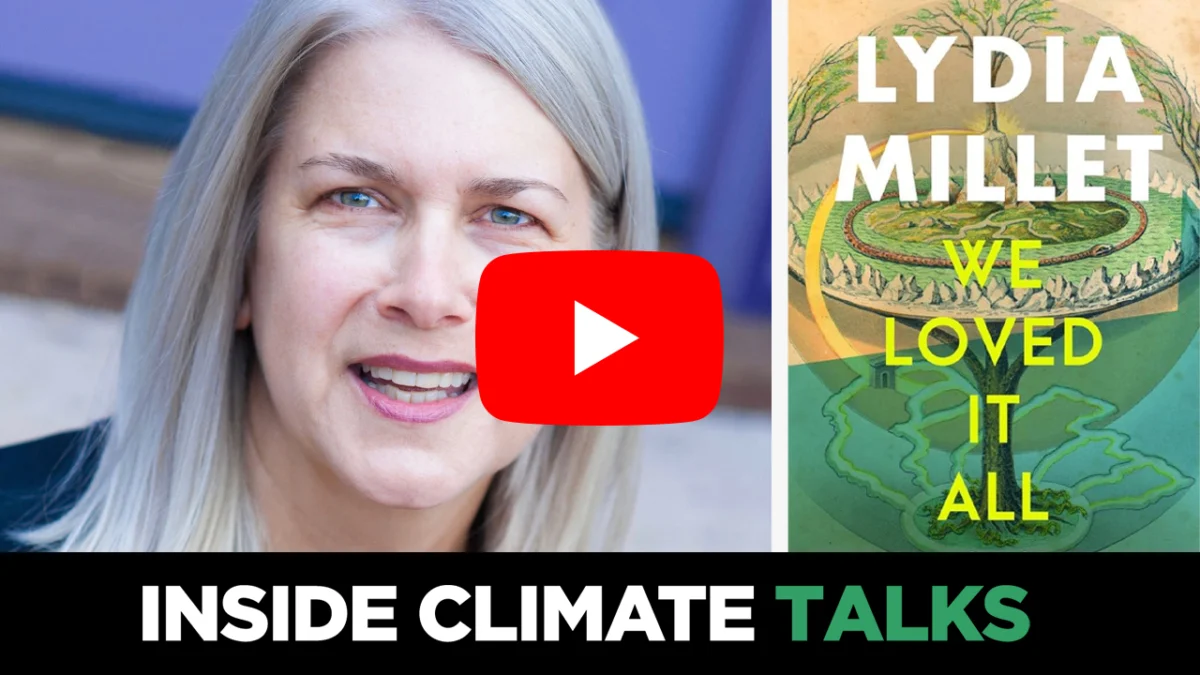
The third installment of a special Earth Day series features an in-depth conversation between acclaimed author Lydia Millet and reporter Kiley Bense regarding the release of Millet’s first nonfiction book, We Loved It All. This memoir marks a significant departure for Millet, who has spent decades crafting a prolific and award-winning body of fiction that often grapples with the intricate relationships between humanity, the animal kingdom, and the encroaching realities of climate change. The discussion centers on the psychological and philosophical ramifications of living through a period of mass extinction and the challenge of maintaining human identity as the biological richness of the planet diminishes.
Millet, a finalist for both the Pulitzer Prize and the National Book Award, has long been recognized as a leading voice in "cli-fi" or climate fiction. Her previous works, such as A Children’s Bible and The Last Summer of the World, have used narrative storytelling to explore the consequences of environmental negligence. However, in We Loved It All, she pivots to an "anti-memoir" format, blending personal history with natural history. The book serves as an urgent meditation on what it means to be human at a moment when the wildness of the world is being systematically replaced by human-made infrastructure and artifacts.
The Philosophical Shift from Fiction to Nonfiction
The transition from fiction to nonfiction allows Millet to address the climate crisis with a different level of directness. During the conversation with Inside Climate News, Millet noted that while fiction can evoke empathy and simulate the experience of crisis, nonfiction provides the space to analyze the underlying structures of human thought that have led to the current ecological predicament. She explores the concept of human exceptionalism—the belief that humans are fundamentally separate from and superior to other species—and how this mindset has facilitated the destruction of the natural world.
One of the most poignant themes discussed is the alienation of the modern human from the animal world. As urban centers expand and biodiversity declines, the average person’s interaction with non-human life is increasingly mediated through screens, domestic pets, or plastic representations. Millet raises the provocative question of what happens to the human psyche when the creatures that have shared our evolutionary journey for millennia disappear. She suggests that our identity is inextricably linked to the "otherness" of animals, and as they vanish, a part of our own humanity is lost.
Biodiversity Loss: The Scientific Backdrop
The themes explored in Millet’s memoir are supported by a mounting body of scientific data. According to the Intergovernmental Science-Policy Platform on Biodiversity and Ecosystem Services (IPBES), approximately one million animal and plant species are now threatened with extinction, many within decades. This is more than at any other time in human history. The average abundance of native species in most major land-based habitats has fallen by at least 20 percent, mostly since 1900.
Data from the World Wildlife Fund’s (WWF) Living Planet Report 2022 further illustrates the severity of the situation, showing an average 69 percent decline in monitored wildlife populations—including mammals, birds, amphibians, reptiles, and fish—between 1970 and 2018. This period of "biological annihilation" provides the grim context for Millet’s work. In the interview, she discusses how these statistics are not just numbers but represent a fundamental stripping away of the world’s vibrancy.
The Symbolism of Children’s Toys
A unique aspect of the conversation involves Millet’s observation regarding children’s toys. For generations, the nursery has been populated by representations of the wild: stuffed bears, plastic lions, and wooden elephants. Millet posits a future where these toys become artifacts of a "ghost world." As the actual species go extinct, the toys will remain as hollow echoes of a biodiversity that children will never experience in the flesh. This transition from living creature to cultural icon to historical relic serves as a metaphor for the broader human experience of loss.
Millet argues that this shift impacts the development of empathy in children. If the animals they play with no longer exist in the wild, the connection to the physical earth is severed, replaced by a purely symbolic relationship. This contributes to what some psychologists call "shifting baseline syndrome," where each generation accepts a degraded natural world as the norm because they have no memory of what was lost.
A Chronology of Environmental Narrative
The release of We Loved It All and its feature in this Earth Day series fits into a broader timeline of environmental awareness and literature.
- 1962: Rachel Carson publishes Silent Spring, often credited with launching the modern environmental movement by highlighting the dangers of pesticides.
- 1970: The first Earth Day is held on April 22, leading to the creation of the U.S. Environmental Protection Agency (EPA) and the passage of the Clean Air and Clean Water Acts.
- 2000s: The term "Anthropocene" gains traction in scientific and literary circles to describe the current geological epoch in which human activity is the dominant influence on climate and the environment.
- 2013: Inside Climate News wins the Pulitzer Prize for National Reporting, signaling a shift in the media landscape toward specialized, high-stakes environmental journalism.
- 2020: Millet’s A Children’s Bible is published, becoming a definitive work of contemporary climate fiction and a finalist for the National Book Award.
- 2024: The publication of We Loved It All represents a new phase in Millet’s career, focusing on the synthesis of personal memory and global ecological change.
The Role of Specialized Journalism in the Climate Crisis
The interview with Millet was produced by Inside Climate News (ICN), a non-profit newsroom that has become a cornerstone of environmental reporting in the United States. Founded in 2007, ICN was established to fill the void left by traditional media outlets that were scaling back their science and environment desks due to budget constraints.
The organization’s model relies on reader donations rather than advertising or paywalls, a strategy designed to keep vital information accessible to the public. This is particularly relevant in an era of climate disinformation, where facts are often obscured by political interests. The work of ICN in holding polluters accountable and scrutinizing policy solutions provides the factual foundation upon which authors like Millet build their narratives. By providing these stories for free to local newsrooms across the country, ICN ensures that the "complexity of the story" reaches diverse audiences who might otherwise lack access to rigorous environmental reporting.
Implications and Fact-Based Analysis
The intersection of literature and journalism, as seen in the Millet-Bense interview, suggests a growing recognition that data alone is insufficient to spur collective action. While scientific reports provide the "what" and the "how" of climate change, literature explores the "why" and the "what now."
Millet’s work implies that the climate crisis is not just a technical or political problem but a spiritual and existential one. The loss of biodiversity is a loss of the "richness of the planet’s life," which in turn diminishes the human experience. Analysis of current social trends suggests a rising phenomenon of "climate anxiety" and "solastalgia"—the distress caused by environmental change in one’s home environment. Millet’s memoir provides a framework for processing these emotions, moving away from despair and toward a deeper sense of witnessing and stewardship.
Furthermore, the interview highlights the importance of narrative in shaping policy. When the public begins to view the extinction of a species not just as a biological fact but as a personal and cultural loss, the pressure on decision-makers to implement protective measures increases. The transition of climate change from a distant, abstract threat to a present, felt reality is a key driver in the shift toward renewable energy and conservation efforts.
Conclusion
Lydia Millet’s We Loved It All serves as a vital contribution to the Earth Day discourse, reminding readers that the fight for the planet is also a fight for the integrity of the human soul. By bridging the gap between the animal world and human identity, Millet challenges her audience to reconsider their place in the natural order. Supported by the rigorous reporting of outlets like Inside Climate News, these narratives ensure that the facts of climate change are not only understood but felt, fostering a more profound commitment to preserving the world that remains. As the third part of this series concludes, the focus remains on the urgent need for both investigative truth-telling and creative reflection to navigate the challenges of the 21st century.