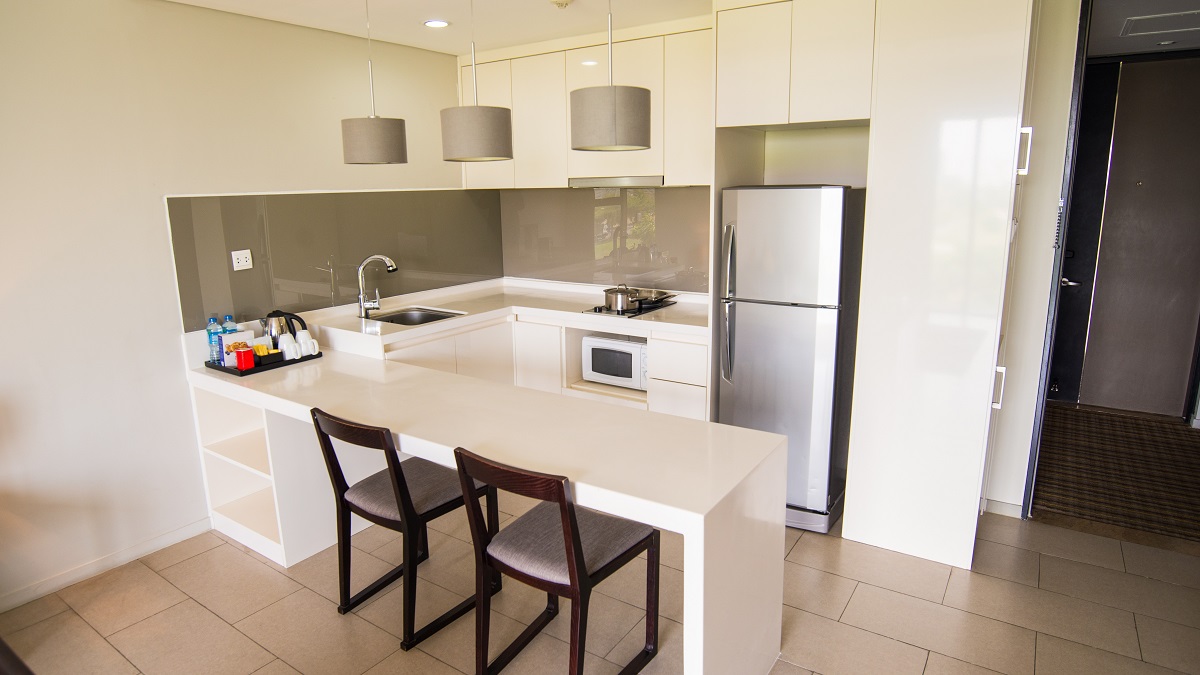
The modern kitchen has evolved into a space where aesthetic precision meets high-performance engineering, making the choice of major appliances more complex than ever. For homeowners navigating the constraints of narrow galley kitchens, the minimalist requirements of tiny homes, or the sleek demands of open-concept architectural designs, the physical dimensions of a refrigerator often dictate the entire layout. The counter-depth refrigerator, once a niche luxury item characterized by significantly lower storage volumes, has undergone a technological revolution. In 2026, the trade-off between a flush-mount look and actual food storage capacity has largely vanished, driven by breakthroughs in insulation materials and a global shift toward environmentally friendly refrigerants.
The Shift Toward Counter-Depth Dominance
Historically, consumers faced a difficult choice: a standard-depth refrigerator that protruded six to ten inches past the cabinetry, or a counter-depth model that looked built-in but offered roughly 20% less interior space. However, the appliance landscape in 2026 reflects a major engineering milestone. Leading manufacturers such as LG and Samsung have introduced "Counter-Depth MAX" technologies, utilizing thinner, vacuum-insulated panels that provide higher R-value insulation with less bulk. This has allowed counter-depth units to reach 26.5 to 27 cubic feet of capacity, nearly matching the 28 to 30 cubic feet typical of standard-depth models.
The demand for these units is not merely aesthetic. According to industry market reports from early 2026, the rise in urban "micro-living" and the continued popularity of the "work-from-home" kitchen—where the kitchen serves as a backdrop for video calls—has spurred a 15% year-over-year increase in counter-depth sales. This shift is accompanied by a complete overhaul of the chemical components inside these machines, marking the end of the transition to sustainable cooling.
The R-600a Revolution and Environmental Standards
The most significant change in the 2026 appliance market is the universal adoption of R-600a (isobutane) as the industry-standard refrigerant. This transition was necessitated by the global phase-down of hydrofluorocarbons (HFCs), such as R-134a, which were notorious for their high Global Warming Potential (GWP). While R-134a has a GWP of approximately 1,430, R-600a has a GWP of only 3. This 500-fold reduction in environmental impact represents one of the most successful green transitions in consumer electronics history.
However, the adoption of R-600a brings new operational nuances. Isobutane is a hydrocarbon and is technically flammable. While the small amounts used in household sealed systems (typically less than 150 grams) pose virtually zero risk to the homeowner during daily operation, they have fundamentally changed the appliance repair industry. In 2026, standard HVAC tools are no longer sufficient for sealed-system repairs. Technicians must now be certified in hydrocarbon handling and utilize specialized recovery equipment and "no-spark" tools. For the consumer, this means that while the fridge is greener, finding a qualified technician for a compressor repair may require more vetting than it did five years ago.
A Chronology of Progress: 2021 to 2026
To understand the current market, one must look at the timeline of innovation over the last five years:
- 2021: The first wave of high-efficiency French-door models gains traction, but most counter-depth units remain limited to 20–22 cubic feet. R-600a is present but not yet universal in the U.S. market.
- 2023: The Department of Energy (DOE) announces stricter Energy Star 7.0 requirements, forcing manufacturers to move away from energy-intensive through-the-door ice dispensers in favor of internal dispensers.
- 2024: LG and Samsung launch their "Max Capacity" series, breaking the 25-cubic-foot barrier for counter-depth units.
- 2025: The final phase-out of R-134a for new residential appliances takes effect. The secondary market for older refrigerants begins to shrink, making repairs on 10-year-old fridges significantly more expensive.
- 2026: The current generation of appliances focuses on "Smart Preservation," using AI-driven compressors that adjust cooling cycles based on humidity levels and door-opening patterns, further reducing kWh consumption.
Top-Tier Recommendations for 2026
The selection of a refrigerator in 2026 should be based on three primary pillars: configuration, preservation technology, and serviceability. Below are the leading models categorized by their specific strengths.

Best for Energy Efficiency: Frigidaire FFTR1835VW (Top Freezer)
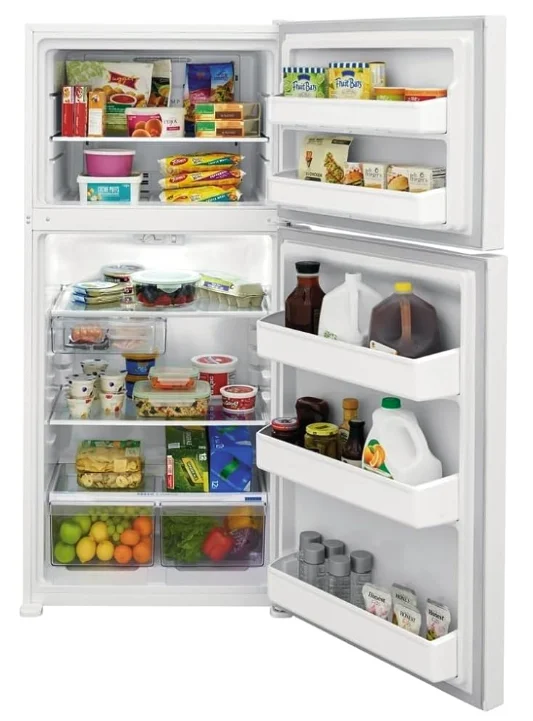
The top-freezer configuration remains the gold standard for thermal efficiency because the freezer is located away from the heat-generating compressor at the base of the unit. The Frigidaire FFTR1835VW, an 18.3 cu. ft. unit, is the premier choice for budget-conscious and eco-centric households. Consuming approximately 369 kWh per year, it bypasses the energy "vampires" of modern fridges, such as external water pumps and heaters for ice chutes. Its 30-inch depth makes it a "shallow-depth" hybrid, perfect for small apartments.
Best Value French Door: Samsung RF18A5101SR
For kitchens with a narrow 33-inch width requirement, the Samsung RF18A5101SR offers a premium French-door experience without the massive footprint. Its Twin Cooling Plus system is a standout feature in this price bracket, utilizing separate evaporators for the fridge and freezer. This prevents the dry, cold air of the freezer from dehydrating fresh produce in the refrigerator. In 2026, Samsung has also integrated its SmartThings Energy module into this model, allowing users to monitor real-time energy costs via a smartphone.
Best Large-Capacity: LG LRFLC2706S (Counter-Depth MAX)
The LG LRFLC2706S is the flagship for those who refuse to compromise on storage. By re-engineering the ductwork and using thinner insulation, LG has achieved a 26.5 cu. ft. capacity in a frame that sits flush with 24-inch deep cabinets (plus the door thickness). According to 2026 reliability data from Yale Appliance, LG’s latest linear compressors have shown a marked improvement in first-year service rates compared to the early 2020s, making this a reliable choice for large families.
Best for Food Preservation: Bosch 800 Series B36CT80SNS
The Bosch 800 Series continues to dominate the "preservation" category. It is one of the few freestanding units to feature dual compressors. While most fridges use one compressor to cool both sections, the Bosch uses two entirely independent systems. This ensures that the refrigerator maintains a consistent 40-60% humidity level—ideal for vegetables—while the freezer stays at 0% humidity to prevent freezer burn. The 2026 model includes the "FlexBar" system, maximizing vertical space that is often wasted in counter-depth units.

Best Premium Option: GE Profile PVD28BYNFS
The GE Profile PVD28BYNFS is designed for the high-traffic kitchen. Its "door-in-door" design allows users to access frequently used items like milk or condiments without releasing the cold air from the main compartment. GE’s primary advantage in 2026 remains its service network; the brand maintains the largest fleet of factory-trained technicians in North America, a critical factor for an appliance expected to last 12 to 15 years.
Comparative Data and Economic Impact
When evaluating these models, the long-term cost of ownership is often more significant than the sticker price.
| Model | Capacity | Est. Annual Energy | Depth (Case) | Key Innovation |
|---|---|---|---|---|
| Frigidaire FFTR1835VW | 18.3 cu. ft. | 369 kWh | 30" | Garage-ready / ADA |
| Samsung RF18A5101SR | 17.5 cu. ft. | 448 kWh | 28.5" | Twin Cooling Plus |
| LG LRFLC2706S | 26.5 cu. ft. | 632 kWh | 29.25" | Thin-wall Insulation |
| Bosch 800 Series | 21.0 cu. ft. | 530 kWh | 24" | Dual Compressors |
| GE Profile PVD28 | 27.9 cu. ft. | 760 kWh | 36.75"* | LED Light Wall |
*Note: The GE Profile listed is the standard-depth variant; the counter-depth version (PYD22) offers similar features with a 22 cu. ft. capacity.
Industry Analysis: The Future of Cold Storage
Experts in the appliance industry suggest that we are entering an era of "modular refrigeration." As counter-depth units become the standard, we are seeing a trend toward "column" refrigeration—separate full-sized fridges and freezers that can be placed independently.

"The 2026 consumer is no longer just looking at cubic feet," says an industry analyst for the Association of Home Appliance Manufacturers (AHAM). "They are looking at ‘active’ preservation. They want sensors that can detect when a head of lettuce is beginning to emit ethylene gas and increase airflow to neutralize it. Sustainability is now baked into the hardware through R-600a, so the new frontier is reducing food waste."
Broader Implications for Homeowners
The move toward these high-efficiency, counter-depth models has broader implications for home valuation and maintenance. A kitchen equipped with a flush-mount, Energy Star-certified refrigerator is often a key selling point in the real estate market, signaling a modern, well-maintained home.
However, homeowners must be proactive in maintenance to protect these sophisticated machines. Because counter-depth units are tucked tightly into cabinetry, airflow is often restricted. In 2026, manufacturers have improved front-venting systems, but the fundamental rule of refrigerator longevity remains: clean the condenser coils. Dust buildup on the coils forces the compressor to run longer and hotter, which is the leading cause of premature failure in R-600a systems.
Furthermore, the integration of Wi-Fi and "Smart" features across all price points introduces a new consideration: software longevity. Most 2026 models from Samsung and LG offer "over-the-air" updates to optimize cooling algorithms, but consumers should inquire about the duration of software support, as a "smart" fridge with an obsolete app can lose some of its energy-saving potential.

In conclusion, the counter-depth refrigerator of 2026 is a triumph of engineering over space constraints. By combining the environmental benefits of R-600a, the efficiency of dual-evaporator systems, and the unexpected capacity of thin-wall insulation, these appliances have moved from being a compromise to being the preferred choice for the modern, sustainable home. Whether prioritizing the raw efficiency of a top-freezer Frigidaire or the advanced preservation of a Bosch, today’s consumers have access to a level of performance that was once reserved for high-end professional kitchens.