The Greater Boston real estate market experienced notable shifts as summer drew to a close, with Norfolk County emerging as one of the most resilient and competitive suburban regions in Massachusetts. According to comprehensive real estate data and market analysis released for August 2026, Norfolk County housing conditions defied broader national headwinds. While the United States housing market grappled with affordability challenges, sticky inflation, and high mortgage rates, Norfolk County recorded a robust median sale price of $787,365. This figure represents a 4.6% year-over-year increase, a rate of appreciation more than double the national average of 2.0%.
The local real estate landscape continued to heavily favor sellers, driven by a diverse portfolio of communities ranging from affluent commuter havens like Wellesley and Brookline to more accessible towns like Stoughton and Randolph. Despite an influx of new inventory, robust buyer demand kept properties moving at a rapid pace, with the typical home going under contract in just 23 days—roughly half the national duration of 50 days.
National Economic Pressures and Comparative Performance
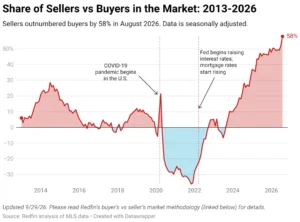
To fully understand Norfolk County’s anomalous strength, it is necessary to examine the broader macroeconomic climate governing the United States housing sector. Nationally, the median home sale price crept up to $398,596 in August, marking a modest 2.2% annual gain. Concurrently, national pending sales contracted by 1.3% down to 336,973, while active listings experienced a minor recovery, rising 2.7% to 1,534,918 homes. Across the country, buyers faced a structurally imbalanced market where active sellers and prospective inventory were heavily outpaced by baseline demand, resulting in an environment where sellers outnumbered buyers by 57.9%.
Chen Zhao, Redfin’s head of economics research, highlighted the prevailing market friction observed across the nation during the late-summer period. "The U.S. housing market faced some hurdles in August, as inflation and an AI-fueled economy kept mortgage rates high and weighed heavily on homebuyers, sellers, and investors," Zhao explained. "Until recently, affordability and activity had been slowly improving for months, helping the market recover. But now, economic uncertainty and rising prices are keeping more people on the sidelines and slowing the market further. For buyers who need to buy, now is a great time because there’s less competition and a bit more inventory—for sellers, pricing competitively is key to attract attention."
Despite these national deterrents, Norfolk County completely bypassed the localized slumps seen elsewhere. While national pending sales dropped, Norfolk County’s pending transactions held virtually flat at 590, up 0.2% year-over-year. Furthermore, total homes sold edged up 1.1% to 697 transactions. This ability to absorb higher borrowing costs and broader economic anxieties points to the structural strengths of the Boston suburbs, where top-tier school districts, proximity to major employment hubs, and high household equity create an insulated micro-economy.
Inventory Dynamics and Supply Realities
A central narrative of the August 2026 housing data in Norfolk County is the interplay between expanding inventory and unyielding buyer demand. Active listings within the county jumped significantly, rising 19.2% year-over-year to reach 2,025 properties. Simultaneously, new listings saw a 21% surge, pushing 619 new properties onto the market.
Ordinarily, a nearly 20% expansion in active inventory signals a cooling trend that shifts power back to buyers. However, in Norfolk County, surging buyer activity quickly absorbed the incoming supply. Consequently, the months of housing supply—a metric measuring how long existing inventory would last at the current sales pace—remained extremely constrained at just 1.9 months. This figure stands at roughly half the national average of approximately 4 months, cementing the county’s status as a persistent seller’s market.
Market participants responded to these conditions with varying degrees of success. Approximately 16% of active listings in Norfolk County carried a price reduction in August, representing the lowest rate among the four Greater Boston counties analyzed during the period. This indicates that while inventory expanded, sellers retained strong pricing power, provided their initial asking prices aligned with localized neighborhood comps.
Price Appreciation Across Property Tiers
Detailed segmentation of Norfolk County’s real estate data reveals distinct micro-trends across different price brackets, highlighting divergent consumer behaviors between luxury purchasers and entry-level buyers.
The luxury tier, defined as the top 5% of the market, command a staggering median sale price of $2,817,721, reflecting a 5.6% year-over-year increase—the highest rate of price appreciation across all segments. However, volume in this upper echelon contracted sharply, with sales plunging 19.5% to 165 transactions. Luxury properties also lingered on the market longer, with days on market expanding by 11 days to an average of 27 days. Above-list sales in the luxury bracket dropped by 9.1 percentage points to 30.9%, signaling that high-end buyers are exercising greater selectivity and caution as inventory accumulates.
Conversely, the non-luxury tier (spanning the 35th to 65th percentiles with a median price of $749,701) emerged as the most fiercely competitive segment of the county. In this bracket, 65.2% of homes sold above the list price, holding virtually steady compared to the previous year.
The starter home tier (5th to 35th percentiles) recorded a median price of $525,362, up 1.4% year-over-year, alongside a healthy 3.2% increase in sales volume. Meanwhile, the absolute bottom tier of the market saw a slight price contraction of 0.2% to $309,079, accompanied by a 13.4% drop in sales volume and a steep 15.1-percentage-point decline in properties selling above list price, indicating localized cooling for the lowest-priced housing stock.
City-by-City Breakdown Across Norfolk County
The county-level aggregates are further illuminated by examining individual municipalities, which experienced wildly divergent trajectories depending on geography and baseline valuations.
Quincy, the county’s most active urbanized market by transaction volume, recorded 217 closed sales with a median sale price of $669,557, down 4.3% year-over-year. Active listings in Quincy stood at 461, with a months-of-supply metric of 2.5 and 48.7% of homes commanding over-asking offers.
At the high end of the municipal spectrum, Wellesley posted a median sale price of $2,238,519, representing a 1.2% annual gain across 135 closed sales. Wellesley maintained a tight inventory posture with a months-of-supply reading of just 1.2, and homes there moved rapidly at a median of 17 days on market. Brookline similarly commanded elite pricing, registering a median sale price of $1,260,416 with 176 closed sales, though homes there averaged a lengthier 30 days on market.
Suburban communities farther from the immediate urban core experienced intense buyer competition. Franklin Town recorded a median sale price of $749,504—up an impressive 9.0% year-over-year—with a staggering 68.9% of properties selling above the list price. Similar competitive pressures were observed in Norwood, where prices climbed 7.7% to $753,876, and 63.3% of homes sold above asking.
Conversely, municipalities such as Stoughton ($564,626; -9.5% YoY), Canton ($707,032; -5.7% YoY), and Dedham ($754,501; -5.9% YoY) experienced minor price corrections, offering prospective buyers valuable pockets of negotiation amid an otherwise competitive regional market.
Strategic Guidance for Buyers and Navigating the Fall Season
Real estate analysts and local brokerage professionals suggest that prospective market participants adopt targeted strategies as the region transitions into the autumn selling season.
For buyers entering the Norfolk County market, the August data underscores both the challenges and opportunities of a competitive environment. While the overall county median price sits at nearly $787,000 and 46% of homes close above asking, entry points in towns such as Stoughton, Randolph, and Canton offer viable alternatives below the $750,000 threshold where competition is slightly more muted. Furthermore, starter-tier buyers benefit from positive volume growth and decreasing above-list frequencies, providing room for deliberate decision-making.
For prospective sellers, Norfolk County remains one of the premier strongholds in the Greater Boston metropolitan area. With months of supply holding under 2 months and properties frequently transacting within 23 days, fundamental demand remains intact. However, because active inventory has expanded by roughly 20% and price-reduction rates have crept upward, pricing discipline is paramount. Industry experts caution that modern buyers are increasingly resistant to over-priced inventory, making accurate initial valuations essential for securing optimal market attention.