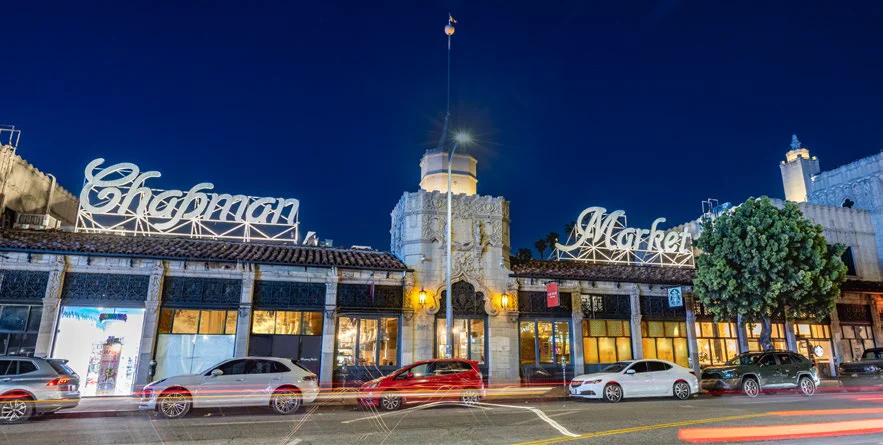
Arc Capital Partners has successfully secured $29.3 million in refinancing for the Chapman Market, a historic 41,241-square-foot retail and dining anchor situated at 3465 West Sixth Street in the heart of Los Angeles’ Koreatown. The financing package, provided by Voya Investment Management, marks a significant milestone for the property, which continues to serve as a high-traffic nexus for the neighborhood’s thriving culinary and entertainment scene. This latest capital infusion replaces a $25.5 million bridge loan obtained in 2021, reflecting both the sustained market value of the asset and the confidence institutional lenders maintain in the long-term viability of prime urban retail corridors.
The transaction was orchestrated by a brokerage team from Northmarq, including Joe Giordani, Alex Kane, and Karl Weidell, who collaborated with Bryan Ley and Tim Kuruzar to finalize the deal. The refinancing ensures that Arc Capital Partners, which acquired the landmark a decade ago for $30 million, maintains a stable debt structure as it continues to manage the property’s evolution in a rapidly changing economic landscape.
A Century of Architectural and Commercial Significance
The Chapman Market, commonly referred to as Chapman Plaza, occupies a unique position in the history of urban development in the Western United States. Constructed in 1928, the property was one of the earliest retail centers specifically engineered to accommodate the rise of the automobile. According to the L.A. Conservancy, the center’s design—which featured an interior courtyard meant to allow drivers to pull in and shop—represented a shift in how retail spaces were conceived in the early 20th century, moving away from traditional sidewalk-facing storefronts to car-centric accessibility.
The structure is recognized today as a Los Angeles Historic-Cultural Monument. Its Spanish Colonial Revival architecture, characterized by its distinctive courtyard layout and ornamental detailing, has been carefully preserved even as the tenant mix has modernized. The site has transitioned from its original iteration as an early market to a vibrant, multi-concept hub that anchors one of the most densely populated and economically active neighborhoods in Southern California.
Chronology of Ownership and Investment
The financial history of the Chapman Market highlights the asset’s resilience. When Arc Capital Partners acquired the property in 2014, the acquisition price of $30 million was viewed as a strategic investment in an area of Los Angeles that was undergoing significant cultural and commercial revitalization.
The timeline of the property’s recent financial trajectory includes:
- 2014: Arc Capital Partners completes the acquisition of the Chapman Market for $30 million.
- 2014–2020: The property undergoes sustained curation of its tenant base, shifting focus toward high-end Korean dining, specialty dessert concepts, and nightlife venues to align with Koreatown’s demographic shifts.
- 2021: The firm secures a $25.5 million bridge loan to stabilize the property’s capital structure and fund operational improvements.
- 2024: Voya Investment Management provides $29.3 million in new financing, signaling an appreciation in the property’s valuation and a successful refinancing strategy in a high-interest-rate environment.
The Tenant Ecosystem and Cultural Impact
The success of the Chapman Market as a commercial asset is inextricably linked to its diverse and highly specialized tenant roster. Unlike standard strip malls, the Chapman Market has curated a destination-based experience that attracts both local residents and regional tourists. The current tenant mix features a blend of established culinary institutions and trending specialty shops, including:
- Dining: Escala, Quarters Korean BBQ, Origin Korean BBQ, and Toebang Café.
- Specialty/Retail: KazuNori, Shibuyala, and Danbi.
- Beverage/Dessert: Starbucks, Tiger Sugar Boba, BHC Chicken, and Uncle Tetsu.
- Entertainment: Club HUE.
The concentration of these businesses within a single, historic footprint creates a "sticky" retail environment, where patrons are encouraged to move from dinner to dessert or entertainment without leaving the property. This operational model has proven effective in maintaining high occupancy rates, even as the retail sector faces broader challenges related to e-commerce and shifting consumer habits.
Brokerage Perspectives and Market Sentiment
Joe Giordani, a key facilitator of the deal at Northmarq, emphasized the unique positioning of the property in his statement regarding the transaction. "If you’ve been to this property, you know it sits at the epicenter of Koreatown’s vibrant nightlife," Giordani noted. His assessment underscores the value of "place-making"—the ability of a property to become an essential cultural landmark rather than merely a square footage lease.
From a market perspective, the involvement of Voya Investment Management suggests that institutional lenders are still willing to commit capital to high-quality, "trophy" retail assets, provided they are located in transit-oriented or high-density urban nodes. The refinancing of the Chapman Market stands in contrast to the broader cooling of the commercial real estate market, where lenders have become increasingly selective regarding office and secondary retail assets.
Broader Economic Implications
The refinancing of the Chapman Market carries several implications for the Los Angeles commercial real estate market:
- Resilience of Urban Retail: While big-box retail and regional malls have struggled, urban "lifestyle" retail centers that cater to specific cultural demographics and dining experiences continue to perform well. The Chapman Market serves as a case study for the successful repurposing of historic infrastructure for modern consumer needs.
- Valuation Trends: The increase in financing amount from $25.5 million in 2021 to $29.3 million in 2024 reflects a positive outlook on the cash flow generated by the property. Despite the current inflationary environment, the consistent demand for high-quality dining in Koreatown has allowed the property to maintain strong rent rolls.
- Koreatown’s Continued Growth: Koreatown remains one of the most active commercial markets in Los Angeles. The success of the Chapman Market highlights the ongoing investment in the area’s infrastructure and the desire of investors to capture the spending power of the local population and the significant visitor traffic the neighborhood attracts.
Conclusion
The $29.3 million refinancing deal for the Chapman Market serves as a testament to the enduring value of well-preserved historic architecture combined with strategic commercial management. By securing this debt, Arc Capital Partners has successfully positioned the property to continue its role as a vital contributor to the Los Angeles economy. As the city continues to densify and evolve, the Chapman Market remains a hallmark of how historical significance and modern commercial utility can coexist, ensuring its relevance for years to come.
The transaction serves as a positive indicator for the Los Angeles retail investment market, suggesting that assets with strong local identity and high tenant demand remain attractive to institutional capital, regardless of broader macroeconomic pressures. For stakeholders in the Koreatown area, the stability of the Chapman Market is a welcome sign of continued confidence in the region’s commercial potential.