Between 11 million and 16 million years ago, during the middle Miocene period, the ancestors of the modern Indus River dolphin migrated into the turbid, silt-heavy waters of the proto-Indus Basin. As sea levels receded and their environment shifted, these cetaceans underwent a profound evolutionary transformation. Over millions of years, they traded their vision for a sophisticated, biological sonar system, allowing them to navigate the murky, shallow, and seasonally fluctuating currents of what is now one of the world’s most heavily engineered river systems. Today, these "blind" mammals, locally known as the bhulan, navigate by swimming on their sides, using echolocation to hunt and communicate in a landscape that has become increasingly hostile to their survival.
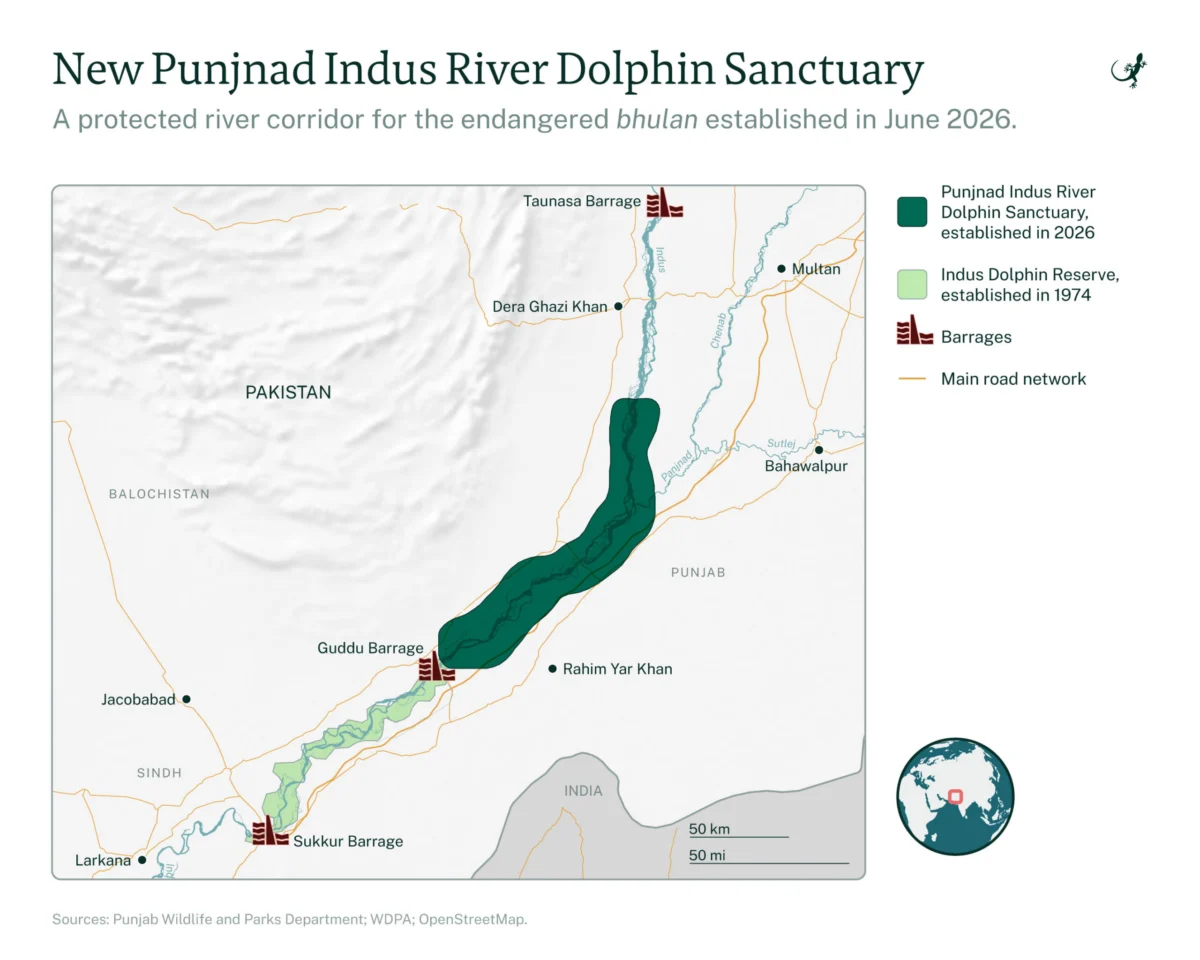
The recent establishment of the Punjnad Indus River Dolphin Sanctuary in June 2026 marks a pivotal milestone in the history of this endangered species. By safeguarding nearly 200 kilometers (123 miles) of the river in Punjab, the Pakistani government has created a contiguous 400-km (249-mi) protected corridor that bridges the gap between Punjab and the existing protected areas in Sindh province. This legal designation provides a necessary, albeit fragile, lifeline for a species whose historical range has been decimated by human intervention.

A Chronology of Decline and Resilience
The history of the Indus River dolphin is a narrative of near-extinction followed by a tenuous recovery. During the late 19th century, the population was estimated at approximately 10,000 individuals. As the 20th century progressed, the industrialization of the Indus Basin—characterized by the construction of massive barrages, irrigation canals, and dams—fragmented the river into isolated segments. This physical partitioning severely restricted the dolphins’ movement, limiting their ability to migrate for breeding or to escape harsh, low-water conditions during the dry season.
By 2001, the population had cratered to a record low of just 617 individuals. This alarming statistic served as a wake-up call for the international conservation community and the Pakistani government. Since then, a concerted, decades-long effort involving the banning of dolphin hunting in the 1970s, the deployment of specialized rescue teams for stranded animals, and stricter environmental monitoring has begun to pay dividends. According to a landmark 2025 study published in the journal Endangered Species Research, the total population has rebounded to approximately 1,987 individuals, representing a 19.4% increase between 2011 and 2017.
The Geography of Survival
The survival of the Indus River dolphin is currently tethered to a narrow geographical window. Nearly 99% of the remaining population is concentrated within a 690-km (430-mi) stretch of the river between the Chashma Barrage in the north and the Sukkur Barrage in the south. Hamera Aisha, the lead author of the 2025 ESR study, emphasizes that this concentration is both a blessing and a liability.

"The Indus River dolphin is endemic to the Indus River system, and the overwhelming majority of the remaining global population occurs in Pakistan, with only a very small remnant population now left in the Beas River in India," Aisha stated. "This also means that if these populations were lost from the Indus, there is no comparable population elsewhere that could secure the future of the species. This gives Pakistan a unique, non-transferable global responsibility for the species’ survival."
Multifaceted Threats in a Working River
While the expansion of protected areas is a significant victory for conservationists, experts warn that legal protection is only the first step in a much larger struggle. The Indus is a "working river," serving as the primary source of water for Pakistan’s vast agricultural sector. Consequently, the dolphins must share their habitat with the competing needs of human industry and food security.
The primary cause of mortality remains accidental entanglement in fishing nets. Between 2008 and 2023, data suggests that 52% of all recorded dolphin deaths in the Indus Basin were attributed to gillnet entanglement. Uzma Khan, a biologist with the World Wildlife Fund (WWF) and a co-author of the 2025 study, explains the systemic nature of this threat. "Punjab auctions fishing contracts for commercial activity," Khan noted. "Contractors are incentivized to extract as much biomass as possible to ensure the economic viability of their contracts. In this high-pressure environment, incidental bycatch is an unavoidable consequence that disproportionately impacts the dolphin population."

Furthermore, the physical fragmentation caused by dams and barrages remains a permanent threat. When water levels are manipulated for irrigation, dolphins are frequently swept into human-made canals, where they become stranded. For over two decades, rescue units have worked to locate these stranded animals, manually transporting them back to the main river channel—a process that is as stressful for the animals as it is logistically challenging for the responders.
The Role of Governance and Community
The declaration of the Punjnad Sanctuary by the Pakistani government is being lauded as a mature, science-based policy shift. Javed Mahar, a conservator with the Sindh Wildlife Department, underscored the importance of inter-provincial cooperation. "Before the construction of major irrigation infrastructure, these dolphins were found from Attock all the way to the Indus Delta," Mahar said. "The expansion of protection into Punjab is a vital, logical step. It complements the work already being done in Sindh and provides a framework for consistent regulation across the river’s path."
Beyond enforcement, the future of the species depends on the economic integration of local communities. Many traditional fishing families have seen their livelihoods decline, leading to a shift toward more aggressive commercial fishing practices. Conservationists believe that the new sanctuary can serve as a hub for "community-based sustainable fishing." By involving local populations in the management of the sanctuary, the government hopes to transition away from extractive models toward practices that prioritize the long-term health of the river ecosystem.

Broader Environmental Implications
The health of the Indus River dolphin is an indicator of the overall health of the Indus River. The ecosystem is currently under pressure from multiple environmental stressors, including toxic chemical runoff from gold mining, heavy metal contamination from industrial discharge, and the pervasive issue of plastic pollution.
Moreover, the specter of climate change looms large. The Indus is fed primarily by Himalayan glaciers, and shifting precipitation patterns, combined with the rapid melting of these glaciers, threaten to destabilize the river’s natural flow. "Dolphins depend on specific ecological cues, such as adequate water depth, interconnected channels, and deep, calm pools," Aisha explained. "When you disrupt the flow regime through water abstraction or climate-induced instability, you aren’t just harming the dolphin; you are degrading the entire aquatic food web upon which the local human population also depends."
The Path Forward: Standards and Science
To ensure the sustainability of the recent gains, experts advocate for the adoption of the Conservation Assured | River Dolphin Standards (CA|RDS). This international framework provides a standardized approach to managing river dolphin habitats, focusing on evidence-based decision-making, stakeholder engagement, and transparent reporting.

The implementation of these standards within the new Punjnad sanctuary could transform it from a mere "line on a map" into a functional, dynamic conservation zone. However, as Uzma Khan points out, the burden of protection is shared. "The notification is a welcoming development, but it is not a finish line," Khan said. "The responsibility for protecting the species now rests on our ability to enforce these standards, mitigate the impact of commercial fishing, and maintain the ecological integrity of the river for the next generation of both humans and dolphins."
As the Indus River dolphin faces an uncertain future in a rapidly changing environment, the success of the Punjnad sanctuary will serve as a bellwether for global river conservation. By reconciling the needs of a growing nation with the requirements of an ancient, highly specialized predator, Pakistan has the opportunity to demonstrate that development and biodiversity are not necessarily mutually exclusive, provided that the stewardship of the natural world is treated with the same urgency as economic growth.