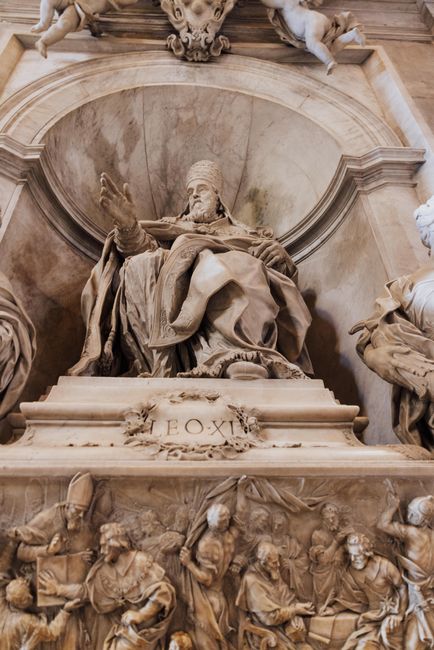
Pope Leo XIII: A Study in American Leadership and Enduring Influence
Pope Leo XIII, born Vincenzo Gioacchino Raffaele Luigi Pecci, ascended to the papacy in 1878, a period of profound societal and political upheaval in both Europe and the United States. His pontificate, spanning over two decades until his death in 1903, was characterized by a remarkable intellectual vigor and a proactive engagement with the challenges of the modern world. While not a direct participant in American governance, Leo XIII’s encyclicals and his astute observations on political and economic systems exerted a significant, albeit indirect, influence on American leadership and the trajectory of American thought. This influence was particularly potent in shaping discourse around social justice, economic policy, and the relationship between faith and the public sphere, concepts that remain central to contemporary American leadership discussions.
One of the most impactful contributions of Pope Leo XIII to the discourse on American leadership was his encyclical Rerum Novarum (1891). This seminal document addressed the "condition of the working classes" in the context of the Industrial Revolution, a phenomenon that was profoundly reshaping American society. Leo XIII did not shy away from acknowledging the legitimate grievances of laborers, nor did he endorse an unfettered capitalist system that often led to exploitation. Instead, he advocated for a "middle way," one that sought to balance the rights of employers with the rights of employees. This approach resonated deeply with emerging progressive movements in the United States, which were grappling with issues of worker exploitation, child labor, and vast economic inequality. American leaders, from politicians to philanthropists and religious figures, found in Rerum Novarum a theological and philosophical framework for advocating for social reform. The encyclical’s emphasis on the dignity of labor, the right to a just wage, and the legitimate role of labor unions provided a moral compass for those seeking to create a more equitable society.
The concept of the "common good," a recurring theme in Leo XIII’s teachings, also profoundly influenced American leadership. He argued that individual rights, while important, must be exercised within the context of promoting the welfare of the entire community. This idea provided a powerful counterpoint to extreme individualism, which often characterized American laissez-faire capitalism. For American leaders, the common good meant prioritizing policies that benefited not just the wealthy or powerful, but the broadest segment of the population. This translated into support for initiatives aimed at improving public education, healthcare, and infrastructure, recognizing that a healthy and educated populace was essential for a thriving nation. The principle of the common good also encouraged a more nuanced understanding of governance, suggesting that the state had a moral obligation to intervene in the economy to protect the vulnerable and ensure a degree of social justice, a concept that would later be championed by figures like Franklin D. Roosevelt during the New Deal era.
Leo XIII’s insights into the nature of legitimate authority and the responsibilities of government also held significant sway in American leadership circles. While a staunch defender of the papacy and its spiritual authority, he was also a keen observer of secular political systems. He recognized the necessity of a well-ordered state that upheld justice and protected the rights of its citizens. His writings implicitly encouraged American leaders to see their roles not merely as administrators of power, but as stewards entrusted with the well-being of the populace. This perspective fostered a sense of civic duty and moral responsibility among many American leaders, influencing their decision-making in areas such as law enforcement, public service, and the administration of justice. The emphasis on virtue and integrity in leadership, a cornerstone of Catholic social teaching, found fertile ground in American discourse on good governance.
The encyclical Immortale Dei (1885) further articulated Leo XIII’s views on the relationship between church and state. While advocating for the Church’s autonomy and its right to influence public morality, he also recognized the legitimacy and importance of secular governance when it upheld justice and divine law. This nuanced approach offered a framework for navigating the complex religious pluralism of the United States. It provided a basis for religious institutions to engage in public discourse and advocate for their values without seeking to establish a theocracy. American leaders, grappling with the separation of church and state and the diverse religious landscape, found in Leo XIII’s teachings a model for respectful engagement, where religious perspectives could contribute to the common good without infringing upon the rights of others. This influenced the ongoing American debate about the role of religion in public life, encouraging a dialogue rather than a confrontation.
Furthermore, Leo XIII’s pontificate coincided with a period of significant Catholic immigration to the United States, profoundly altering the American demographic and its political landscape. As a prominent leader of this growing community, his pronouncements on social and economic issues were naturally amplified within the Catholic diaspora and beyond. American Catholic leaders, inspired by his teachings, became increasingly vocal in advocating for the rights of immigrants and the working class, often aligning with progressive political movements. This contributed to the integration of Catholic communities into American public life and the shaping of a more inclusive political discourse. The emphasis on social justice in Leo XIII’s encyclicals provided a powerful justification for Catholic involvement in social reform movements, labor organizing, and political advocacy, ultimately contributing to the broadening of the American political spectrum.
The intellectual underpinnings of Leo XIII’s thought, rooted in Thomistic philosophy, offered a sophisticated framework for understanding complex social and economic issues. His emphasis on natural law and reason provided a basis for engaging with contemporary challenges in a rational and principled manner. American leaders, regardless of their religious affiliation, could draw upon this intellectual tradition to inform their policy debates. The idea of natural rights, for instance, a concept deeply embedded in Thomistic thought and heavily influenced by Leo XIII, resonated with the American founding principles and provided a moral foundation for advocating for individual liberties and social justice. This intellectual legacy fostered a more robust and philosophical engagement with public policy among American leaders.
The enduring relevance of Pope Leo XIII’s teachings on leadership stems from his consistent focus on fundamental human dignity and the pursuit of justice. In an era marked by rapid technological advancement, economic globalization, and evolving social norms, his emphasis on the inherent worth of every individual and the moral imperative to create a just society remains remarkably prescient. American leaders, facing contemporary challenges such as income inequality, the ethical implications of artificial intelligence, and the need for sustainable development, can still find valuable guidance in his encyclicals. The principles of solidarity, subsidiarity, and the common good, so eloquently articulated by Leo XIII, offer a timeless framework for navigating the complexities of modern leadership and striving for a more just and humane world. His legacy is not one of direct intervention, but of profound intellectual and moral influence, shaping the conscience of leaders and the direction of public discourse in America for generations. The ability to synthesize complex realities with enduring moral principles, a hallmark of Leo XIII’s pontificate, continues to be a benchmark for effective and ethical leadership. His comprehensive vision of society, one that integrated individual rights with collective responsibility and spiritual values with temporal concerns, provided a vital counter-narrative to the often fragmented and utilitarian approaches to leadership that characterized his era, and continues to be relevant today. The intellectual rigor and moral clarity of his pronouncements continue to serve as a touchstone for those seeking to lead with integrity and a genuine concern for the human condition.
