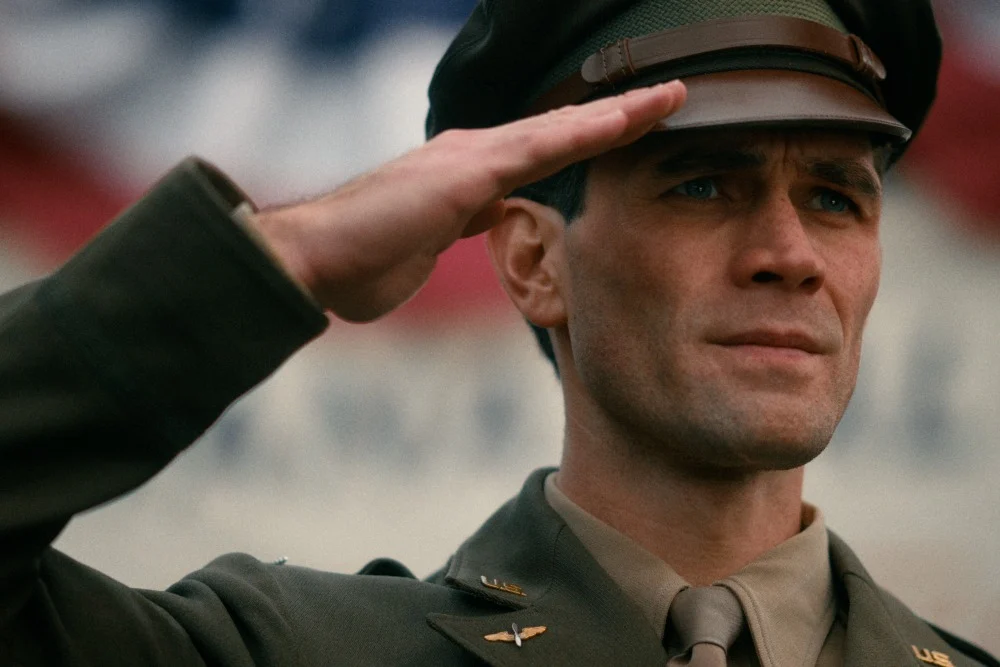
The newly released biographical drama Jimmy attempts to capture the extraordinary life of legendary Hollywood icon James Stewart, focusing heavily on his patriotic military service rather than his illustrious cinematic artistry. Directed by Aaron Burns and distributed by Fathom Entertainment, the film stars Riverdale actor KJ Apa as the celebrated actor. However, rather than offering a complex psychological examination of a multifaceted man, the movie delivers a hokey, superficial portrait that leans heavily into sanitized hagiography. While Stewart was well-known during his lifetime as one of Hollywood’s staunchest Republicans and a genuine American patriot, this cinematic tribute ultimately reduces a complex cultural icon to a bland, one-size-fits-all vessel of conventional virtue, lacking the artistic depth and emotional grit that defined the actor’s actual legacy.
Background Context and Production Framework
To understand the tonal leaning of Jimmy, one must examine the creative provenance behind the project. Director Aaron Burns previously helmed two features produced by the streaming arm of Affirm Films, a studio renowned for its output of faith-based cinema. While Jimmy is not explicitly marketed as a traditional faith-based movie, it sits firmly in a faith-adjacent territory. The screenplay, penned by Justin Strawhand, places substantial emphasis on Stewart’s Presbyterian upbringing and features multiple moments of overt religious epiphany during times of crisis.
This thematic choice aligns with public perceptions of Stewart, who cultivated a cinematic persona rooted in ordinary decency, down-to-earth charm, and a stark rejection of Hollywood glamour and decadence in favor of traditional family values. Yet, by filtering his life through this narrow lens, the filmmakers miss the opportunity to explore the inner turmoil of a man caught between the glittering illusions of the studio system and the harsh, bloody realities of global warfare. Instead of feeling like a genuine exploration of a human being, the film trades psychological nuance for sentimental platitudes, leaving viewers with little insight into what truly drove one of the 20th century’s most enduring actors.
Chronology of a Star at War
The narrative structure of Jimmy opens in medias res, plunging audiences directly into the post-World War II era. A traumatized Stewart is shown debating whether to take on the lead role in Frank Capra’s classic holiday film, It’s a Wonderful Life. Capra, played by Max Casella, attempts to convince a hesitant Stewart by prophesying that the film will be remembered a century later—a piece of dialogue that leans heavily into self-aware, on-the-nose screenwriting.
From this framing device, the film rewinds five years to 1941. At this juncture, Stewart is fresh off winning the Academy Award for Best Actor for The Philadelphia Story, standing at the absolute zenith of his early Hollywood career. However, the trajectory of his life shifts dramatically when he receives his draft notice from the U.S. Army.
The historical tension of the moment is depicted through polarized industry reactions: studio mogul Louis B. Mayer, portrayed by Jason Alexander, attempts to wave the draft away to keep his prized box-office asset working, while infamous gossip columnist Hedda Hopper falsely reports that the actor is dodging his military obligations. Simultaneously, Stewart faces familial pressure from his stern, salt-of-the-earth father, played by Neal McDonough, who dismisses his son’s military aspirations with stinging skepticism.
Despite these external pressures, Stewart ultimately enlists in the United States Army Air Forces, triggering a five-year hiatus from the silver screen. The narrative then shifts to his wartime service stationed in England as a B-24 bomber pilot with the 453rd Bombardment Group. During this sequence, the film portrays his bonding with fellow servicemen, his execution of perilous aerial combat—rendered via synthetic, video game-style visual effects—and a fictionalized, rather tedious romance with a brittle English aristocrat named Julia, played by Kara Killmer.
Analysis of Performances and Cinematic Execution
The core of the film rests upon the shoulders of KJ Apa, whose portrayal of James Stewart relies heavily on capturing the actor’s signature drawl, physical posture, and aw-shucks demeanor. While Apa delivers an enthusiastic performance, the execution remains thin. Rather than portraying a complex individual navigating the immense pressures of public stardom and the psychological devastation of war, Apa’s Stewart functions primarily as an interchangeable nice guy.
When the film attempts to delve into his internal struggles, it resorts to a generic, surface-level depiction of World War II-related PTSD. The dialogue throughout the feature frequently relies on clunky platitudes—such as Stewart declaring his desire to look in the mirror and see a good man, or asserting that he wishes to be a man rather than a god. These lines risk rendering the cinematic icon as overly preachy rather than deeply human.
Furthermore, the cinematographic choices made by director of photography James Mather fail to establish a distinct visual boundary between the artificial glitter of Hollywood backlots and the mud and blood of European airfields. By applying a smooth, gilded finish to every scene, the film robs the transition from civilian stardom to combat duty of its seismic psychological impact. The audience is constantly reminded of the camera’s presence, undercutting the emotional authenticity required to make a biographical drama resonate.
Broader Impact and Critical Implications
The release of Jimmy highlights a growing trend within contemporary biographical filmmaking: the creation of hagiographic tributes that prioritize comfort, political alignment, and sentimentality over historical rigor and artistic inquiry. By transforming James Stewart into a simplistic archetype of American virtue, the film ultimately does a disservice to a man whose real-life trajectory was infinitely more complex, contradictory, and compelling than any simplistic cinematic narrative can capture.
As a cultural artifact, the film underscores the enduring power of the persona Stewart built on screen, even as it struggles to decode the man behind the myth. Towards the end of the narrative, during the making of It’s a Wonderful Life, a beleaguered Stewart receives crucial advice from a colleague: what the audience truly needs is raw, unvarnished truth, and the question is whether the artist is brave enough to deliver it. While James Stewart spent his legendary career proving time and again that he possessed that courage, this particular cinematic tribute ultimately falls short of that standard, leaving the definitive story of his extraordinary life yet to be told.