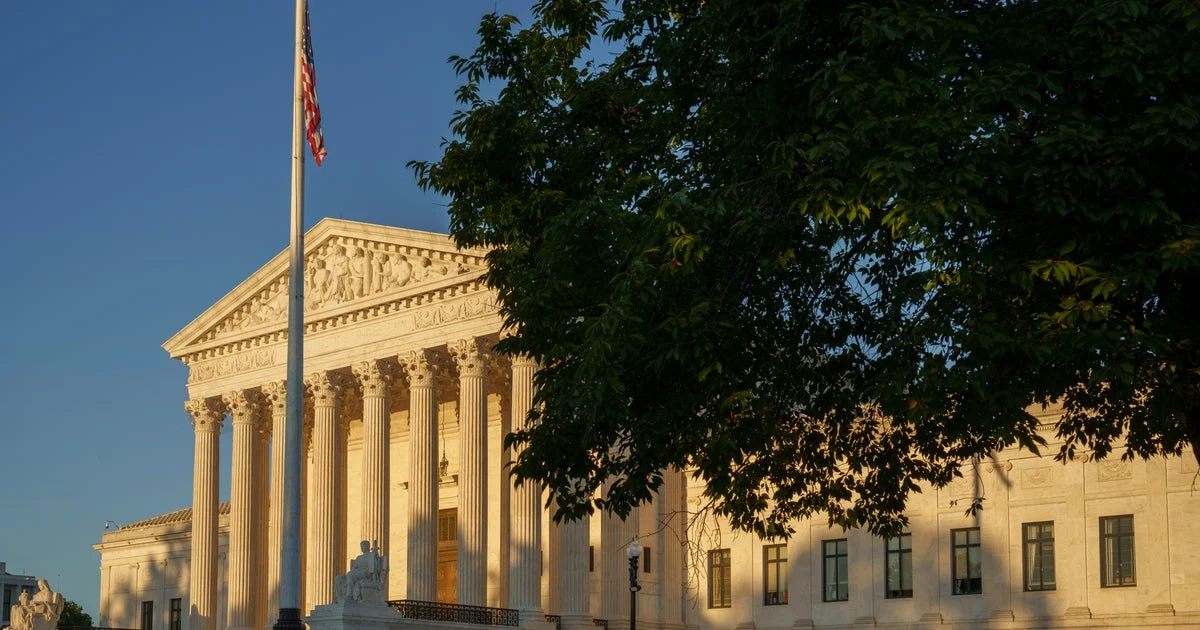
The Supreme Court of the United States has once again intervened in the high-stakes legal battle over congressional maps in Missouri, issuing an unsigned order that prevents the state from implementing a newly redrawn map for the upcoming November 3 general election. Friday’s decision ensures that Missouri will conduct its congressional elections using the existing district lines established in 2022, effectively rebuffing an eleventh-hour push by state officials and Republican leadership to secure a more favorable political landscape ahead of the midterm contests.
The ruling, which featured no noted dissents, heavily emphasized the logistical impossibility of altering election administration while voting is actively underway. In its opinion, the high court noted that "the election is not merely upcoming; it has already started," warning that forcing a reversion to the newly drawn 2025 map at this advanced stage would "usher in electoral chaos."
The decision serves as a definitive punctuation mark on a chaotic sequence of lower court rulings and emergency filings that have whipsawed Missouri voters, candidates, and election administrators for months. With military and overseas ballots already distributed and in-person absentee voting officially underway, the Supreme Court’s action brings a measure of procedural finality to a deeply contested electoral map.
The Anatomy of a Redistricting Battle
The controversy stems from a mid-decade redistricting push orchestrated by the Republican-led Missouri General Assembly. Strongly backed by former President Donald Trump, the state legislature approved a heavily modified congressional map last year designed to secure a more commanding partisan advantage. Under the contested 2025 plan, Republicans would have held a distinct structural edge in seven of Missouri’s eight congressional districts, a significant shift from the current delegation, which divides the state’s representation between six Republicans and two Democrats.
The most notable structural alteration in the newly drawn map involved the strategic fragmentation of the Kansas City metropolitan area. By dividing the traditional Democratic stronghold, the map effectively diluted the voting power of urban constituents and shifted the political leanings of the district currently represented by Democratic U.S. Representative Emanuel Cleaver, rendering it substantially more conservative.
Proponents of the map argued that the redrawing was a lawful exercise of legislative authority aimed at reflecting shifting population demographics and aligning the state’s representation with its broader conservative voting patterns. Conversely, voting rights advocates and civil groups challenged the map, contending that it constituted an unconstitutional partisan gerrymander designed to improperly tilt the electoral playing field in favor of the GOP.
A Chronology of Judicial Whiplash
The path to the Supreme Court’s final intervention was marked by a rapid succession of conflicting rulings across both state and federal benches, creating a dizzying procedural maze for election officials.
- August 2026: Missouri conducted its primary elections using the newly redrawn 2025 congressional districts, leaving candidates and voters operating under the assumption that the boundaries would govern the general election.
- Early September 2026: A series of state-level legal challenges culminated in a decision by the Missouri Supreme Court blocking the use of the new map, prompting the state to consider reverting to the 2022 framework.
- Mid-September 2026: A federal district court intervened in a separate lawsuit, ordering the state to use the 2025 map. Supreme Court Justice Brett Kavanaugh subsequently issued a temporary administrative stay, preserving the status quo and allowing the 2022 lines to remain in place momentarily.
- September 22, 2026: The legal conflict intensified when an emergency appeal was filed by the advocacy group People Not Politicians, urging the Supreme Court to halt lower-court attempts to reinstate the Republican-backed map.
- September 21–22, 2026: In a rapid about-face, the U.S. Court of Appeals for the 8th Circuit ruled that utilizing the 2022 map violated the U.S. Constitution, prompting a federal district judge to issue a permanent injunction mandating the implementation of the 2025 map.
- September 25, 2026: The Supreme Court issued its final unsigned order, vacating the lower federal court injunctions and cementing the use of the 2022 boundaries for the November 3 general election.
Official Responses and Competing Arguments
The protracted litigation exposed deep divisions over the administrative realities of running a modern election and the constitutional rights of the electorate. Throughout the emergency proceedings, both advocacy groups and state election administrators painted grim pictures of the consequences associated with whichever map ultimately prevailed.
Attorneys representing People Not Politicians argued before the high court that the 8th Circuit’s late-stage ruling was an improper attempt to override prior judicial directives, resulting in widespread confusion. "The result is chaos on both sides of Election Day: confusion over how to conduct the election now, and uncertainty over the rules governing its results," the organization stated in its legal filings.
On the other side, Missouri state officials warned of severe operational hurdles and potential disenfranchisement. In briefs submitted to the Supreme Court, state representatives argued that forcing a return to the 2022 map after primaries had already been contested under the 2025 boundaries would invalidate the votes of hundreds of thousands of citizens and force candidates to campaign in unfamiliar territory.
Furthermore, state election officials underscored the physical and financial impossibility of redesigning, printing, and distributing hundreds of thousands of new ballots while voting was already in progress. Missouri was legally obligated under federal law to dispatch overseas and military ballots by September 19, a deadline met using the framework of the ongoing legal disputes. Local election authorities maintained that any further disruption would fundamentally compromise the integrity and punctuality of the election administration process.
Broader Implications for the 2026 Midterms
The Supreme Court’s decision carries profound national implications as both political parties fight tooth and nail for control of the U.S. House of Representatives in the 2026 midterm elections. Missouri is one of several Republican-leaning states where legislative majorities sought to aggressively redraw congressional lines mid-cycle to maximize their party’s durability in Washington.
By locking in the 2022 map for Missouri, the high court’s ruling preserves the existing partisan balance within the state’s congressional delegation, denying national Republicans a targeted pickup opportunity that could have proved decisive in a tightly contested House majority battle.
At the same time, the protracted saga highlights the recurring friction between judicial oversight of election laws and the rigid, immovable deadlines of modern electoral administration. As state lines and voting rules remain flashpoints of intense partisan competition, the Missouri case underscores the growing frequency with which federal courts are forced to intervene to establish certainty before ballots are cast. With the legal avenues now exhausted, Missouri voters will proceed to the polls on November 3 under the familiar boundaries of the 2022 map, bringing an end to months of jurisdictional uncertainty.