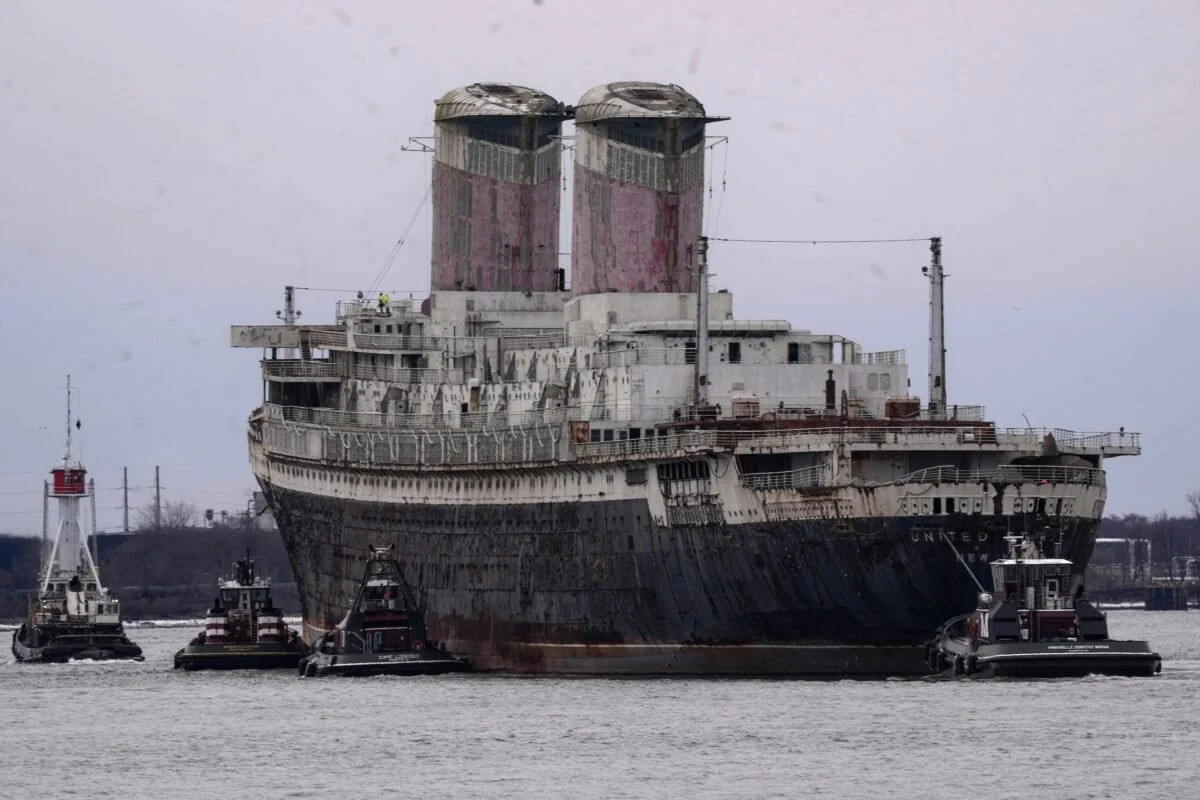
The SS United States, once the undisputed titan of the North Atlantic and a symbol of mid-century maritime engineering, has transitioned from a storied passenger liner to a permanent fixture of the deep sea. On Wednesday, officials along the Florida Panhandle successfully scuttled the 990-foot vessel approximately 25 miles southwest of Destin. This $13.5 million operation, situated in the waters between Panama City and Pensacola, marks the culmination of a years-long effort to repurpose the historic ship, transforming a decaying technological marvel into a massive artificial reef intended to bolster marine biodiversity and regional tourism.
A Legacy of Speed and Innovation
To understand the magnitude of this event, one must look back to the ship’s inception. Launched in 1952, the SS United States was designed not merely for luxury, but for speed and military versatility. Built by the United States Lines, the ship was a product of the Cold War era, secretly designed to be converted into a troopship capable of carrying 14,000 soldiers should the need arise.
On its maiden voyage in July 1952, the liner shattered the transatlantic speed record, making the crossing from New York to Bishop Rock, England, in just three days, 10 hours, and 40 minutes. It reached an average speed of 35.59 knots—a record for a passenger ship that remains unbroken to this day. Throughout the 1950s and early 1960s, the ship served as the flagship of the American merchant marine, hosting heads of state, Hollywood celebrities, and thousands of transatlantic travelers.
However, the advent of the jet age in the late 1960s rendered the slow, expensive nature of ocean travel obsolete. The SS United States was withdrawn from service in 1969, entering a long, uncertain period of decline that spanned over five decades. It spent years docked in Philadelphia, serving as a ghostly reminder of a bygone era of luxury travel, while various preservation efforts struggled to secure the funding necessary for a full restoration.
Chronology of the Reefing Project
The path to the Gulf of Mexico was fraught with legal, financial, and logistical hurdles. The decision to convert the ship into an artificial reef was not reached lightly; it followed years of failed attempts to find a buyer capable of restoring the vessel to operational status.
- 2011–2021: The SS United States Conservancy fought to maintain the ship in Philadelphia, hoping to transform it into a stationary hotel, museum, or event space. Despite significant fundraising efforts, the costs of asbestos abatement and structural repairs proved insurmountable.
- 2023: As the structural integrity of the ship began to decline and pier lease costs mounted, the Conservancy acknowledged that the vessel could no longer be preserved in its original form.
- Early 2024: Discussions began with Florida authorities regarding the state’s robust artificial reef program, which has successfully deployed dozens of decommissioned ships, bridge rubble, and concrete structures to stimulate fish habitats.
- February 2025: The ship was towed from Philadelphia to the Gulf of Mexico, a complex maritime operation that drew spectators and historians alike, marking the final voyage of the vessel.
- March 2025: The scuttling process was finalized, with charges placed to breach the hull in a controlled manner, allowing the vessel to settle upright on the seafloor.
Technical Specifications and Environmental Impact
The SS United States measures 990 feet in length, making it significantly larger than any other vessel currently serving as an artificial reef. For context, the previous record-holder, the USS Oriskany, which was sunk off the coast of Pensacola in 2006, measured 888 feet.
The environmental implications of this project are substantial. The Gulf of Mexico has long benefited from the state of Florida’s aggressive artificial reef deployment strategy. By placing such a massive steel structure on the sandy, relatively barren bottom of the Gulf, biologists expect a rapid colonization process. Within months, the ship’s vast exterior and interior spaces will likely become encrusted with barnacles, corals, and sponges. This "living structure" creates a complex habitat that provides shelter and hunting grounds for apex predators, including tuna, marlin, and swordfish, as well as smaller reef species like snapper and grouper.
“We are essentially building an underwater skyscraper,” said a marine biologist familiar with the project. “The vertical profile of the ship disrupts local currents, bringing nutrient-rich water to the surface and creating a micro-ecosystem that supports life from the smallest microorganisms up to large pelagic fish.”

Economic Implications for the Panhandle
For the communities of Destin, Panama City, and Pensacola, the SS United States is expected to be an economic catalyst. The Florida Panhandle relies heavily on a dual-track tourism economy: beach recreation and maritime sport.
Local officials anticipate that the ship will become one of the premier dive sites in the world. While the deeper sections of the ship will be accessible only to technical divers, the sheer scale of the wreck provides opportunities for a wide range of underwater exploration. Furthermore, the concentration of game fish around the structure is expected to draw recreational anglers, potentially increasing demand for charter boat services and local hospitality accommodations.
Estimates from the Florida Fish and Wildlife Conservation Commission suggest that for every dollar spent on artificial reef construction, the state sees a significant return in economic impact through increased tax revenue, equipment sales, and tourism-related spending.
Official Responses and Preservation Concerns
While the project has been hailed as a triumph of recycling and resource management, it remains a bittersweet conclusion for maritime preservationists. The SS United States Conservancy issued a statement noting that while they are saddened to see the end of the vessel as a physical icon, they are pleased that its "final resting place will honor its legacy by serving as a sanctuary for marine life."
Government officials involved in the project emphasized that the scuttling was conducted in full compliance with the Environmental Protection Agency (EPA) and international maritime standards. "Every step was taken to ensure the vessel was stripped of hazardous materials, particularly asbestos and fuel oils, prior to the sinking," said a spokesperson for the project. "This is not merely the disposal of a ship; it is the creation of a permanent marine asset."
Critics, however, have noted that the loss of the ship represents a permanent erasure of an engineering marvel. Unlike a museum, the ship will eventually succumb to the slow process of corrosion. Even with the best preparation, the structure will, over several centuries, return to the earth.
Broader Implications for Maritime History
The fate of the SS United States raises broader questions about how modern society treats its industrial heritage. As ships, aircraft, and large-scale infrastructure age, the cost of preservation often outweighs the cultural value in the eyes of the public and private donors.
The successful reefing of the SS United States may serve as a blueprint for future large-scale disposals. By repurposing massive steel structures into artificial reefs, the shipping and defense industries can avoid the environmental damage associated with breaking ships down in scrap yards—a process that often involves significant pollution and carbon emissions—while simultaneously providing a net positive for ocean conservation.
As the bubbles from the final descent dissipate and the SS United States settles into its new role as a reef, the ship enters a new chapter of its existence. No longer a passenger liner racing across the Atlantic, it is now a foundational piece of the Gulf of Mexico’s ecological future. For those who once walked its decks, it remains a memory of a vanished era of elegance. For the Gulf itself, it marks the beginning of a vibrant, deep-sea legacy that will outlast the history of the 20th century, serving as a testament to the intersection of human engineering and natural resilience.