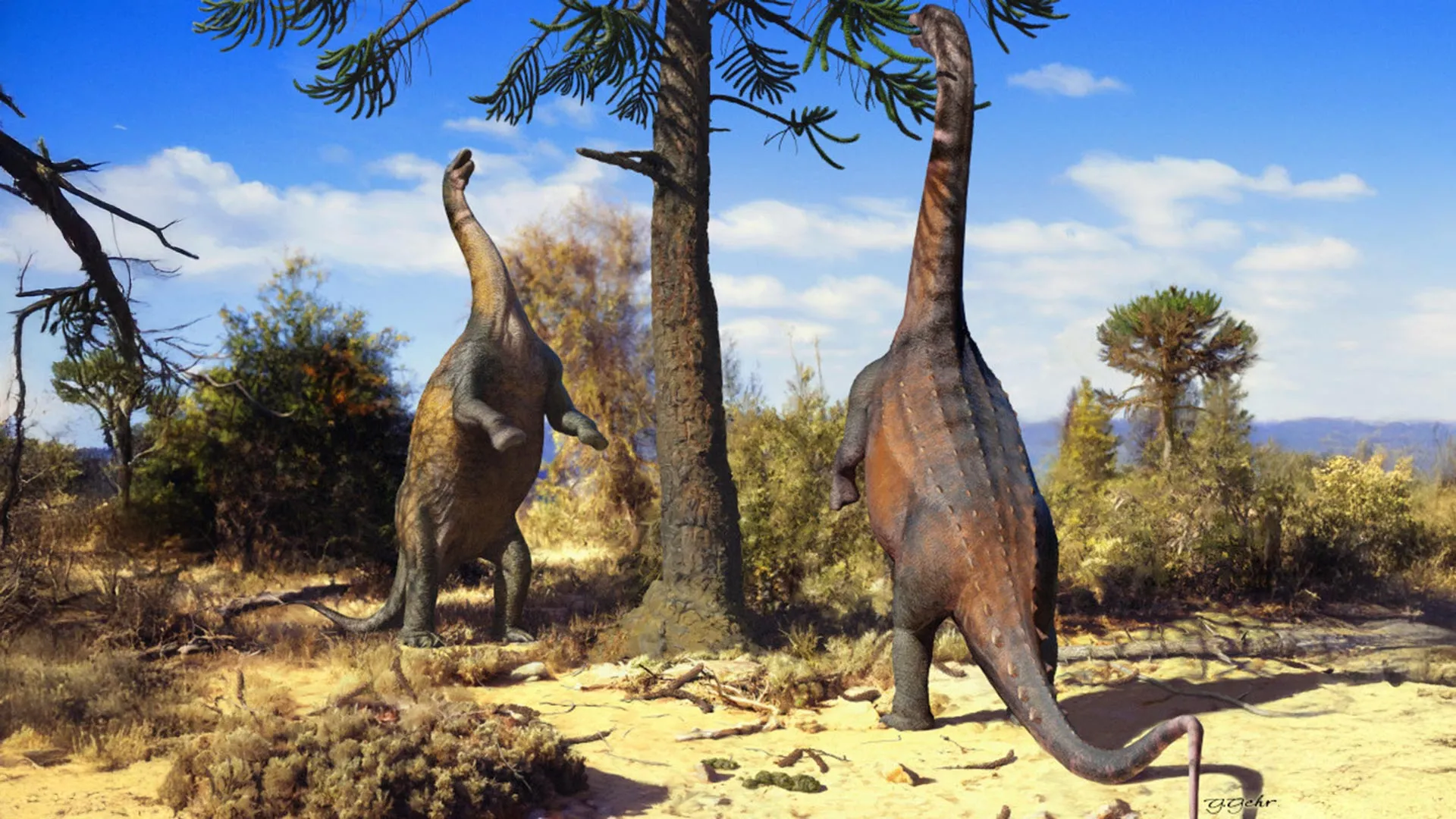
Sixty-six million years ago, during the twilight of the dinosaur era, two South American sauropods, Uberabatitan from Brazil and Neuquensaurus from Argentina, may have possessed a surprising degree of agility. Contrary to the common perception of these long-necked herbivores as lumbering behemoths, new research suggests they were capable of standing on their hind legs for extended periods, particularly during their youth. This newfound understanding, derived from advanced engineering simulations applied to fossilized bones, paints a more dynamic picture of these ancient giants and offers insights into their survival strategies in the Late Cretaceous world.
Engineering the Past: Unlocking Sauropod Biomechanics
The groundbreaking study, published in the journal Palaeontology and supported by the São Paulo Research Foundation (FAPESP), utilized computational engineering techniques to analyze the biomechanical stresses on the femurs (thigh bones) of several sauropod species. By digitally reconstructing fossilized femurs and employing Finite Element Analysis (FEA), a method commonly used in civil and mechanical engineering to assess structural integrity, an international team of scientists from Brazil, Germany, and Argentina aimed to quantify the forces these dinosaurs endured when adopting an upright posture.
FEA works by dividing a complex structure into a multitude of smaller, interconnected elements. Each element’s response to applied forces, such as gravity and body weight, is then calculated. This allows researchers to map areas of high stress and strain within the bone, providing a detailed understanding of how it would withstand pressure.
"The ability to stand on two legs, even for short durations, would have placed significant stress on the femur, the largest bone in the leg," explained Dr. Julian Silva Júnior, a postdoctoral researcher at the School of Engineering of São Paulo State University (FEIS-UNESP) and the study’s lead author. "Our goal was to simulate how these forces were distributed and to identify which species were best equipped to handle them."
The research team focused on seven sauropod species, chosen to represent diverse evolutionary lineages, body sizes, and anatomical variations. Digital models were constructed from fossilized femurs housed in natural history museums across the globe. These included not only the two South American species of particular interest but also other sauropods of varying sizes.
The South American Advantage: Robust Skeletons for Upright Prowess
The simulations revealed a striking difference in stress distribution among the studied sauropods. The lowest stress levels, indicating a superior ability to support upright posture, were observed in Uberabatitan ribeiroi and Neuquensaurus australis. These two species, which coexisted approximately 66 million years ago during the Late Cretaceous period, possessed femurs that were notably more robust. Their thicker and sturdier bones were better able to dissipate the considerable forces generated when they shifted their weight onto their hind legs.
"These South American sauropods exhibited particularly robust femurs, allowing them to effectively spread and manage the stress associated with bipedalism," stated Dr. Silva Júnior. "While larger sauropods also had immense musculature and formidable femurs, the sheer magnitude of their body weight likely meant that standing upright for extended periods would have been significantly more taxing and uncomfortable for them compared to their smaller South American counterparts."
This suggests that while many sauropods might have possessed the physical capacity to briefly rear up, Uberabatitan and Neuquensaurus were biomechanically predisposed to prolonged bipedalism, especially when younger. As these animals grew, their increasing mass would have amplified the stress on their femurs, gradually diminishing their acrobatic capabilities. Adult Uberabatitan, though among the largest known dinosaurs from Brazil, reaching lengths of up to 26 meters, would have faced similar biomechanical challenges to other giant sauropods, despite their ancestral lineage suggesting a propensity for upright movement.
A World of Advantages: Why Stand Tall?
The ability to stand on hind legs would have conferred several significant evolutionary advantages upon these herbivorous dinosaurs. In a world where food sources could be a constant challenge, reaching higher vegetation would have provided access to a richer and less contested food supply. Towering trees, inaccessible to shorter herbivores, could have become a vital larder.
Beyond sustenance, bipedalism could have played a crucial role in social interactions and survival. Appearing taller and more imposing could have served as a potent deterrent against predators, making a sauropod seem a more formidable and less appealing target. In the intricate dance of reproduction, standing tall might have facilitated courtship rituals, allowing males to engage in visual displays to attract mates or even to mount females for mating.
When standing on their hind legs and using their powerful tails for balance, these dinosaurs would have adopted a tripodal stance. This three-point contact system – two hind legs and the tail – provided a stable platform, enabling them to maintain their upright posture for longer durations. This stability would have been particularly advantageous when feeding or engaging in other activities that required a steady base.
Contextualizing the Giants: Sauropods in the Late Cretaceous
The Late Cretaceous period, the final chapter of the Mesozoic Era, was a dynamic time for dinosaur evolution. This era, which concluded with the Cretaceous-Paleogene extinction event approximately 66 million years ago, saw the diversification of many dinosaur groups, including the iconic sauropods. While the largest sauropods, like Argentinosaurus and Patagotitan, were already well-established giants, smaller and more agile forms continued to thrive.
Uberabatitan ribeiroi, named after the Brazilian municipality of Uberaba where its fossils were discovered, and Neuquensaurus australis, found near the Neuquén River in Argentina, represent these more moderately sized sauropods. While still substantial – comparable in size to modern elephants – they were dwarfed by their colossal relatives. This size difference is crucial to understanding their biomechanical capabilities. The research highlights that while immense size often implies reduced agility, evolutionary adaptations in skeletal structure, as seen in these South American species, could have allowed for surprising levels of maneuverability.
The presence of diverse sauropod forms in South America during this period underscores the continent’s role as a significant evolutionary crucible. Fossil discoveries in regions like Patagonia have consistently yielded remarkable insights into dinosaurian life, and the findings regarding Uberabatitan and Neuquensaurus add another layer to this rich paleontological tapestry.
Limitations and Future Directions: Refining the Picture
While the FEA simulations provide robust insights, the researchers acknowledge certain limitations. The models did not incorporate the contribution of cartilage, the flexible tissue that cushions joints and absorbs shock. Cartilage would have played a role in distributing stress and potentially enhancing the dinosaurs’ ability to stand upright comfortably. Furthermore, the precise stabilizing function of the tail in a tripodal stance was not explicitly modeled.
"Our analysis focused on the skeletal structure and the forces acting upon it," Dr. Silva Júnior noted. "While we assume cartilage played a similar role across species, its absence from the direct analysis means our results are more comparative than absolute for individual species. However, for understanding relative capabilities between different dinosaurs, this method is highly effective."
The study’s strength lies in its comparative nature. By analyzing a range of sauropod representatives, the researchers can draw reliable conclusions about their differing abilities to adopt and maintain an upright posture. Future research could explore incorporating more complex biomechanical models that account for soft tissues, providing an even more refined understanding of sauropod locomotion.
Broader Implications: A More Nuanced View of Dinosaur Behavior
The findings challenge the simplistic portrayal of all sauropods as perpetually ground-bound. They suggest that at least some species possessed a degree of flexibility in their locomotion, adapting their posture to suit their needs. This research contributes to a growing body of evidence that paints a more nuanced and dynamic picture of dinosaur behavior and ecology.
The implications extend beyond understanding individual species. It prompts further questions about the selective pressures that favored bipedalism in certain sauropod lineages. Was it primarily for foraging, predator evasion, or reproductive success? The comparative biomechanical data provides a foundation for exploring these hypotheses with greater scientific rigor.
In conclusion, the study of Uberabatitan and Neuquensaurus offers a compelling glimpse into the sophisticated biomechanics of ancient life. By applying the tools of modern engineering to the fossilized remnants of these magnificent creatures, scientists are not only rewriting our understanding of their physical capabilities but also piecing together a more vivid and accurate narrative of the world they inhabited millions of years ago. The long-necked giants, it seems, were capable of far more than simply reaching for the highest leaves; they possessed an unexpected aptitude for standing tall and surveying their ancient domain.