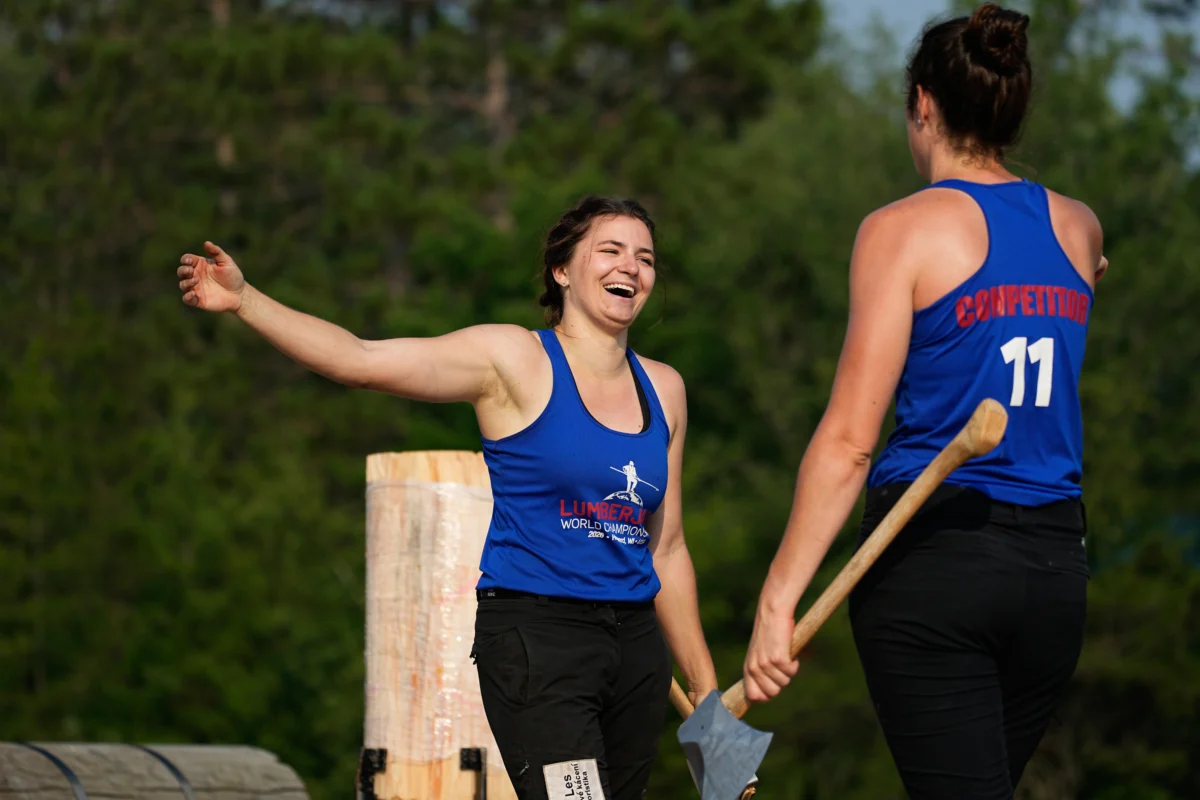
The 63rd annual Lumberjack World Championships, a revered institution in timber sports, concluded on a high note in Hayward, Wisconsin, showcasing unparalleled athleticism and setting new benchmarks for female competitors. Over three days, from Thursday to Saturday, the historic Lumberjack Bowl on the tranquil shores of Lake Hayward transformed into an arena of raw power and refined skill, attracting 66 men and 40 women from 16 states and nine countries. This global convergence of elite timber athletes not only celebrated the rich heritage of logging but also marked a pivotal moment for women in the sport, with three new world records cementing their growing dominance and skill.
A Triumph of Skill and Strength: New World Records Fall in Hayward
The highlight of this year’s competition was undoubtedly the shattering of three world records by female athletes, underscoring the relentless progression and competitive spirit within women’s timber sports. Two of these monumental achievements came from Karolina Urbanová, a formidable competitor hailing from the Czech Republic, whose precision and power left spectators in awe.
Urbanová demonstrated her exceptional prowess in the Women’s Underhand Chop, an event demanding both brute strength and meticulous accuracy. Competitors stand on a log and chop through it between their feet. She blazed through an 11-inch (27.9-centimeter) white pine log in a staggering 21.28 seconds, securing a first-place finish and establishing a new world record. This feat requires not just immense physical strength but also a deep understanding of axe mechanics, wood grain, and body positioning to maximize each swing’s impact. The intensity of the blows, the rhythm of the chop, and the explosive power generated from a low stance are critical elements that Urbanová mastered to achieve this record.
Not content with a single record, Urbanová then went on to dominate the Women’s Standing Chop. In this event, a log is secured vertically, and competitors chop through it from an upright position, simulating the felling of a tree. She cleanly cut through a 9-inch (22.8-centimeter) white pine log in an astonishing 19.38 seconds, once again claiming first place and etching her name into the record books. The Standing Chop demands a different set of skills, emphasizing balance, powerful overhead swings, and the ability to maintain a consistent cutting line while shifting position around the log. Urbanová’s dual record-breaking performance is a testament to her comprehensive mastery of axe-based timber sports, solidifying her status as a global leader in the field.
Adding to the excitement and demonstrating the diverse skill set required in timber sports, local hero Meredith Ingbretson of Hayward, Wisconsin, captivated the home crowd by setting a new world record in the Women’s Boom Run. This thrilling event, a staple of logrolling competitions, involves athletes sprinting across a series of free-floating logs on water, testing their balance, agility, and speed. Ingbretson navigated a challenging course of eight red cedar logs, traversing them across the water and back, in an incredible 13.78 seconds. The Boom Run is a high-risk, high-reward event, where a single misstep can send a competitor plunging into the cool waters below. Ingbretson’s flawless execution and explosive speed highlighted her exceptional balance and coordination, bringing immense pride to her hometown and demonstrating the specialized talents cultivated within the Hayward community.
The Evolution of Women in Timber Sports
The remarkable achievements of Urbanová and Ingbretson are not isolated incidents but rather a powerful reflection of the profound evolution of women’s participation in the Lumberjack World Championships and timber sports at large. While women have been an integral part of the competition since its inaugural year in 1960, their role and the scope of their events have expanded significantly over the decades.
Initially, female competitors were largely confined to logrolling, an event that, while demanding, represented only a fraction of the diverse disciplines showcased in timber sports. Organizers proudly note that women now participate in more than 20 timber sports events, a dramatic increase that mirrors broader societal shifts towards gender equality in athletics. This expansion has opened new avenues for female athletes to demonstrate their strength, skill, and competitive spirit across a wider range of disciplines, from precision chopping and powerful sawing to agile speed climbing.
Nancy Zalewski, a veteran competitor with 27 years of experience in the sport, vividly recalled the early days of her career, stating, “When I started chopping, I was chopping with the men.” Her observation underscores the historical context where dedicated women athletes often had to compete directly against men due to the limited number of female-specific categories. Zalewski, who has not only competed but also trained other aspiring timber athletes, including fellow participant Kate Witkowski, represents a generation that paved the way for the current era of expanded opportunities. Her persistence and passion have been instrumental in fostering a more inclusive environment within the sport.
The increased number of events for women has not only led to greater participation but also to a higher level of specialization and competition. This year’s championship, with 40 women competing from various countries, is a testament to the global appeal and professionalization of women’s timber sports. The expansion of categories ensures that female athletes are recognized for their unique talents and provides a platform for them to push the boundaries of human performance, as evidenced by the record-breaking feats witnessed in Hayward.
A Legacy Forged in Wood: The Lumberjack World Championships’ Rich History
The Lumberjack World Championships are more than just a sporting event; they are a living tribute to a bygone era and a vibrant celebration of a rich cultural heritage. The tradition of competition among lumberjacks, a direct descendant of the friendly rivalries and skill tests common in logging camps, dates back to the 1890s. These informal contests served not only as entertainment but also as a way for loggers to hone essential skills, prove their mettle, and determine the fastest and strongest among them.
The modern Lumberjack World Championships, founded in 1960, formalized these traditions, transforming them into an internationally recognized professional sport. The choice of Hayward, Wisconsin, as its permanent home is no accident. The region, deeply steeped in logging history, provides an authentic backdrop for the competition. The Lumberjack Bowl, the iconic venue for the championships, holds significant historical resonance. In the past, this very area served as a critical holding pond for massive log drives that journeyed down the Namekagon River, a vital artery for transporting timber to mills. The echoes of falling trees, the roar of the river, and the shouts of rivermen once filled this space, making the Lumberjack Bowl a profoundly fitting stage for contemporary timber athletes to honor their predecessors.
The championships serve as a crucial link between the past and the present, preserving the skills, tools, and ethos of traditional logging while elevating them to the level of competitive sport. This commitment to heritage is evident in every aspect of the event, from the types of wood used (often locally sourced white pine and red cedar) to the emphasis on traditional techniques alongside modern advancements. The organizers and community take pride in sustaining this historical connection, ensuring that the legacy of the Northwoods lumberjack remains vibrant and celebrated.
The Art and Science of Timber Sports: Precision, Power, and Prowess
Timber sports are a unique blend of athleticism, technical skill, and an intimate understanding of natural materials. The disciplines showcased at the Lumberjack World Championships are a testament to the specialized training and equipment required to excel. Competitors approach their gear with an almost reverential seriousness, understanding that their tools are extensions of their own bodies and crucial to their performance.
Custom-Built Equipment:
The article highlights the dedication to custom-built chain saws and carefully sharpened axes. Modern competitive chainsaws are far removed from their commercial counterparts. They are meticulously modified, often with enhanced engines, lightweight frames, and specialized cutting chains designed for maximum speed and efficiency. These machines are fine-tuned for specific events, requiring expert mechanics and considerable investment.
Single buck saws, the massive, two-person saws used in events like the Hot Saw and Single Buck, are another prime example of specialized equipment. These colossal blades, often five to seven feet long, are crafted from high-grade steel and engineered for optimal cutting geometry. The mention that a single buck saw can cost "upward of $400 just to sharpen" is not an exaggeration. Sharpening these saws is an art form, typically performed by highly skilled craftsmen known as "filers." The process involves carefully filing each tooth to a precise angle, ensuring uniform sharpness and set, which dictates how the saw clears sawdust. An improperly sharpened saw can bind in the wood, slow down the cut, and even pose a safety risk, making the filer’s expertise invaluable. The competitive edge often lies in these minute details of equipment preparation.
The Physics of Chopping:
Events like the Underhand Chop and Standing Chop are complex biomechanical challenges. Athletes must generate immense force, often exceeding 1,000 pounds per square inch at the axe’s edge, while maintaining precise control. The angle of attack, the depth of the cut, and the sequence of chops are critical. Competitors learn to "read" the grain of the wood, identifying the path of least resistance to maximize efficiency. The white pine, a relatively soft wood, is often chosen for speed events, but even then, inconsistencies in the grain can drastically affect performance. The rhythmic sound of axe striking wood is a cadence of power, technique, and endurance.
The Agility of Logrolling and Boom Run:
Logrolling, and its more dynamic cousin, the Boom Run, are tests of balance, agility, and quick reflexes. Logrollers use their feet to spin a floating log, attempting to dislodge their opponent. The Boom Run elevates this, requiring athletes to sprint across multiple logs. The physics of maintaining balance on a rotating, unstable surface while moving at high speed demands incredible core strength, proprioception, and footwork. Red cedar logs, often used for these events, are chosen for their buoyancy and consistent density, but even then, each log presents a unique challenge. Training for these events often involves hours of practice on the water, developing muscle memory and an intuitive feel for the moving logs.
Training Regimens:
Elite timber athletes follow rigorous training regimens that combine strength and conditioning, specific event practice, and mental preparation. Their training includes weightlifting for power, cardiovascular exercises for endurance, and countless repetitions with axes and saws to perfect their technique. They also spend significant time analyzing wood types, understanding tool maintenance, and studying their opponents. The sport demands a holistic approach to athleticism, blending the raw power of a weightlifter with the precision of a surgeon and the endurance of a marathon runner.
Global Gathering: Diversity on the Deck
The Lumberjack World Championships have evolved into a truly international spectacle, drawing competitors from across the globe. This year’s participation of 66 men and 40 women representing 16 states and nine countries underscores the event’s significant global reach and growing appeal. Athletes traveled from diverse corners of the world, including the Czech Republic, Canada, Australia, and New Zealand, all renowned nations in timber sports, alongside competitors from various regions of the United States.
This international participation not only elevates the level of competition but also fosters a unique cultural exchange. Athletes share techniques, strategies, and experiences, contributing to the global advancement of timber sports. The diversity of backgrounds, united by a common passion for the sport, creates a vibrant and dynamic atmosphere both on and off the competition grounds. The presence of international champions like Karolina Urbanová highlights the world-class talent that converges on Hayward each year, reinforcing the Championships’ status as a premier event in the timber sports calendar.
Hayward’s Heartbeat: Community, Culture, and Economic Impact
The Lumberjack World Championships are inextricably linked to the identity and economy of Hayward, Wisconsin. For this small community, the event is far more than a sporting contest; it is a profound cultural celebration and a significant economic driver. The entire town embraces the "lumberjack theme," transforming into a festive hub during the championships. Children can be seen sporting lumberjack socks, miniature flannels, and suspenders, embodying the spirit of the event. Brands and vendors contribute to the festive atmosphere, handing out playful blow-up axes and toy chain saws, ensuring that even the youngest attendees feel part of the lumberjack world.
Beyond the intensity of the competition in the Lumberjack Bowl, the surrounding area buzzes with activity. Wood-carving demonstrations showcase intricate artistry, providing a counterpoint to the raw power of the chopping events. Logrolling practice sessions for kids offer a playful introduction to the sport, potentially inspiring future champions. Live music fills the air, food trucks offer a diverse array of culinary delights, and various axe-themed events provide entertainment for all ages. This carnival-like atmosphere extends the championships’ appeal beyond avid timber sports fans, drawing in families and tourists seeking a unique cultural experience.
The economic impact on Hayward is substantial. Local businesses, from hotels and restaurants to retail shops, experience a significant boost in revenue during the three-day event. The influx of competitors, their support teams, and thousands of spectators injects vital capital into the local economy, supporting jobs and contributing to the community’s overall prosperity. The championships are a cornerstone of Hayward’s annual tourism calendar, cementing its reputation as a vibrant and welcoming destination. The local community’s enthusiastic embrace of the event ensures its continued success and growth, solidifying its place as a beloved tradition.
Beyond the Axe: The Spirit of Camaraderie and Competition
One of the most remarkable aspects of the Lumberjack World Championships, as highlighted by competitor Kate Witkowski, is the unparalleled sense of camaraderie among the athletes. She eloquently stated, “The culture of it I think is really wonderful. I don’t know any other sports where the athletes support each other like we do here because it’s such a niche sport and because the gear is so hard to come by that we’re all just trying to get better.”
This sentiment underscores a unique characteristic of timber sports. Unlike many mainstream athletic competitions where rivalries can often be intense and isolating, the lumberjack community fosters a supportive and collaborative environment. This cooperative spirit stems partly from the niche nature of the sport, where the pool of elite competitors is relatively small. Athletes often share insights, provide technical advice, and even lend specialized equipment, recognizing that their collective improvement benefits the sport as a whole. The high cost and specialized nature of competitive gear also contribute to this bond; sharing knowledge about sourcing, maintenance, and sharpening becomes a communal effort.
This culture of mutual support ensures that while competition is fierce, it remains respectful and sportsmanlike. Competitors celebrate each other’s successes, commiserate over setbacks, and push each other to achieve new personal bests and, as seen this year, new world records. This deep-seated camaraderie transforms the championships from a mere contest into a reunion of a unique athletic family, strengthening the bonds that tie this global community of timber athletes together. It is this spirit that truly defines the Lumberjack World Championships, making it an experience that resonates deeply with both participants and spectators.
Looking Ahead: The Future of Timber Sports
The 63rd Lumberjack World Championships in Hayward have not only provided thrilling competition but also offered a glimpse into the evolving future of timber sports. The setting of three new women’s world records signals a powerful trajectory for female athletes, promising even greater achievements and inspiring a new generation of participants. This growth in women’s events and performance will undoubtedly lead to increased visibility, sponsorship opportunities, and professionalization for female timber athletes.
The consistent international participation highlights the sport’s global appeal and its potential for further expansion beyond its traditional strongholds. As timber sports continue to gain recognition, leveraging media coverage and digital platforms, its reach is likely to broaden, attracting more athletes and fans worldwide. The blend of historical reverence with modern athleticism makes it a compelling spectacle, capable of captivating diverse audiences.
Furthermore, the unwavering commitment of the Hayward community to hosting and celebrating these championships ensures the event’s enduring legacy. The integration of the competition with local culture and economy creates a sustainable model for growth, demonstrating how a niche sport can become a vital part of a community’s identity. As the axes are sharpened and saws are readied for next year, the Lumberjack World Championships stand as a testament to human strength, skill, and the enduring spirit of competition, promising many more thrilling chapters in the annals of timber sports.