United States military forces disabled a commercial vessel in the Gulf of Oman on Saturday, November 7, 2026, after the ship’s civilian crew repeatedly ignored direct warnings and attempted to breach the ongoing U.S. naval blockade against Iran. According to statements released by U.S. Central Command (CENTCOM), a U.S. military aircraft targeted the stern of the St. Kitts-flagged cargo vessel M/V Huda with precision munitions. The strike successfully disabled the ship following instructions given to the crew to evacuate the targeted spaces. The vessel had previously visited an Iranian port and was attempting to depart regional waters in defiance of maritime restrictions enforced by coalition forces.
The incident
underscores the high-stakes maritime standoff in the Persian Gulf and surrounding waterways, which has persisted since armed conflict erupted between the United States, Israel, and Iran in February 2026. CENTCOM reiterated its stern advisory to regional mariners, emphasizing that all commercial vessels transiting near Iranian coastal waters must heed blockade warnings issued by U.S. forces. The U.S. military continues a strict enforcement strategy within the Strait of Hormuz, a critical global trade chokepoint that normally handles roughly one-fifth of the world’s crude oil supply. Tehran established a strategic chokehold over the strait at the outset of the war, leading to frequent exchanges, accusations of maritime attacks, and extensive naval disruptions. Despite U.S. escort operations that have helped stabilize crude shipments near pre-war levels, the United Kingdom Maritime Trade Operations (UKMTO) reported a record-breaking 30 attacks on commercial vessels in the region during the month of October alone.
Expanding the Theater: Task Force Iron Gate and Ground Supply Disruptions
In a related escalation of military strategy, CENTCOM announced the creation of a specialized unit designated Task Force Iron Gate. Comprising approximately 20 civilian and military personnel based in Florida, the new task force aims to disrupt the illegal trafficking of prohibited items, including advanced military technology, dual-use components, sanctioned materials, and illicit revenue streams, across Iran’s land borders and the Caspian Sea.
Admiral Brad Cooper, chief of U.S. Central Command, stated that Task Force Iron Gate builds upon the foundational success of the maritime blockade. The expansion reflects a tactical pivot toward addressing Iran’s land-based trade routes. Following the severe restrictions imposed on Iranian ports, Tehran has increasingly pivoted its commerce overland, utilizing Central Asian railway networks and trade corridors with primary partners such as China. Furthermore, Iran has leveraged the landlocked Caspian Sea—situated a mere 80 miles north of Tehran—to maintain direct supply lines with southwest Russia, circumventing traditional maritime vulnerabilities.
Diplomatic Fronts and International Reactions
The military maneuvers coincide with intense diplomatic engagements aimed at mitigating a broader conflagration. President Donald Trump held a telephone conversation with Qatari Emir Sheikh Tamim bin Hamad Al Thani to discuss joint efforts to de-escalate tensions and navigate potential diplomatic resolutions. Qatar continues to serve as a pivotal mediator between Washington and Tehran. Concurrently, Iranian diplomats have engaged in regional outreach across the Persian Gulf to preserve stability, as regional capitals express growing apprehension over potential large-scale U.S. military escalations.
The political landscape in Washington is also influencing foreign policy decisions. Secretary of State Marco Rubio is slated to travel to France to meet with Group of Seven (G7) foreign ministers from Britain, Canada, France, Germany, Italy, and Japan. The diplomatic summit is expected to focus heavily on the administration’s Middle East policies, particularly in the wake of significant Republican setbacks in the 2026 midterm elections—outcomes that analysts and voters have linked directly to public exhaustion with the ongoing conflict.
Simultaneously, the U.S. Treasury Department, in coordination with Canadian authorities, announced sweeping sanctions targeting digital asset providers and currency exchange networks in Vancouver, Toronto, and overseas. These entities allegedly facilitated transactions involving Iranian rials and cryptocurrency exchanges designed to help Tehran evade international sanctions and finance its regional proxy networks.
Nuclear Concerns and Escalating Regional Rhetoric
Amid ongoing kinetic operations, the U.S. State Department announced a reward of up to $20 million through its Rewards for Justice program for actionable intelligence regarding Iran’s clandestine nuclear program. The initiative seeks information on nuclear facilities, equipment, key scientific personnel, and material supply chains. The State Department highlighted International Atomic Energy Agency (IAEA) reports indicating that Iran’s uranium stockpile includes material enriched up to 60% purity—a technical threshold dangerously close to the 90% weapons-grade benchmark. Tehran suspended IAEA inspections following joint U.S.-Israeli strikes on Iranian nuclear infrastructure in June 2025, severely undermining international oversight.
The rhetoric from Tehran has grown increasingly defiant. Aliakbar Velayati, international affairs adviser to Iran’s supreme leader, asserted that Iran has cemented its status as one of the primary architects of Middle East security, warning that any future energy transit corridors attempting to bypass the Islamic Republic would face exorbitant costs or instability. This posture was mirrored by Islamic Revolutionary Guard Corps (IRGC) officials, who announced that Tehran has officially lifted its self-imposed 1,200-mile range limitation on ballistic missiles. While military spokesmen declined to confirm whether new long-range delivery systems are currently operational, U.S. intelligence officials have previously warned that Iranian space-launch technologies could readily be repurposed to develop intercontinental ballistic missiles.
The Chronology of Escalation: February to November 2026
The trajectory of the current conflict has evolved through distinct phases of direct military engagement, infrastructure destruction, and asymmetric warfare:
- February 28, 2026: Joint U.S. and Israeli airstrikes strike vital military, nuclear, and energy infrastructure across Iran, resulting in the death of the nation’s supreme leader and triggering all-out war. Mojtaba Khamenei subsequently succeeds leadership behind the scenes.
- June 2025 – October 2026: Iran suspends international nuclear inspections, steps up asymmetrical operations in the Strait of Hormuz, and mines key shipping lanes. The U.S. military implements a comprehensive naval blockade, successfully rerouting or blocking commercial traffic and restricting Iranian crude oil exports.
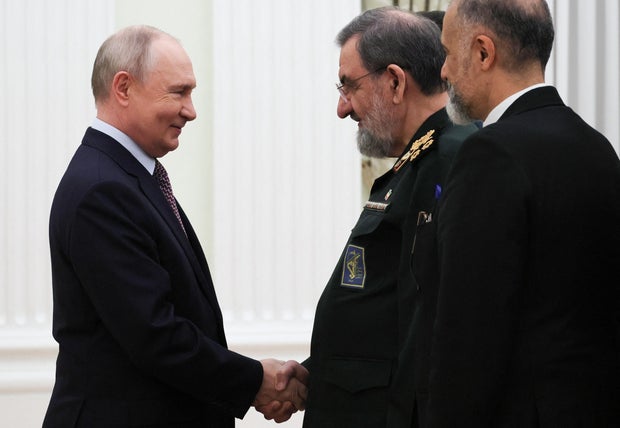
- November 5–6, 2026: Reports emerge of multiple tanker incidents involving sea mines in the Strait of Hormuz, while Russian President Vladimir Putin meets with Iranian security chief Mohsen Rezaei in Moscow to discuss prospective gas pipeline infrastructure.
- November 7, 2026: U.S. forces disable the M/V Huda in the Gulf of Oman, and CENTCOM inaugurates Task Force Iron Gate to choke off overland and Caspian Sea supply networks.
Economic Implications and Global Fallout
The protracted nature of the conflict continues to exert profound pressure on global energy markets and domestic economies. Domestically, U.S. motorists have experienced fluctuating fuel costs, though energy analysts project that national averages for gasoline could drop below $4.00 per gallon for the first time since July. According to petroleum analysts at GasBuddy, receding fuel prices are largely driven by market optimism that the outcome of the U.S. midterm elections will compel the administration to seek a negotiated diplomatic off-ramp rather than expanding military campaigns.
Meanwhile, the humanitarian toll in peripheral theaters of the conflict continues to mount. Houthi-controlled media outlets in Yemen reported that recent Saudi-led coalition airstrikes in Sanaa province and Taiz resulted in dozens of civilian casualties, intensifying a humanitarian crisis that has displaced over 300,000 individuals since active hostilities resumed. The Saudi-led coalition countered by reporting the successful interception of multiple ballistic missiles and drones launched toward Najran, Riyadh, and the Mecca region.
As international pressure mounts and diplomatic channels are tested across capitals from Washington and Paris to Moscow and Doha, the coming weeks will determine whether the United States and Iran can pivot from military confrontation toward a sustainable diplomatic framework, or whether the region faces an even deeper cycle of escalation.