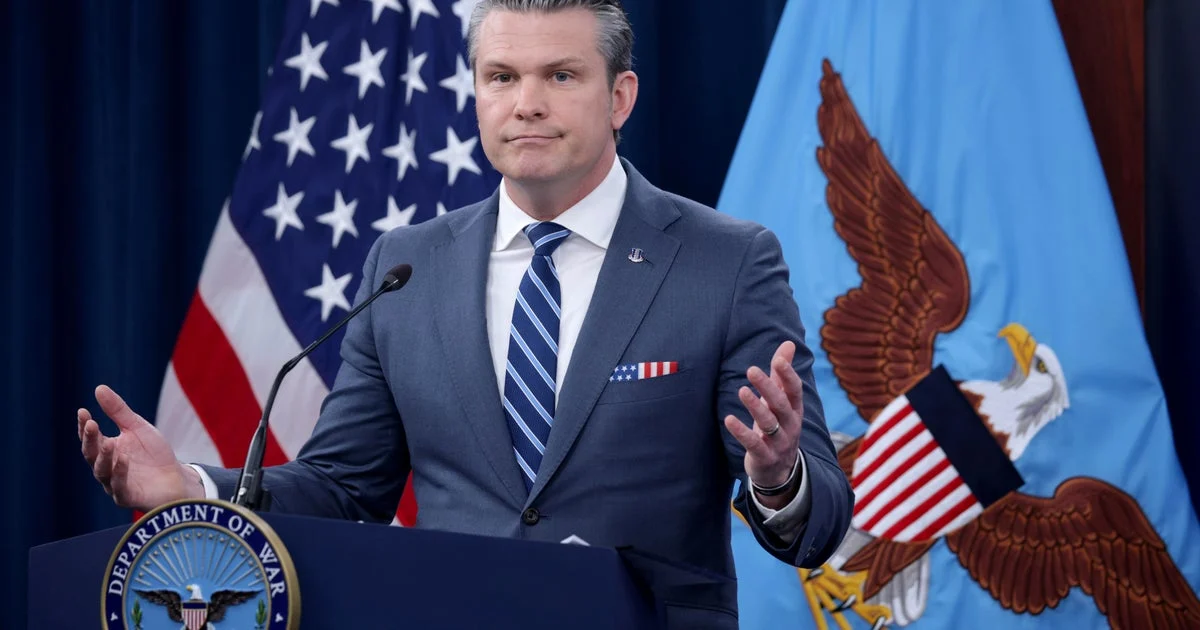
Defense Secretary Pete Hegseth and Chairman of the Joint Chiefs of Staff Gen. Dan Caine delivered a stern warning on Thursday, April 16, 2026, affirming that U.S. forces are poised for immediate action should any vessel defy the ongoing blockade in the Strait of Hormuz. This declaration comes despite a tenuous two-week ceasefire in the protracted conflict with Iran, underscoring the high-stakes environment in the Persian Gulf. The U.S. military leadership reiterated its commitment to maintaining the "successful blockade" and signaled a readiness to escalate to "major combat operations" with unprecedented speed and power if diplomatic efforts falter.
The Strait of Hormuz Blockade: A Crucial Chokepoint Under Pressure
The United States initiated the naval blockade of the Strait of Hormuz on Monday, April 13, a strategic maneuver designed to counter Iran’s asserted control over the vital waterway and its efforts to restrict maritime traffic. This blockade is being enforced primarily in the Gulf of Oman, just outside the strait itself, a U.S. official confirmed. The Strait of Hormuz is arguably the world’s most critical oil transit chokepoint, through which approximately one-fifth of global oil consumption passes daily, making its stability paramount for international energy security. Disruptions here send immediate ripples through global energy markets, impacting prices and supply chains worldwide.
"If you do not comply with the blockade, we will use force," Gen. Caine stated unequivocally at the news conference. Defense Secretary Hegseth echoed this resolve, emphasizing the U.S. military’s capacity to swiftly transition from the current blockade posture to full-scale combat operations. "We can make that transition again very quickly and even more powerfully than ever," Hegseth asserted, sending a clear message to Tehran and international shipping. He clarified that the blockade applies universally to all ships, regardless of their national flag, that are either heading to or departing from Iranian ports. So far, the U.S. Central Command (CENTCOM) has reported that 13 ships have made the "wise choice of turning around," opting to comply rather than challenge the naval enforcement. This preemptive compliance has, to date, prevented the need for U.S. forces to board any vessels, a scenario that could rapidly escalate tensions.
Iran, in response to the blockade and broader U.S. pressure, has publicly threatened to retaliate by sinking American ships and closing the Red Sea, another crucial maritime passage. Such actions would represent a significant escalation, further destabilizing global shipping and energy flows. Since the ceasefire commenced, transits through the Strait of Hormuz have remained significantly below pre-war levels, indicative of the lingering apprehension and the practical impact of the blockade.
Fragile Diplomacy: US-Iran Peace Talks and the Nuclear Imperative
Thursday’s news conference occurred eight days into a two-week ceasefire, a pause intended to facilitate high-level negotiations aimed at ending the ongoing conflict. Initial talks between Iranian and U.S. negotiators in Pakistan last weekend concluded without a breakthrough, with substantial disagreements persisting, particularly concerning Iran’s contentious nuclear program. However, President Trump has indicated the possibility of another round of talks in the coming days, suggesting a persistent, albeit challenging, diplomatic track.
President Trump has made the complete cessation of Iran’s nuclear weapons ambitions a cornerstone of his administration’s policy. "At the direction of President Trump, the War Department will ensure that Iran never has a nuclear weapon, never," Hegseth declared. He presented a stark choice to Iran: "We prefer to do it the nice way through a deal led by our great vice president and negotiating team, or we can do it the hard way." This statement highlights the dual approach of the Trump administration, coupling diplomatic overtures with a clear threat of military force.
Gen. Caine reinforced this message of preparedness, stating that U.S. joint forces "remain postured and ready to resume major combat operations at literally a moment’s notice." This readiness is a critical element of the "maximum pressure" campaign, designed to compel Iran to make concessions at the negotiating table. The success or failure of these talks hinges on resolving deep-seated mistrust and fundamental disagreements over Iran’s nuclear enrichment capabilities, its ballistic missile program, and its regional proxy activities.
A senior U.S. official confirmed on Wednesday that the country "has not formally agreed to an extension of the ceasefire," though discussions on this matter are ongoing. Iran has also acknowledged indirect talks, with Pakistan actively pressing for further negotiations, seeking to mediate a lasting peace. The uncertainty surrounding the ceasefire’s expiration date, approximately April 22, casts a long shadow over the diplomatic process. Hours after the initial pause began, Secretary Hegseth had already warned that the military was "prepared to restart at a moment’s notice," a sentiment echoed by Israeli Prime Minister Benjamin Netanyahu, who stated his country’s readiness to resume fighting if necessary. Despite these cautious preparations, President Trump has expressed optimism, remarking on Tuesday that the war is "very close to over," reflecting a desire for a swift resolution.
Escalating Regional Tensions: Israel, Lebanon, and Hezbollah
Compounding the complexities of the US-Iran conflict are the ongoing hostilities between Israel and Hezbollah in Lebanon. President Trump announced on Wednesday, via a post on Truth Social, that Israel and Lebanon were slated to hold direct talks, an event of considerable historical significance. "Trying to get a little breathing room between Israel and Lebanon. It has been a long time since the two leaders have spoken, like 34 years. It will happen tomorrow. Nice! President DJT," Trump wrote, highlighting the rarity of such high-level contact.
Indeed, Lebanese and Israeli officials met this week in Washington, D.C., marking their first direct talks in decades. The two sides reportedly agreed to hold further negotiations, a cautious step toward de-escalation. However, the Iran-backed militant group Hezbollah, a powerful political and military force in Lebanon, immediately rejected these talks, underscoring the deep divisions within Lebanon and the challenges to any comprehensive peace efforts.
Israel has continued its offensive, hitting Hezbollah targets in southern Lebanon, maintaining that Lebanon is not covered by the tenuous two-week ceasefire agreement between the U.S. and Iran. This stance is explicitly supported by the U.S., but Iran has vehemently insisted that these Israeli strikes constitute a violation of the ceasefire deal. The conflict in southern Lebanon has been devastating, with Lebanon’s health ministry reporting over 2,100 fatalities in the Israeli offensive. The ministry’s figures, however, do not differentiate between civilian and combatant casualties, making it difficult to ascertain the full humanitarian cost. The continued Israeli operations risk drawing Iran more directly into the conflict, potentially unraveling the fragile ceasefire and escalating regional tensions to dangerous levels.
The Geopolitical Chessboard: Alliances Under Strain
The unfolding crisis has also placed significant strain on existing international alliances, particularly the North Atlantic Treaty Organization (NATO). President Trump has been an outspoken critic of NATO’s perceived inaction in the Iran conflict, going so far as to lash out at the organization and weigh the possibility of the U.S. withdrawing. On Tuesday, he declared that NATO "wasn’t there for us, and they won’t be there for us in the future!" This sentiment reflects a broader skepticism within the Trump administration regarding the utility and burden-sharing aspects of traditional alliances, potentially reshaping the global security architecture.
NATO, an intergovernmental military alliance between 32 member states, primarily in North America and Europe, operates under a collective defense clause (Article 5) that states an attack against one member is an attack against all. However, its mandate is primarily focused on the Euro-Atlantic area. While individual member states may have contributed to U.S.-led operations in the Middle East, the organization itself has not taken a direct combat role in the Iran conflict, leading to Trump’s criticisms. Such pronouncements from a U.S. President send shockwaves through allied capitals, raising questions about the future of transatlantic security cooperation and the reliability of American leadership on the global stage.
A Chronology of Recent Events: A Rapidly Evolving Landscape
The past week and a half have witnessed a rapid succession of events that underscore the volatile nature of the Middle East conflict:
- April 8, 2026: A two-week ceasefire between the U.S. and Iran officially commences, offering a window for de-escalation and diplomatic engagement.
- April 11-12, 2026 (approx.): The first round of U.S.-Iran peace talks in Pakistan concludes without a definitive deal, highlighting significant sticking points, particularly regarding Iran’s nuclear program.
- April 13, 2026 (approx.): The U.S. naval blockade of the Strait of Hormuz begins, enforced in the Gulf of Oman, aimed at restricting Iranian maritime activities.
- April 15, 2026 (Wednesday):
- President Trump announces on Truth Social that Israel and Lebanon are scheduled for direct talks, signaling a potential diplomatic breakthrough in another regional flashpoint.
- Mr. Trump tells Fox News that the conflict is "very close to over," expressing optimism for an impending resolution.
- A senior U.S. official clarifies that there is no formal agreement yet to extend the ceasefire, maintaining pressure on ongoing negotiations.
- Israeli Prime Minister Benjamin Netanyahu reiterates Israel’s readiness to resume fighting if necessary, mirroring the U.S. military’s stance.
- April 16, 2026 (Thursday):
- Defense Secretary Pete Hegseth and Chairman of the Joint Chiefs of Staff Gen. Dan Caine hold a news conference, issuing a stern warning regarding the Strait of Hormuz blockade and emphasizing military readiness.
- Lebanese and Israeli officials meet in Washington D.C. for their first direct talks in decades, agreeing to further negotiations despite Hezbollah’s rejection.
Economic Repercussions and Global Stability: A Precarious Balance
The U.S. blockade of the Strait of Hormuz, coupled with Iranian threats to retaliate, carries profound economic repercussions. Global oil prices are highly sensitive to stability in the Persian Gulf. Any perceived escalation or prolonged disruption could send crude oil benchmarks soaring, triggering inflation and potentially dampening global economic growth. Shipping insurance premiums for vessels operating in the region have already seen sharp increases, raising operational costs for tanker companies and ultimately affecting consumer prices for goods transported through these vital waterways.
Beyond oil, the Strait is also a crucial transit point for liquefied natural gas (LNG) and other goods. A protracted crisis or full-scale conflict would severely disrupt global supply chains, impacting industries from manufacturing to retail. The uncertainty alone, even without direct military confrontation, is enough to deter investment and slow economic activity in a region already grappling with instability. The international community watches with bated breath, recognizing that a miscalculation or an unintended incident could swiftly transform a tense standoff into a wider conflagration with catastrophic global consequences.
The Path Forward: High Stakes and Unpredictable Outcomes
The current situation represents a precarious balance between military deterrence and diplomatic engagement. The U.S. military’s readiness, articulated by Hegseth and Caine, serves as a powerful coercive tool, aiming to push Iran toward a "nice way" resolution regarding its nuclear ambitions. However, such overt displays of force also carry the inherent risk of accidental escalation, particularly in a region as volatile as the Persian Gulf.
For negotiators, the challenges are immense. Reconciling Iran’s demand for nuclear sovereignty with international demands for non-proliferation, alongside addressing its regional proxy network and ballistic missile program, requires extraordinary diplomatic skill and political will. The interwoven conflicts involving Israel, Lebanon, and Hezbollah further complicate the picture, as regional actors pursue their own interests, sometimes at cross-purposes with broader peace efforts.
As the two-week ceasefire draws to a close, the international community faces an unpredictable future. Will further rounds of diplomacy yield a breakthrough, or will the "hard way" become an unavoidable reality? The fate of Iran’s nuclear program, the stability of global energy markets, and the intricate web of Middle Eastern alliances hang in the balance, making the coming days critical for regional and global security.