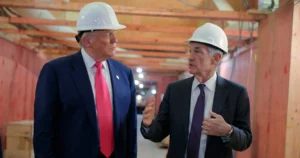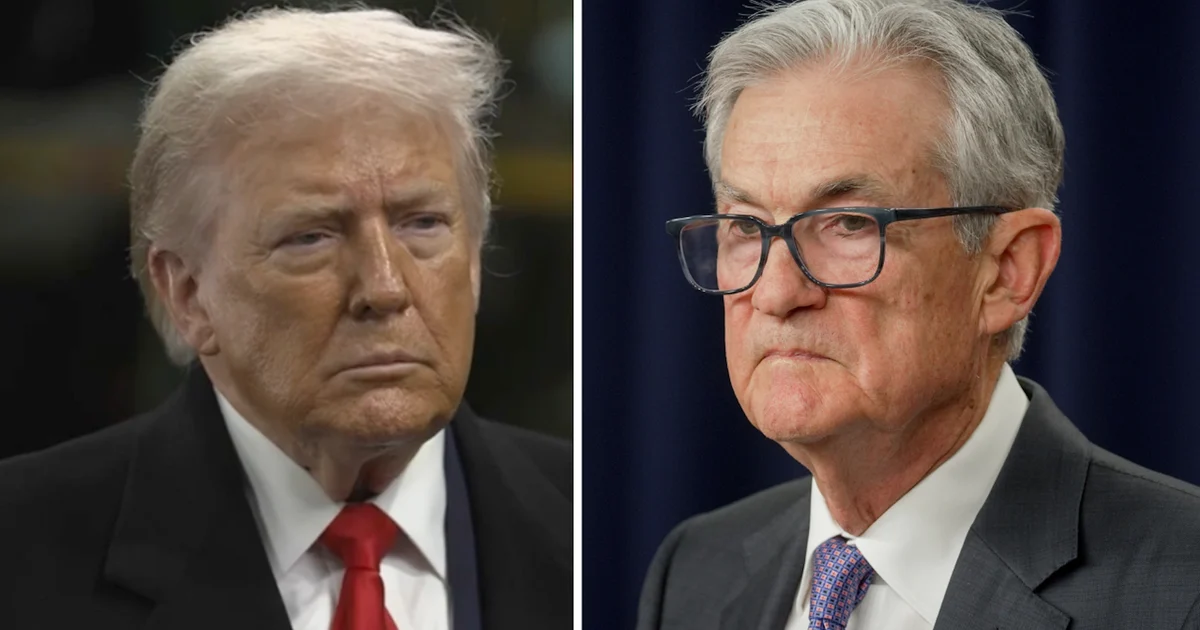
President Trump’s latest threat to dismiss Federal Reserve Chair Jerome Powell heralds a potentially unprecedented clash between the executive branch and the nation’s central bank, as Powell’s term as head of the Fed is slated to conclude on May 15. The escalating tension, underscored by the President’s public remarks, raises profound questions about the independence of the Federal Reserve and the legal limits of presidential authority.
The contentious statement came during an interview with Fox Business’ Maria Bartiromo on Wednesday, April 16, 2026. Mr. Trump explicitly stated his intention to fire Powell should the central bank chief adhere to his public pledge of remaining on the Fed’s Board of Governors. Powell’s decision to stay as a governor is contingent on the Department of Justice continuing its criminal probe into ongoing building renovations at the Federal Reserve. Powell has publicly characterized this investigation as a politically motivated attempt to pressure him into either advocating for lower interest rates or resigning from his post.
"Then I’ll have to fire him, OK, if he’s not leaving on time," Mr. Trump told Bartiromo. "I’ve held back firing him. I’ve wanted to fire him. But I hate to be controversial." This remark marks the most direct and publicly stated intention by President Trump to remove Powell, following a string of previous threats rooted in the President’s dissatisfaction with the Fed’s monetary policy, particularly its pace of interest rate adjustments, which he has consistently deemed too slow.
The Legal Labyrinth: Firing a Fed Chair or Governor
The President’s assertion, however, immediately confronts significant legal hurdles. Dan Urman, director of the law and public policy minor at Northeastern University, emphasized the dubious legality of such an action. "As the law currently stands, it is not legal for President Trump to fire Powell at any point – as chair or as governor – unless the firing is ‘for cause,’" Urman explained to CBS News. He cited the Federal Reserve Act of 1913, the foundational statute governing the central bank, which stipulates that members of the Federal Board of Governors can only be removed for "serious misconduct." Urman unequivocally stated, "Powell has done no such thing."
This "for cause" provision is a cornerstone of the Federal Reserve’s institutional independence, designed to insulate monetary policy decisions from short-term political pressures. Unlike cabinet secretaries who serve at the President’s pleasure, Fed Governors are appointed to lengthy 14-year terms, significantly longer than the four-year term of the Fed Chair. This structural design ensures continuity and expertise, preventing wholesale changes with each new presidential administration. Even after their term as Chair concludes, individuals like Powell are entitled to complete their tenure as a Governor. In Powell’s specific case, while his chairmanship ends on May 15, his term as a Fed Governor extends until January 2028, setting the stage for a potential legal battle over his continued presence on the board.
Historically, no U.S. President has ever successfully fired a Federal Reserve Chair. While tensions between presidents and Fed chiefs are not uncommon—ranging from Lyndon Johnson’s legendary temperamental clashes with William McChesney Martin Jr. to Richard Nixon’s strong influence over Arthur Burns—these disagreements have typically been resolved through resignation or the natural end of a term, rather than outright dismissal. President Trump’s aggressive and public stance represents a departure from these historical norms, pushing the boundaries of executive power and challenging a long-held understanding of central bank autonomy.
The DOJ Probe: A Political Weapon?
Central to the current standoff is the Department of Justice’s criminal probe into the Federal Reserve’s building renovations. While the specific details of the alleged misconduct remain somewhat opaque in public discourse, reports indicate that the DOJ has issued subpoenas related to the extensive renovation projects. Powell and his supporters view this investigation as an overtly political maneuver, designed to create leverage against the Fed leadership. The timing of the probe, coinciding with the President’s vocal criticism of the Fed’s interest rate policy, lends credence to Powell’s assertion that it is intended to coerce him into aligning with the administration’s economic agenda or to compel his resignation.
Such an investigation, if indeed politically motivated, would represent a severe breach of the separation of powers and an alarming precedent for future administrations seeking to influence independent agencies. The integrity of the Federal Reserve’s operations and its ability to conduct monetary policy without fear of political reprisal are paramount for maintaining domestic economic stability and international confidence in the U.S. financial system.
Stalled Succession: The Warsh Confirmation Saga
Further complicating the situation is the stalled effort to confirm former Fed official Kevin Warsh as the new Federal Reserve Chair. Warsh, a Republican favored by the administration, has been awaiting confirmation, but his path has been obstructed by political gridlock. Senator Thom Tillis of North Carolina, a Republican, has publicly declared his refusal to vote for any Fed nominees until the Justice Department’s investigation into the Fed renovations is dropped. This linkage between a key Senate vote and an ongoing DOJ probe underscores the highly politicized atmosphere surrounding the central bank.
The delay in Warsh’s confirmation poses a practical challenge for a smooth transition. When asked in March about the potential delay, Powell stated his intention to serve as "pro tem chair" of the Fed until a successor could be confirmed and officially step into the role. This declaration signals Powell’s resolve to maintain continuity and uphold the institutional integrity of the Fed, even in the face of presidential pressure.
Acting Chair Appointment: A Contested Path
Even if President Trump were to follow through on his threat to remove Powell as Chair, the path to installing a new leader is fraught with legal and political pitfalls. Mr. Trump could theoretically name another Fed Governor, such as Stephen Miran, as an "acting" Fed Chair on May 15. However, this move would likely face an immediate legal challenge.
"Jerome Powell has said that he would serve as ‘chair pro tem’ until his successor is confirmed. So Powell could sue, suggesting that he, not Miran, is chair. It’s quite messy," Urman noted, highlighting the potential for protracted litigation. Jaret Seiberg, an analyst with TD Securities, echoed this sentiment in a research note, emphasizing the unprecedented nature and legal uncertainty of such an appointment. The prospect of two individuals claiming leadership of the central bank would introduce significant instability into the financial markets and governmental operations.
Treasury Secretary Scott Bessent, responding to inquiries about the President’s remarks, attempted to project an image of confidence and smooth transition during a Wednesday press conference. "I am very optimistic that Kevin Warsh will be the chair of the Fed on time, and that will be a moot question," Bessent stated. However, given the political realities and legal complexities, this optimism appears increasingly challenged.
Market Instability and Fed Independence
The implications of President Trump’s threats extend far beyond legal technicalities, posing a direct threat to the stability of financial markets. Brett House, a professor at Columbia Business School, underscored the likely negative market reaction. "There’s little question that markets will sell off if President Trump attempts to fire Jerome Powell," House predicted.
Financial markets deeply value the independence of the Federal Reserve. Investors rely on the central bank to make monetary policy decisions based on economic data and expert analysis, free from political influence. This independence is seen as crucial for maintaining price stability, fostering sustainable economic growth, and preserving the credibility of the U.S. dollar. Any perceived erosion of this independence could trigger significant market volatility, potentially leading to increased uncertainty, higher borrowing costs, and a flight of capital. Domestic and international investors alike could lose confidence in the predictability and impartiality of U.S. economic policy, with ripple effects across global financial systems. The prospect of political interference in monetary policy could be interpreted as a sign of institutional weakness, prompting a re-evaluation of investment strategies and potentially destabilizing the broader economy.
Supreme Court’s Decisive Role: The Lisa Cook Precedent
Adding another layer of complexity and urgency to the situation are two cases currently before the Supreme Court, both concerning the extent of a U.S. president’s legal authority to remove leaders of independent federal agencies. One of these cases, directly relevant to the current dispute, involves Federal Reserve Governor Lisa Cook.
President Trump attempted to fire Cook in August, citing allegations that she had engaged in mortgage fraud, claims which Cook vehemently denied and for which she has not been criminally charged. In a letter informing Cook of her removal, shared publicly on social media, Mr. Trump asserted he had "sufficient cause" for dismissal due to what he claimed was "deceitful and potentially criminal conduct in a financial matter."
As Urman noted, the Cook case "is directly on point and asks if the president can fire a Federal Reserve Board member." The Supreme Court’s decision in this case, expected by late June – notably after Powell’s term as Fed chief concludes – will establish a critical legal precedent. The ruling will clarify the scope of presidential removal powers over independent agency heads, potentially providing a definitive legal framework for future disputes involving the Fed. "We should know where the law stands by the summer, but any attempts to fire Powell before then would pretty clearly be unlawful," Urman added, underscoring the precarious legal ground upon which the administration might act.
A History of Tensions: Trump vs. The Fed
While President Trump’s confrontational style is distinct, tensions between the White House and the Federal Reserve are not entirely new. Presidents throughout history have expressed frustration with the central bank’s policies, particularly when they perceived them as hindering economic growth or electoral prospects. However, previous administrations generally respected the Fed’s institutional autonomy, even amidst private or veiled public criticisms.
President Trump, by contrast, has been unusually vocal and aggressive in his criticism of Powell, whom he himself appointed. His repeated public calls for lower interest rates and threats of dismissal have shattered the traditional decorum that typically characterized the relationship between the President and the Fed Chair. This public pressure campaign represents a fundamental challenge to the institutional norms that have long underpinned the Fed’s independence, risking politicization of one of the nation’s most crucial non-partisan economic institutions.
Looking Ahead: An Unprecedented Constitutional Showdown
The coming weeks and months are poised to unfold into an unprecedented constitutional and legal showdown. With Powell’s term as Chair ending on May 15, the President’s explicit threat to fire him if he remains as a Governor, the stalled confirmation of Kevin Warsh, and the looming Supreme Court decision on presidential removal powers, all converge to create a highly volatile situation.
The outcome will not only determine the leadership of the Federal Reserve but will also set a crucial precedent for the balance of power between the executive branch and independent federal agencies. The integrity of the Fed’s independence, its credibility on the global stage, and the stability of the U.S. financial system hang in the balance as the nation watches to see how this extraordinary confrontation will resolve. The financial markets, already sensitive to geopolitical and economic uncertainties, will be closely monitoring every development, keenly aware that the implications of this dispute could resonate for years to come.