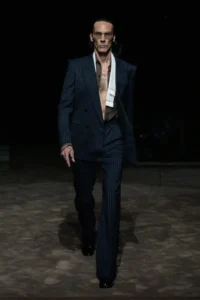
The Paris Haute Couture Fall 2026 season has marked a definitive shift in the relationship between the garment and the wearer, moving beyond traditional tailoring toward the creation of "wearable bodies." Last week, the debut of Pierpaolo Piccioli at Balenciaga couture set a precedent for this movement, showcasing feather-covered gowns so rigorously sculpted they appeared to exist independently of the models. These garments, characterized by chiseled forms and otherworldly embellishments, signaled a broader industry trend where the silhouette is no longer a suggestion of the body, but a replacement for it. This evolution in high fashion comes at a pivotal cultural moment, as advancements in medical technology, 3D printing, and digital scanning converge to redefine human anatomy as a malleable artistic medium.
The Anatomical Turn in Haute Couture
The Fall 2026 couture cycle has seen a surge in highly anatomical looks that function as secondary skins or prosthetic enhancements. At houses such as Schiaparelli, Jean Paul Gaultier, and Balenciaga, designers are increasingly moving away from the "clinging" fabrics of the past to rigid, molded structures. This "anatomical turn" was visible in the pearl-embellished boob corsets at Schiaparelli and the distorted, hyperreal torsos at Jean Paul Gaultier.
Backstage at his debut Balenciaga show, Pierpaolo Piccioli articulated this philosophy, stating that couture is not merely about a dress, but a "mindset" that requires thinking in three dimensions and maintaining a constant "conversation with the body." The result was a collection that prioritized form over fluidity, using internal skeletons to maintain silhouettes that defied gravity.

This trend is not isolated to Balenciaga. Designers including Robert Wun, Ashi Studio, Germanier, and Standing Ground have all integrated elements of hyperrealism into their latest collections. Whether through the use of fiberglass, 3D-printed resins, or traditional clay sculpting, the industry is moving toward a future where the garment is the body.
Chronology of the Bodycon Evolution
To understand the current obsession with sculpted anatomy, one must look at the history of "bodycon"—a portmanteau of "body conscious." The concept first emerged in the late 1980s, primarily driven by the rise of athletic wear and the work of designers like Azzedine Alaïa and Hervé Léger. These designers used stretch fabrics to redefine how clothing could cling to and emphasize the natural female form.
By the early 2000s, bodycon had transitioned into club culture, eventually leading to the mass-market accessibility of shapewear and compression garments popularized by brands like Skims and Lululemon. However, the 2026 couture season marks a departure from this lineage. While traditional bodycon sought to highlight the existing body, the new couture body seeks to replace it or augment it entirely.
The timing of this shift coincides with the mass accessibility of GLP-1 medications, such as Ozempic, which have fundamentally altered societal standards of thinness. Industry analysts suggest that as "skinny" becomes more achievable through pharmaceutical means, the exclusive nature of the traditional bodycon dress has diminished. In response, haute couture has pivoted to the "sculpted body"—a form that cannot be achieved through diet or exercise alone, but must be purchased as a work of art.

Technical Innovations: 3D Scanning and Sculpting
The creation of these new wearable bodies relies on a sophisticated blend of traditional craftsmanship and cutting-edge technology. Both Balenciaga and Jean Paul Gaultier utilized 3D digital technology to achieve their Fall 2026 looks.
At Balenciaga, the design team utilized three-dimensional digital scans of individual models. These scans served as the blueprint for molding leather and creating internal skeletons that allowed the garments to maintain their chiseled, statue-like appearance. This process ensures a level of precision that traditional draping cannot achieve, allowing for a "perfect" fit that is entirely detached from the wearer’s actual proportions.
Duran Lantink’s debut for Jean Paul Gaultier took a more provocative approach. His team employed flexible TPU (thermoplastic polyurethane) and PA12 (thermoplastic polyamide) through 3D printing. One of the season’s most viral looks featured model Leon Dame in a realistic torso that appeared twisted and bent, as if it were a piece of metal involved in a high-speed collision. Lantink, who has a history of creating cheeky, nude-provocative breastplates, noted in his show notes that he prefers to "interrogate the silhouette rather than the body," pushing garments to the "very limits of their sculptural potential."
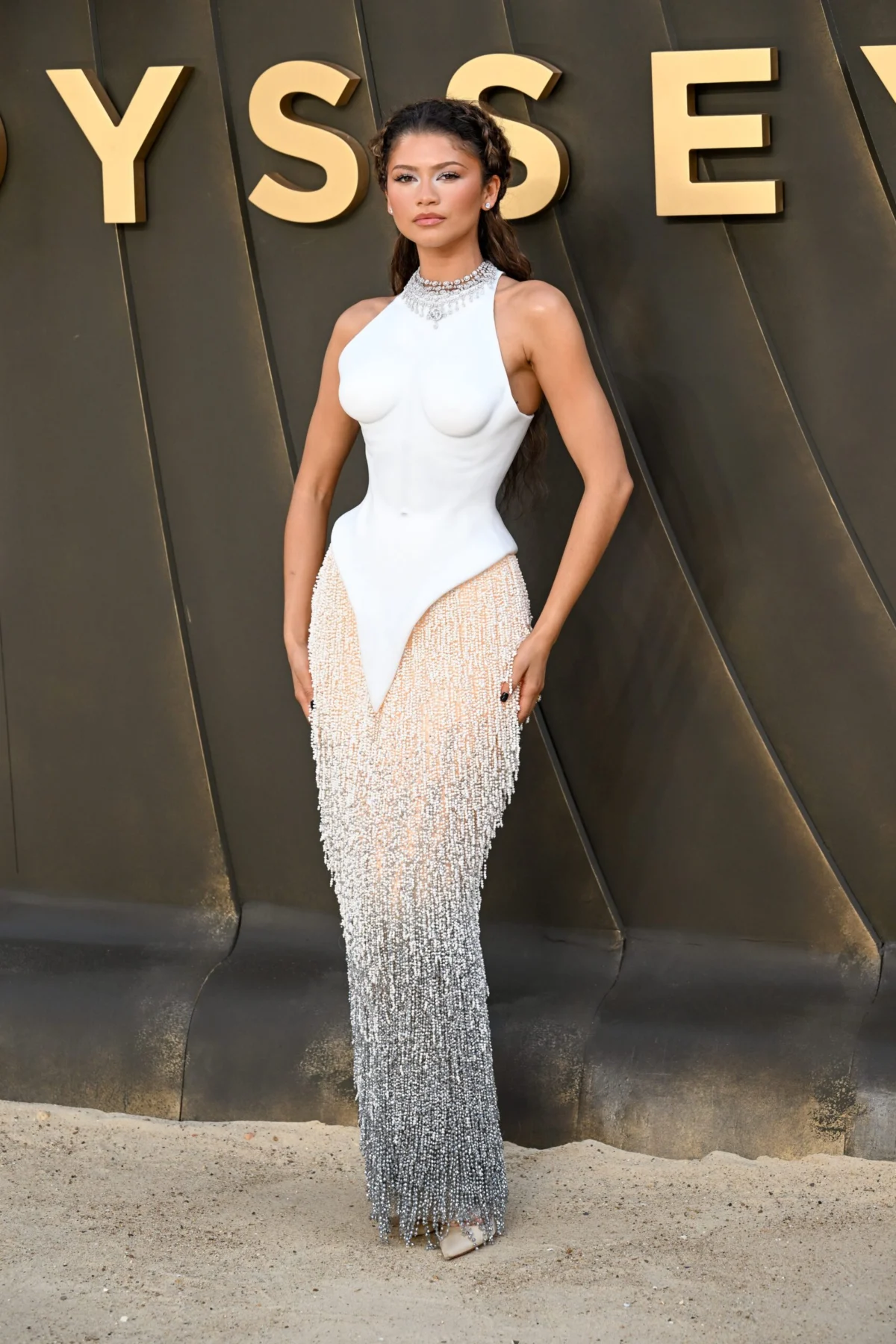
Schiaparelli’s Daniel Roseberry also looked to external industries for anatomical accuracy. For his Fall 2026 collection, he collaborated with Studio Junon, a firm specializing in the production of lifelike infants and prosthetics for the film industry. The process involved casting and sculpting faux bodies in clay before covering them in thousands of pearls. This technique was famously showcased by Zendaya at the world premiere of The Odyssey, where she wore a white version of the sculpted corset featuring a fringed, light-up skirt.

The Met Gala and the "Costume Art" Influence
The foundations for this anatomical obsession were laid earlier this year at the 2026 Met Gala. The theme, "Costume Art," encouraged attendees to view the body as a canvas for structural exploration. Kim Kardashian’s red-carpet appearance in a tangerine fiberglass breastplate—created by British pop artist Allen Jones and leather specialists Whitaker Malem—served as a precursor to the couture shows in Paris.
Whitaker Malem, who collaborated with Lantink on his recent burgundy leather robot-like form, has become a central figure in this movement. Their work sits at the intersection of fashion, sculpture, and fetish wear, emphasizing the "fetishization of the form" that has become a hallmark of the current season.
Furthermore, the accompanying exhibition at the Metropolitan Museum of Art featured body-diverse mannequins that were 3D-scanned from real individuals, including activists and models like Sinéad Burke, Aaron Rose Philip, and Michaela Stark. This inclusion highlighted a growing tension in the industry: while technology is being used to celebrate diverse bodies in museum settings, the runway remains largely dominated by a singular, hyper-sculpted ideal.
Broader Implications and Industry Analysis
The move toward wearable bodies reflects a deeper cultural desire for physical tangibility in an increasingly digital world. As Artificial Intelligence (AI) continues to dominate visual culture, the creation of hyperreal, handmade bodies serves as a counter-movement. These garments are designed to "stop the scroll," offering a level of detail and physical presence that digital filters cannot replicate.

However, the trend also raises questions regarding body diversity and the ethics of anatomical fashion. Critics argue that while these sculpted corsets are presented as art, they often reinforce narrow beauty standards by presenting a "perfected" version of the human torso. In an era where body diversity is reported to be declining on major runways, the creation of "new bodies" through couture could be seen as a way to bypass the need for diverse casting.
Despite these criticisms, the demand for "couture bodies" is expected to grow among the ultra-high-net-worth demographic. For these clients, the garment is no longer just an item of clothing; it is a form of "armor" that offers a sense of protection and transformation.
Conclusion: The Future of the Fashioned Form
As the Fall 2026 couture season concludes, the industry is left to grapple with the implications of a "body-less" fashion future. The works of Piccioli, Roseberry, and Lantink suggest that the future of haute couture lies in the ability to reinvent the human silhouette through a combination of 3D technology and artisanal skill.
Designers are no longer content with merely dressing the body; they are intent on redesigning it. Whether this leads to a more inclusive exploration of the human form or a further retreat into idealized hyperrealism remains to be seen. What is certain is that the "wearable body" has moved from the realm of science fiction and film prosthetics into the highest echelons of luxury fashion, forever changing the definition of what it means to be "body conscious."