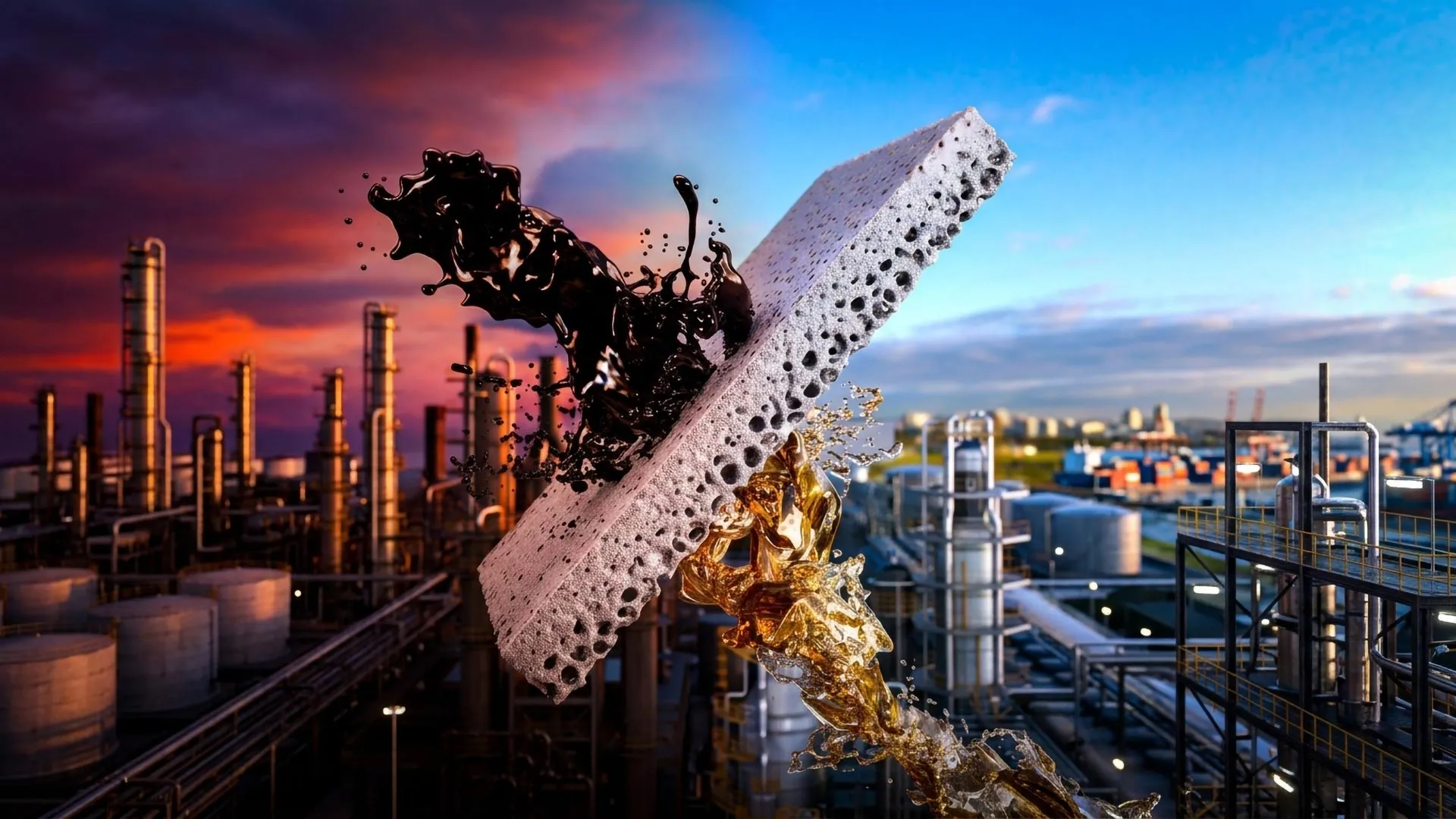
In a development that could fundamentally alter the global energy landscape, an international team of researchers has pioneered a transformative method for separating crude oil that bypasses the energy-intensive heat-based distillation processes that have dominated the petrochemical industry for over a century. Led by Professor Dong-Yeun Koh of the Korea Advanced Institute of Science and Technology (KAIST) and supported by Professor Ryan Lively’s research group at the Georgia Institute of Technology, the team has successfully demonstrated a membrane system that performs complex hydrocarbon separation at room temperature. The study, published in the journal Nature, presents a paradigm shift in industrial filtration, potentially slashing energy consumption and carbon emissions by significant margins.
The Century-Long Reliance on Thermal Distillation
Since the dawn of the modern petroleum age, the refining process has remained remarkably consistent in its fundamental approach: thermal distillation. Crude oil is a complex mixture of various hydrocarbons with different boiling points. To extract usable fractions—such as gasoline, naphtha, kerosene, and diesel—refineries must heat this crude oil to temperatures exceeding 350 degrees Celsius. Once the oil reaches this state of vaporization, it is cooled, allowing the different components to condense into their respective liquid forms.
The energy cost of this process is staggering. Globally, the petrochemical sector consumes approximately 1,100 terawatt-hours (TWh) of energy annually for distillation alone. To put this figure into perspective, it is equivalent to the total annual electricity generation of roughly 130 one-gigawatt nuclear power plants. This thermal reliance is not only a massive operational expenditure but also a primary driver of the refining industry’s substantial greenhouse gas footprint. As global markets pivot toward stricter carbon neutrality mandates and increased energy efficiency, the limitations of traditional distillation have become an urgent focal point for industrial researchers.
Chronology of the Breakthrough
The path to this discovery was rooted in the realization that traditional membrane technology was failing to meet industrial demands. For years, the scientific community focused on developing membranes with highly specialized, thin-film surface coatings designed to act as molecular sieves. While theoretically sound, these coatings proved prohibitively expensive to manufacture and notoriously prone to structural defects when scaled for industrial use.
The collaboration between KAIST and Georgia Tech, which culminated in the current findings, began with a fundamental reassessment of membrane architecture. Instead of seeking a "perfect" coating, the team turned to porous polyacrylonitrile (PAN)—a common, inexpensive, and chemically stable polymer widely used as a structural support in existing filtration systems.
The turning point occurred when the researchers observed the membrane in action with real-world crude oil. Contrary to established wisdom, the membrane did not require a specialized coating to be effective. As the crude oil passed through the bare PAN pores, heavier hydrocarbon molecules began to naturally adhere to the interior walls. This process, often referred to as "fouling" in engineering circles, is typically viewed as a malfunction that reduces throughput and necessitates maintenance. However, in this instance, the buildup served a precise, functional purpose. The accumulated hydrocarbons narrowed the pores to less than 2 nanometers, creating a self-assembled, highly selective filtration channel that allowed lighter, valuable hydrocarbons to pass through while retaining heavier components.
Quantitative Performance and Industrial Viability
The efficiency gains reported by the research team are profound. In testing, the uncoated PAN membrane achieved crude oil permeation rates 23 times higher than those recorded for previous experimental membranes. Most importantly, the system proved its durability, maintaining stable performance for 28 consecutive days of continuous operation.
"One of the key challenges facing membrane systems for crude oil separation was the low productivity of the membrane units," said Professor Ryan Lively. "The PAN membranes, with their surprising separation mechanism, dramatically increase the productivity of the membrane unit to the point where the industry should seriously consider adopting the technology."
The integration of this technology into existing refineries does not necessitate a complete overhaul of infrastructure. Instead, the membranes can be deployed as modular, pre-distillation filtration systems. By filtering the crude oil before it enters the energy-heavy thermal columns, the overall load on the distillation system is significantly reduced.
According to simulations conducted by the team, the adoption of this membrane technology could result in a 31.6% reduction in energy consumption. Furthermore, the environmental impact is estimated to include a 37.6% decrease in carbon dioxide emissions, a 20.7% reduction in cooling water consumption, and a 36% decrease in overall operating costs. For the South Korean refining sector alone, such an improvement could lead to a reduction of roughly 10 million tonnes of greenhouse gas emissions annually—a figure comparable to removing four million internal combustion vehicles from the road.
Official Responses and Future Outlook
The success of the experiment relied heavily on the use of actual industrial crude oil, provided by HD Hyundai Oilbank. This was a critical step in proving that the membrane could withstand the "messy" reality of industrial feedstocks rather than just controlled, laboratory-grade mixtures.
Professor Dong-Yeun Koh emphasized the novelty of the mechanism: "This study reveals a new scientific principle in which a membrane interacts with a complex mixture and spontaneously forms its own separation channels."
The co-first authors of the study, Dr. Jihoon Choi and Dr. Hyeokjun Seo, have already outlined a roadmap for the next phase of development. Their objective is to achieve precise control over the "spontaneous pore-constriction" phenomenon. By mastering this, they hope to scale the platform for a variety of applications beyond crude oil. These include the purification of pyrolysis oil from recycled plastics, the recovery of solvents in high-capacity battery manufacturing, and the streamlining of biofuel production.
Professor Jae W. Lee, a co-corresponding author, noted that the focus is now shifting toward "large-area membrane modularization and long-term operational reliability." By moving toward commercial-scale implementation, the team hopes to catalyze a broader shift toward membrane-based processes that support global carbon neutrality goals.
Economic and Environmental Implications
The broader implications of this research extend far beyond the refinery gate. Crude oil is the foundational material for the production of plastics, synthetic fabrics, packaging, and countless consumer goods. By lowering the cost of the separation process, the industry may see a stabilization or reduction in the cost of these raw materials.
Furthermore, the "self-forming" nature of these filtration channels represents a major cost-saving discovery. By eliminating the need for expensive surface modifications, the technology provides a low-barrier-to-entry solution for smaller or less technologically advanced refineries, potentially democratizing efficiency gains across the global market.
As the industry faces mounting pressure to decarbonize, the ability to retrofit existing assets with energy-efficient modular filters provides a pragmatic pathway to progress. While the transition from bench-scale testing to full-scale industrial deployment remains a complex engineering challenge, the foundational success of the KAIST and Georgia Tech research indicates that the future of oil refining may be found in the very molecules that researchers once considered a nuisance. Through the innovative use of material science and a shift in perspective on "fouling," the path toward a lower-energy, lower-emission petrochemical industry is becoming increasingly clear. The next stages of development, focusing on durability and large-scale manufacturing, will determine how quickly this technology moves from the pages of Nature to the heart of the world’s refining infrastructure.