The research, spearheaded by Andrew Mummery of the Institute for Advanced Study and Adelle Goodwin of the International Centre of Radio Astronomy Research, represents a significant leap forward in high-energy astrophysics. By analyzing the life cycles of black holes through the lens of tidal disruption events—the catastrophic shredding of stars by gravitational tides—the team has successfully bridged the gap between black holes of vastly different scales.
The Mechanics of Cosmic Destruction
Black holes have long been perceived as the ultimate arbiters of destruction, yet their "feeding" habits are surprisingly complex. When a star wanders too close to a supermassive black hole, it is subjected to tidal forces so intense that the star is pulled apart, transforming into a swirling disk of plasma and debris. This process, known as a tidal disruption event (TDE), provides astronomers with a rare, accelerated window into black hole dynamics.
Unlike the gradual, eon-long accretion processes typically observed in galactic centers, TDEs occur on human-relevant timescales. This allows researchers to observe the transition from a dormant black hole to an active, jet-emitting engine within the span of a few years. The study, published in Nature Astronomy, synthesized data from a global network of observatories, including assets in the United States, Australia, India, and South Africa, as well as space-based telescopes.
Bridging the Mass Gap: From Stellar to Supermassive
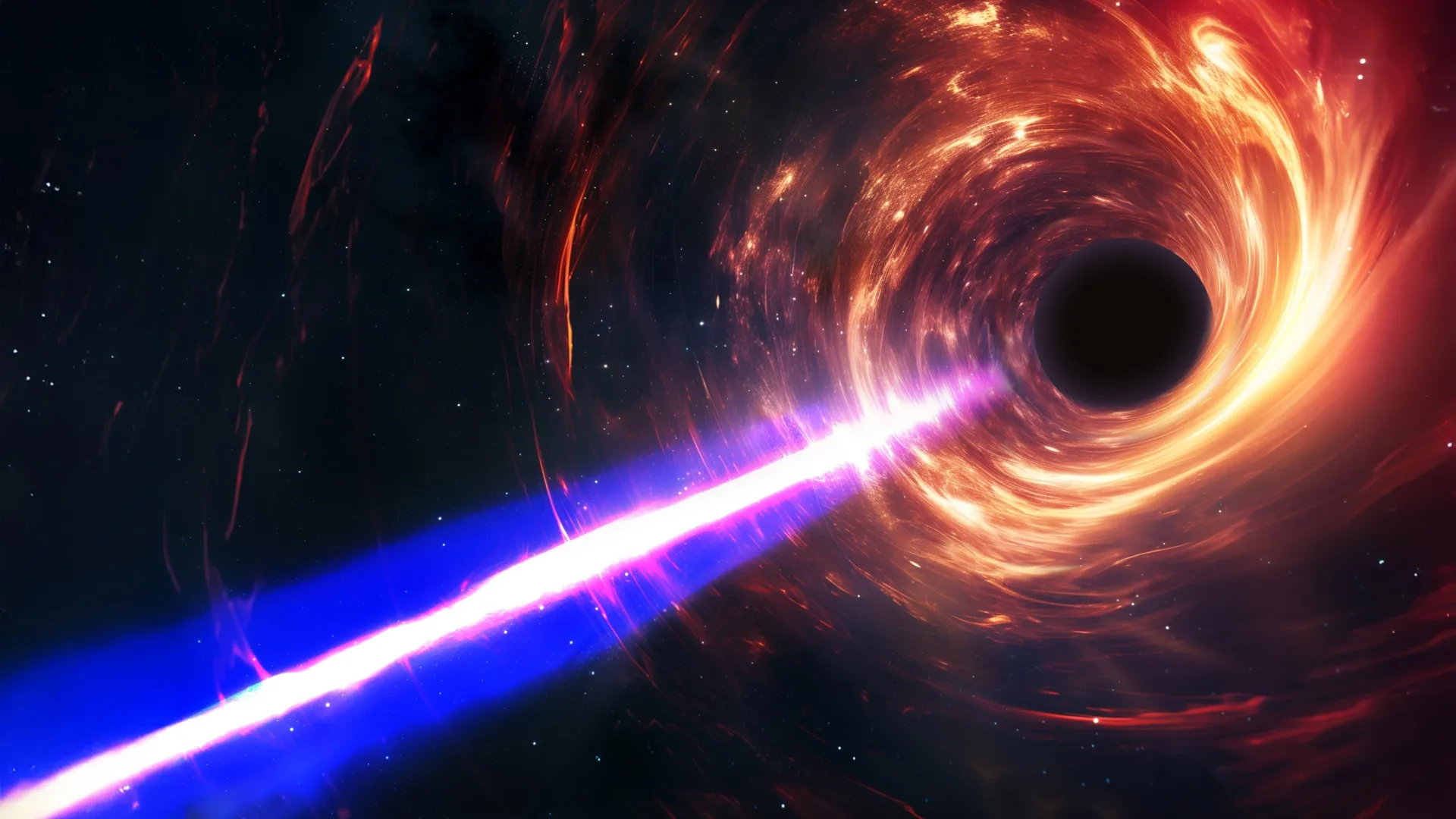
Historically, astrophysicists have categorized black holes based on their mass. Stellar-mass black holes, which typically form from the collapse of massive stars, have been studied extensively within our own galaxy. Observations of these objects consistently showed that they produce radio jets—collimated beams of particles moving at near-light speed—when their accretion rate drops to approximately two percent of the Eddington limit.
The Eddington limit is a theoretical benchmark representing the equilibrium point where the inward pull of gravity is perfectly offset by the outward pressure of radiation. When a black hole consumes material faster than this limit, the environment becomes chaotic; when it drops below this threshold, the physical conditions shift, often triggering the ignition of jets.
For decades, the challenge was confirming whether supermassive black holes—which weigh millions or even billions of times more than our Sun—followed this same behavioral pattern. Because supermassive black holes evolve over millions of years, catching them in the act of changing accretion rates was deemed statistically improbable. By focusing on TDEs, Mummery and Goodwin effectively bypassed this temporal barrier, observing ten high-quality events that confirmed the two-percent threshold exists across the entire mass spectrum of black holes.
Chronology of the Discovery
The synthesis of this research was not a linear path but rather the result of collaborative serendipity. The conceptual breakthrough occurred during an astrophysics conference in Madrid, where Mummery and Goodwin began comparing notes on the disparate behaviors of black holes.
- The Hypothesis Phase: The researchers questioned why some supermassive black holes remain dormant for years after a TDE, only to ignite jets unexpectedly. They hypothesized that the accretion rate, rather than the initial violence of the star’s destruction, dictated the timing of the jet launch.
- Data Integration: The team spent years aggregating archival and new data from optical, ultraviolet, X-ray, and radio wave telescopes. This multi-wavelength approach was essential, as different stages of the accretion process emit energy across the electromagnetic spectrum.
- The Narrowing Process: Out of twenty initial TDE candidates, the team identified ten that offered sufficient data fidelity to correlate feeding rates with the exact timing of radio outflow detection.
- Validation: The correlation held steady across all ten cases: as the accretion rate decayed to the critical two-percent Eddington limit, the radio jets consistently appeared.
Scientific Implications and Theoretical Impact
The implications of this discovery extend far beyond the classification of black hole behavior. For decades, the "galaxy-black hole connection"—the idea that the growth of a central black hole regulates the star-formation history of its host galaxy—has been a cornerstone of cosmological theory.
By confirming that jet formation is governed by a universal accretion rule, researchers can now more accurately model how black holes return energy to their host galaxies. These jets act as a form of cosmic "feedback," blowing gas out of the galaxy and preventing it from cooling and collapsing into new stars. If scientists can now predict the timing and intensity of these jets based on the accretion rate, they can better understand the life cycles of galaxies themselves.
"When a black hole tears apart a star, it does not swallow everything neatly," explained Adelle Goodwin. The material that is not consumed is expelled, and these outflows are the primary mechanism by which energy is injected into the surrounding galactic environment. Understanding the "universal rule" of this process allows for more precise simulations of galaxy evolution.
Operational Efficiency in Modern Astronomy
From a practical standpoint, the discovery promises to revolutionize how observatories allocate time. Telescope time is one of the most precious commodities in science; major facilities like the Very Large Array or the upcoming Square Kilometre Array (SKA) are heavily oversubscribed.
If astronomers can identify a TDE and calculate the time remaining until the black hole hits the two-percent accretion threshold, they can schedule radio observations with surgical precision. This reduces "null results"—observations conducted during dormant periods—and maximizes the scientific return on every hour of telescope time.
This predictive capability is expected to be a major asset for the Square Kilometre Array (SKA), which is set to begin scientific operations in 2028. The SKA will be the world’s largest radio telescope, and its sensitivity will allow researchers to track these accretion thresholds in more distant and fainter TDEs, further refining the universal rule discovered by Mummery and Goodwin.
Expert Reactions and Future Outlook
The scientific community has noted the significance of the findings, particularly regarding the unification of stellar-mass and supermassive black hole physics. While the study is grounded in empirical evidence, theorists are now looking toward how this two-percent rule interacts with the magnetic field structures surrounding black holes. It is widely suspected that magnetic fields play a secondary role in "launching" the jets, while the accretion rate serves as the primary "trigger."
"We hope that our work will pave the way for even more profound discoveries about our universe," said Mummery. The next phase of research will likely involve expanding the sample size of TDEs to include a wider range of galactic environments, testing whether the presence of high-density gas or intense radiation fields can perturb the two-percent rule.
As data collection accelerates with new-generation observatories, the "universal rule" identified by this team will likely become a benchmark for future studies. By demystifying the "cosmic burps" of black holes, astronomers are gaining a clearer understanding of the engine room of the universe—an engine that, despite its immense scale, adheres to the same fundamental laws of physics whether it is a small stellar remnant or a titan at the heart of a galaxy.
This work underscores the importance of interdisciplinary collaboration and the value of looking at old problems through the lens of new, high-cadence data. As the field moves forward, the ability to predict the behavior of these massive objects will remain a vital component in our effort to map the history of the cosmos, from the shredding of a single star to the structural evolution of the largest galaxies.