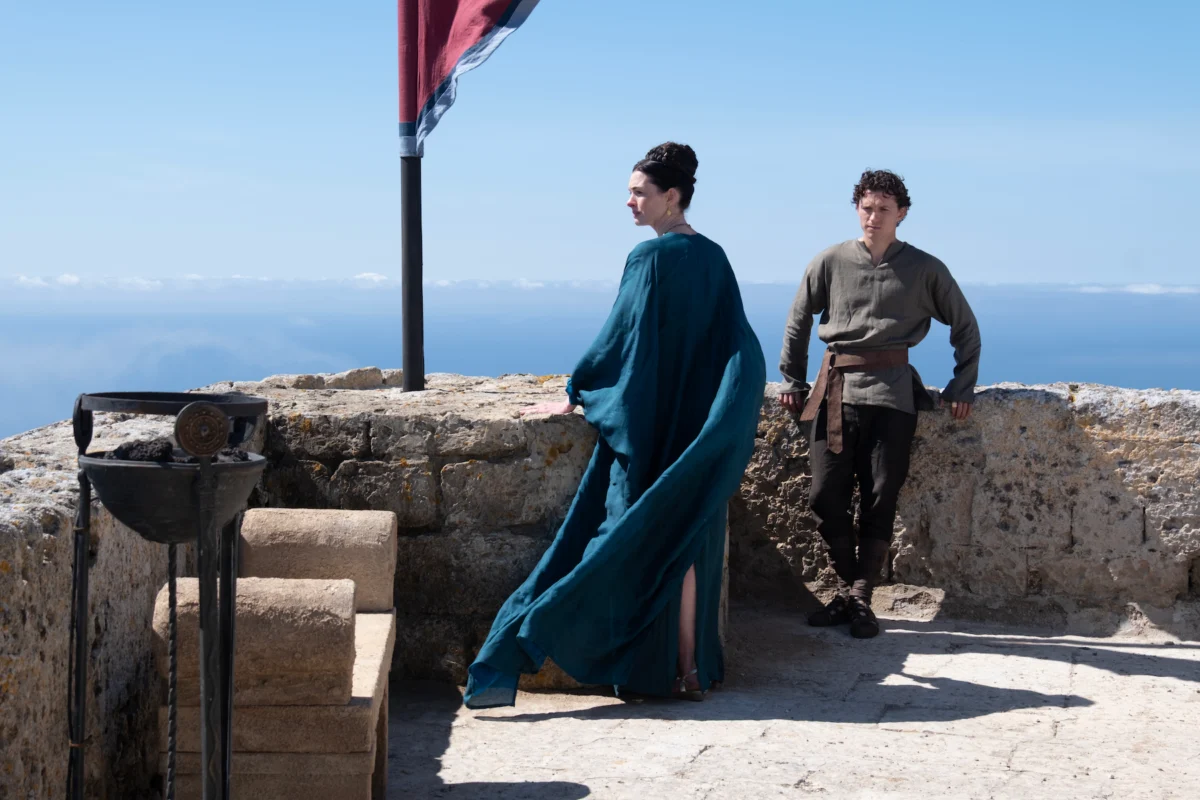
The global cinematic landscape shifted this weekend as Christopher Nolan’s highly anticipated adaptation of The Odyssey finally arrived in theaters, marking a significant milestone in the director’s storied career. Based on Homer’s foundational epic poem—a cornerstone of Western literature and one of the oldest recorded narratives in human history—the film tracks the arduous journey of Odysseus as he navigates a decade of peril to return home following the fall of Troy. Known for his commitment to practical effects and grand-scale storytelling, Nolan has transformed this ancient myth into a visceral, multi-continental spectacle that challenges the boundaries of modern filmmaking. The production, which spanned several years and multiple hemispheres, utilizes a blend of historical landmarks and rugged natural environments to ground the supernatural elements of the myth in a stark, tangible reality.
The Narrative Foundation of a Cinematic Monument
At its core, The Odyssey is the ultimate "road movie," a narrative structure that Christopher Nolan has previously explored through different dimensions in films like Interstellar and Inception. The story picks up after the ten-year Trojan War, focusing on Odysseus, the King of Ithaca, whose return journey is thwarted by the divine wrath of Poseidon and a series of mythological obstacles. The film depicts his encounters with formidable adversaries, including the man-eating Cyclops, the enchanting but dangerous Sirens, and the witch-goddess Circe.
Nolan’s adaptation reportedly emphasizes the psychological toll of the journey, portraying Odysseus not merely as a conquering hero but as a man haunted by the horrors of war and the desperation of his long absence from his wife, Penelope, and his son, Telemachus. By casting Matt Damon in the titular role, Nolan brings a grounded, weary humanity to a character often depicted in broader, more legendary strokes. The supporting cast further elevates the project, featuring a massive ensemble that includes Academy Award winners and contemporary icons such as Anne Hathaway, Charlize Theron, Jon Bernthal, Robert Pattinson, Lupita Nyong’o, Mia Goth, Elliot Page, John Leguizamo, and Benny Safdie. Adding to the film’s cultural weight is the inclusion of Zendaya and Tom Holland, whose participation marks their first major screen appearance as a married couple, a detail that has generated significant buzz among audiences and industry analysts alike.

A Chronology of Global Production
The production of The Odyssey was an immense logistical undertaking, requiring the crew to coordinate across vastly different climates and topographies. While many modern blockbusters rely heavily on "Volume" technology or green screens, Nolan opted for an "on-location first" approach, moving the production across Europe and North Africa to capture the diverse settings of Odysseus’ travels.
The filming timeline began in early 2025. In March of that year, the production was centered in Italy, specifically the Aeolian Islands and Sicily. These locations served as the backdrop for the early stages of Odysseus’ maritime struggles. By July 2025, the unit moved to the northern reaches of Scotland, where the rugged coastlines and medieval ruins provided a stark contrast to the Mediterranean heat. Throughout the remainder of the year, the production touched down in Greece, Iceland, and Morocco, concluding a grueling schedule that sought to capture the "world-weary" aesthetic Nolan desired for the film.
Mediterranean Authenticity: Italy and Greece
To capture the essence of the Ionian and Aegean Seas, Nolan spent considerable time in Italy and Greece. In March 2025, the production was sighted in Favignana, the largest of the Aegadian Islands off the coast of Sicily. Actors including Ryan Hurst, who portrays the wise advisor Mentor, were seen filming scenes that required a blend of coastal beauty and isolation. The production also utilized the Aeolian Islands—specifically Basiluzzo, Lipari, and Vulcano—which provided the volcanic, primordial terrain necessary for the more mystical segments of the journey.
However, the spiritual heart of the production resided in Greece, the setting of the original poem. The Hellenic Film Commission played a vital role in facilitating access to some of the country’s most protected historical sites. The legendary Cyclops sequence, a centerpiece of the film’s second act, was filmed within the natural caves of Messenia. Nolan’s approach to this sequence was famously rigorous; rather than relying solely on digital animation, he utilized a 60-foot mechanical contraption to represent the giant, ensuring that the actors’ reactions were rooted in physical reality.

"Everything about the Cyclops sequence is aimed at trying to imagine: What would this be like in real life?" Nolan stated in an interview with Empire. "Not approaching it from a storybook or cartoony point of view, but really trying to be in there with Odysseus and his men. It’s a horrifying situation."
Other Greek locations included the crescent-shaped Voidokilia Beach and Almyrolaka Beach, which stood in for the shores of various islands encountered by the crew. The production also secured the use of Methoni Castle, a medieval fortification that offered a sense of ancient permanence, and the Acrocorinth, the acropolis of ancient Corinth, to represent the high-stakes political environment of the era.
The Rugged North: Scotland and Iceland
To represent the more desolate and dangerous legs of the journey, Nolan turned to the Atlantic and North Sea environments of Scotland and Iceland. In July 2025, Matt Damon was photographed at Findlater Castle, a dramatic ruin perched on a cliffside in Northeast Scotland. Clad in leather armor and a heavy cape, Damon’s presence at the site underscored the film’s commitment to a "historical-fantasy" aesthetic that prioritizes texture and weight. The castle’s precarious position over the sea served as a metaphor for Odysseus’ own precarious status throughout the narrative.
In Iceland, the production moved to the glacier regions near Landeyjahöfn. Here, the crew constructed a massive, full-scale ship set in the coastal harbor. This location was used to film the intense maritime storms and the crew’s struggles against the elements. Iceland’s volcanic beaches and black sands provided an otherworldly quality that helped transition the film from a standard historical drama into the realm of the mythological, without sacrificing the realism that is a hallmark of Nolan’s filmography.

Reconstructing the Ancient World: Morocco
The production’s final major pillar was Morocco, a country with a long history of hosting epic cinema. The crew utilized various regions, including Marrakech, Tahnaout, El Haouz, and the coastal city of Essaouira. These locations provided the sun-drenched, dusty environments necessary for the film’s desert sequences and the depictions of foreign kingdoms.
Most notably, the UNESCO World Heritage site of Aït Benhaddou was used to represent the ancient city of Troy. The site’s earthen clay architecture and labyrinthine streets offered an authentic texture that CGI cannot replicate. By filming the prologue of the movie at Aït Benhaddou, Nolan established a visual link between the fall of a great civilization and the subsequent wandering of its survivors.
Technical Mastery and the Economic Impact of "Set-Jetting"
The Odyssey was filmed using a combination of IMAX and 65mm large-format film, a choice that necessitates large, open spaces and high-detail environments. This technical requirement drove the selection of these specific global locations. Industry analysts suggest that the production’s presence has already had a measurable impact on local economies. The "set-jetting" phenomenon—where tourists visit locations seen in major films—is expected to surge in regions like Messenia and the Aeolian Islands following the film’s release.
Furthermore, Nolan’s insistence on practical sets and local hiring has been praised by film commissions worldwide. In Greece and Morocco, hundreds of local artisans and extras were employed to build sets and populate the ancient world, providing a boost to the local creative industries. This collaborative approach not only benefits the regions involved but also imbues the film with a cultural richness that reflects the diverse world Odysseus is supposed to have traversed.

Broader Implications and Critical Analysis
Christopher Nolan’s The Odyssey arrives at a time when the "superhero fatigue" of the last decade has left audiences craving more grounded, auteur-driven spectacles. By returning to the roots of Western storytelling, Nolan is attempting to prove that ancient myths still hold immense power in the digital age.
The film’s focus on practical locations serves as a silent critique of the current trend toward entirely digital environments. By placing Matt Damon on a real cliff in Scotland or in a real cave in Greece, Nolan creates a sense of "tactile immersion." For the viewer, the stakes feel higher because the environment is recognizable and physical.
Critically, the film is being viewed as a meditation on the concept of "home." In an era of global displacement and shifting borders, the story of a man trying to find his way back to his family after a decade of war carries a contemporary resonance that transcends its ancient origins. The Odyssey is not just a showcase of beautiful locations; it is an exploration of the human spirit’s endurance against the overwhelming forces of nature and fate.
As the film continues its theatrical run, it is poised to become a definitive entry in the epic genre. By bridging the gap between the ancient past and the technological future of cinema, Christopher Nolan has once again demonstrated his unique ability to turn a classical text into a modern-day event. The Odyssey is more than a movie; it is a global journey that honors the scale of Homer’s imagination while grounding it in the very real, very beautiful landscapes of our own world.