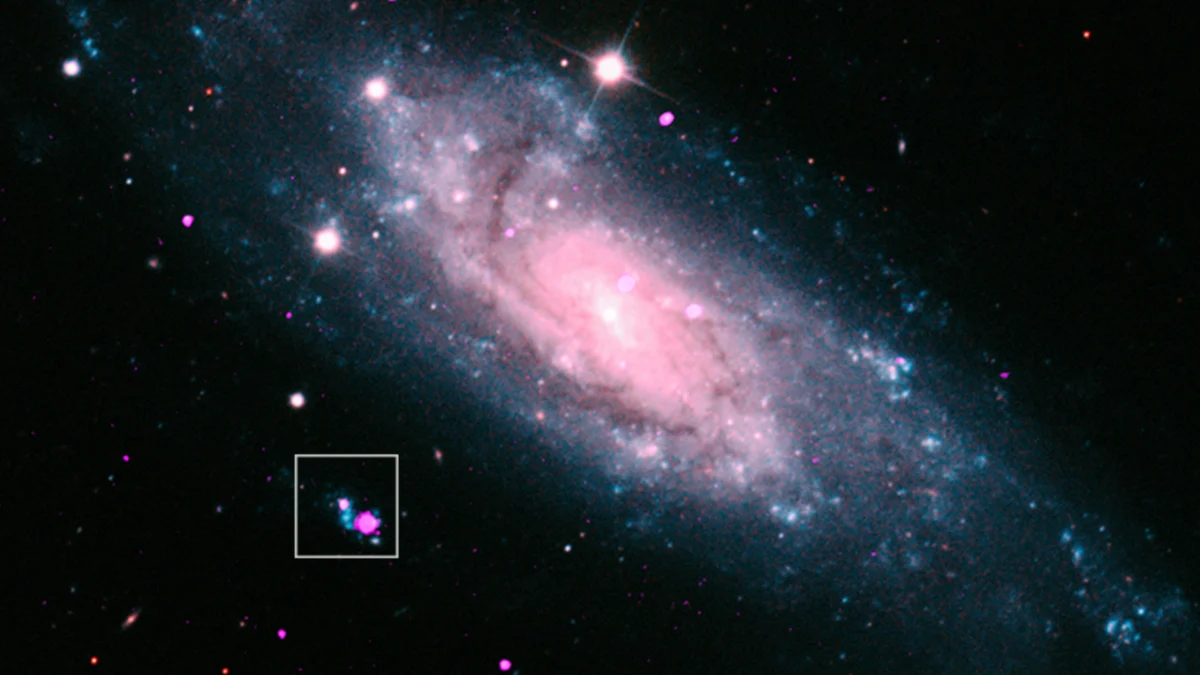
For nearly fifteen years, astronomers have tracked a celestial anomaly on the outskirts of the spiral galaxy NGC 4559, located approximately 25 million light-years away in the constellation Coma Berenices. Originally catalog
ed on January 11, 2012, as a routine supernova explosion—the cataclysmic death throes of a massive star exhausting its nuclear fuel—the object defied standard astrophysical models. Instead of fading into obscurity once the initial outburst subsided, the star survived, returning to life with a repeating cycle of brightness every 113 days. To date, this cosmic imposter has faked its own death at least 27 times.
Recent findings published in The Astrophysical Journal by a team of researchers utilizing NASA’s Chandra X-ray Observatory have finally unmasked the culprit. The recurring outbursts are not the death throes of a lone star, but rather the violent feeding habits of a cosmic vampire—an invisible, highly compact companion object, either a stellar-mass black hole or a neutron star, voraciously stripping material from an unstable supergiant companion.
Anatomy of an Imposter: The Luminous Blue Variable
The central star driving this celestial masquerade is known as AT 2016blu, categorized as a Luminous Blue Variable (LBV). LBVs represent one of the most extreme, massive, and luminous phases in stellar evolution. Because these stars sit near the upper limits of stellar mass—in this case, at least 33 times the mass of our sun—their internal pressures and radiation outputs make them exceptionally volatile. They are prone to intermittent mass loss, shedding vast amounts of material from their outer envelopes into the surrounding interstellar medium over long periods.
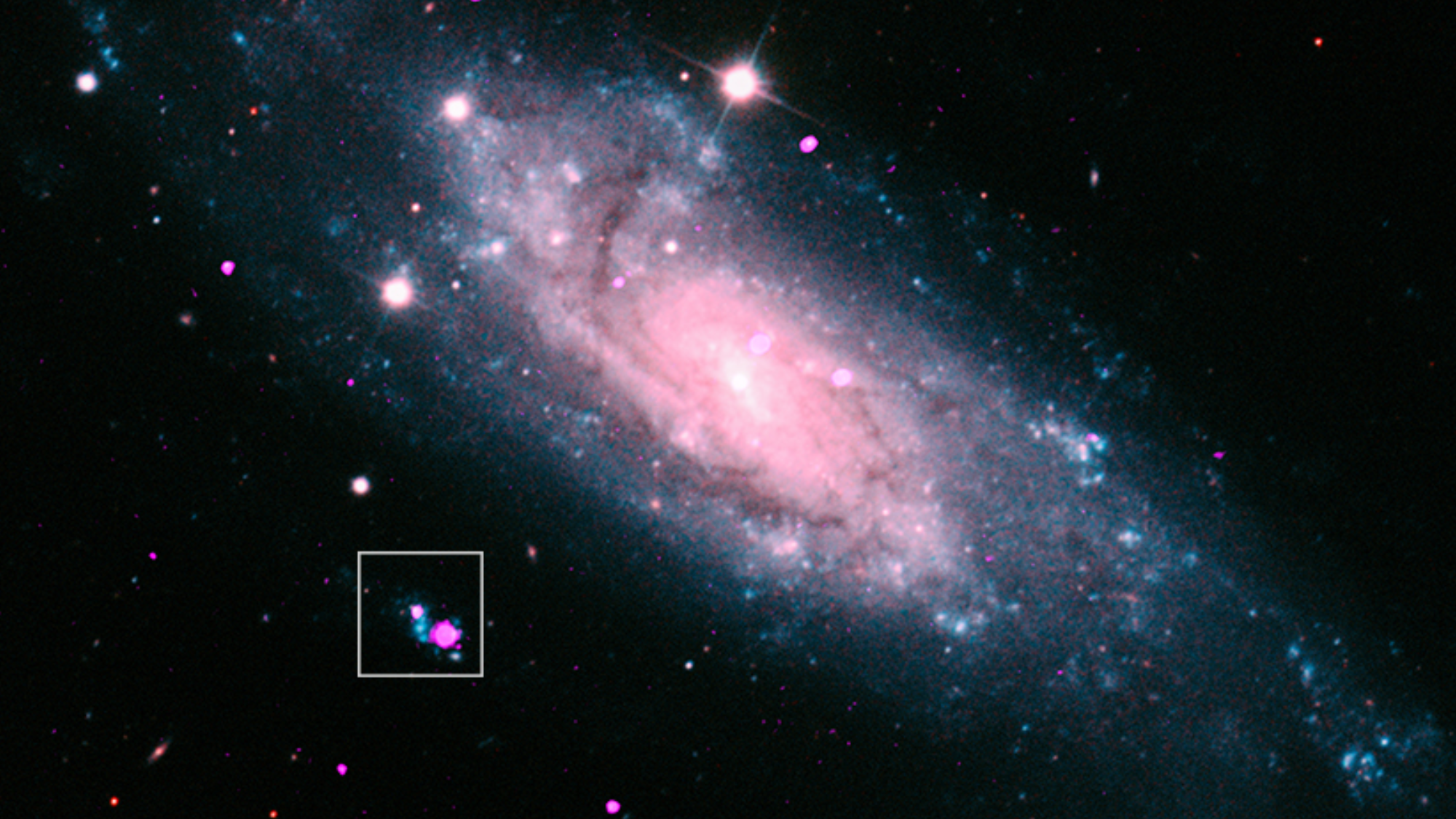
However, standard stellar physics dictates that mass loss alone cannot account for rhythmic, highly energetic outbursts occurring with the clockwork precision observed in AT 2016blu. While other supernova imposters have been documented over the past two decades, the precise mechanism triggering their repeated false alarms remained elusive. Recognizing that optical telescopes alone could not penetrate the physical drivers of the system, an astronomy team led by Mojgan Aghakhanloo of the University of Virginia sought targeted X-ray data to capture the star directly during an active outburst phase.
A Chronology of Discovery: From 2001 to the March 2026 Breakthrough
The investigation into AT 2016blu spans decades of archival data and targeted observations:
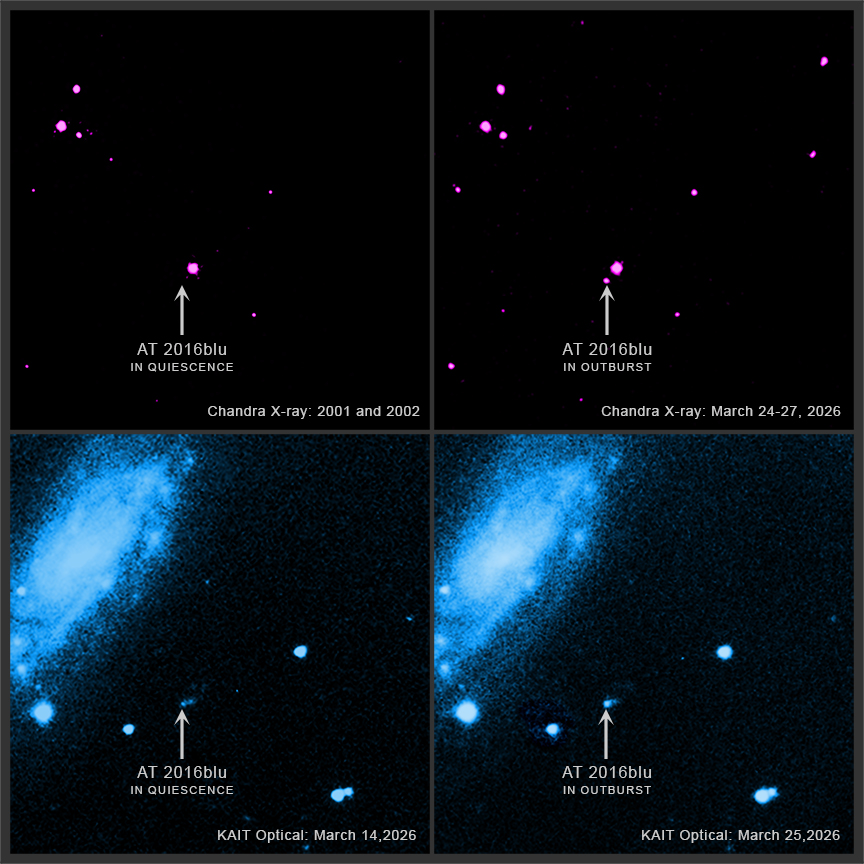
- 2001–2002: NASA’s Chandra X-ray Observatory coincidentally captures images of the region encompassing NGC 4559. At this time, no unusual X-ray activity or outbursts are detected in the vicinity of the star.
- January 11, 2012: Ground-based optical surveys observe a sudden, brilliant surge of light on the periphery of NGC 4559, initially classified as a standard supernova.
- 2012–2026: Successive observations reveal that the optical transient refuses to die. The star dims, only to brighten again in a predictable 113-day cycle, accumulating 27 documented false-alarm outbursts.
- March 2026: Capitalizing on newly granted observation time, Aghakhanloo’s team successfully directs Chandra to capture AT 2016blu precisely as it enters an outburst phase, recording a powerful burst of high-energy X-rays that aligns perfectly with the optical brightening.
"Until we were able to get Chandra data at the right time, we couldn’t figure out what was making this happen," Aghakhanloo stated following the successful campaign. Team member Núria Torres-Albà emphasized the necessity of synchronized multi-wavelength timing, noting that observing the system directly during an active phase was the critical variable in solving the mystery.
The Cosmic Vampire Mechanism
The X-ray data collected by Chandra exposed the presence of a hidden binary companion orbiting the luminous blue variable on an elliptical path every 113 days. Because neutron stars and stellar-mass black holes are the dense remnants of stars that have already undergone genuine supernova explosions in the ancient past, AT 2016blu is confirmed to be an interacting binary system.
As the compact companion swings along its elliptical orbit, its gravitational pull peaks during the close approach (periastron) to the unstable blue variable. At this critical juncture, the high-gravity object strips material directly from the outer layers of the primary star. This stolen stellar matter spirals inward, forming a dense accretion disk around the black hole or neutron star.
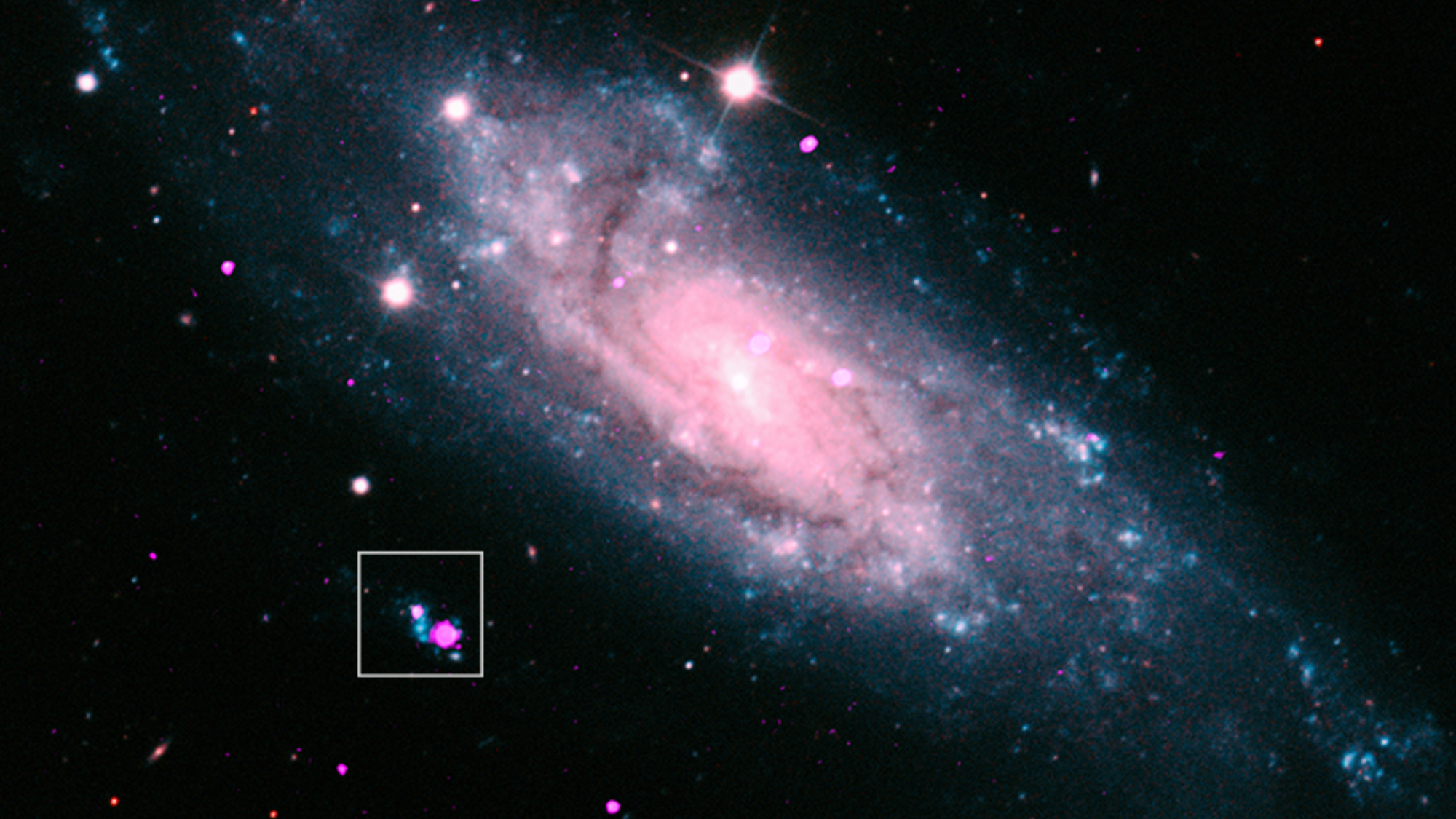
The material accelerates and superheats as it spirals downward, generating intense blasts of X-rays. These X-rays flood outward, interacting with the vast shells of gas and dust that the LBV had ejected into space during previous centuries. When the high-energy X-rays strike this dense surrounding cocoon, they heat the gas, causing it to re-emit the energy as a brilliant flash of visible light. This secondary illumination tricks terrestrial telescopes into registering a supernova signature.
"We suspected that the bright repeating flashes at optical wavelengths might actually be powered by periodic blasts of high-energy X-rays," explained co-author Nathan Smith of the University of Arizona in Tucson. "The dense gas surrounding the system is heated by the X-rays and then glows in the optical."
Quantitative Scale and Physical Limits
Calculations performed by the research team highlight the extreme scale of the mass transfer occurring within the AT 2016blu system. Every year, the compact companion steals a minimum of 440 billion trillion pounds of material from the primary star—with potential upper estimates reaching two orders of magnitude higher.
Despite this immense volume, the rate represents a mere fraction of the stellar mass involved. The stolen material amounts to roughly 800 millionths of a solar mass annually, a relative trickle compared to the 33-solar-mass bulk of the luminous blue variable.
Nevertheless, the rate at which matter falls onto the compact object exceeds what is physically comfortable for a neutron star or black hole to process smoothly. This rate pushes past the Eddington limit—the theoretical threshold where radiation pressure from the accretion disk balances gravity. Surpassing this limit naturally unleashes the extreme, erratic energy releases captured by Chandra’s detectors.
Broader Astrophysical Implications
Beyond solving a decade-long celestial mystery, the confirmation of AT 2016blu’s true nature opens new avenues for understanding related astrophysical phenomena, most notably Ultra-Luminous X-ray sources (ULXs). ULXs are intensely bright sources of X-rays located outside the nuclei of galaxies, whose exact power engines remain a subject of intense debate within the astronomical community.
Because AT 2016blu shines with sufficient X-ray luminosity to qualify as a ULX during its active phases, it serves as a potential Rosetta stone connecting supernova imposters with ultra-luminous binary systems. However, astronomers urge caution before generalizing the model. Only one other supernova imposter, designated SN 2010da, has exhibited similar X-ray emission characteristics indicative of mass transfer onto a compact body. In that specific case, however, the companion is confirmed to be a red supergiant rather than a compact stellar remnant like a black hole or neutron star.
The comprehensive documentation of AT 2016blu bridges gaps in stellar evolution, binary star interactions, and high-energy astrophysics. As researchers continue to monitor its 113-day cycle, this stellar vampire and its victim provide a rare, real-time laboratory for observing the violent physics governing the most massive stars in the universe.