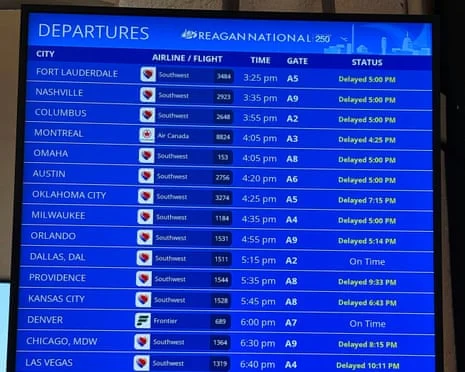
A sweeping and rare nationwide aviation crisis unfolded across the United States on Friday, November 13, 2026, when a catastrophic telecommunications failure forced the Federal Aviation Administration (FAA) to execute an unprecedented total ground stop for all departing flights. The emergency measure, which began at approximately 4:00 PM Eastern Time, paralyzed major travel hubs, grounded thousands of commercial aircraft, and stranded hundreds of thousands of passengers in crowded terminals nationwide. While airborne aircraft already aloft were safely guided to their destinations—albeit with instructions to navigate holding patterns or proceed under restricted parameters—the abrupt halt exposed deep-seated vulnerabilities in the nation’s aging civil aviation infrastructure.
As investigations continued into the weekend, the incident ignited immediate political friction in Washington. Lawmakers from both sides of the aisle clashed over accountability, federal spending on infrastructure, and the transparency of the current administration. The crisis not only disrupted domestic and international logistics but also reignited urgent debates concerning the operational reliability of America’s air traffic control network, cybersecurity preparedness, and the integration of modern artificial intelligence tools into legacy air management systems.
Chronology of the Disruption
The cascading operational failure began escalating mid-afternoon on Friday, catching federal regulators and commercial airlines entirely off guard.
At approximately 3:45 PM ET, air traffic operations in the Chicago airspace encountered sudden and severe anomalies. Localized communications issues prompted initial emergency measures, rapidly escalating within minutes as regional centers reported a systemic breakdown in controller-pilot voice channels.
By 4:00 PM ET, the FAA issued an official national ground stop, citing "extraordinary circumstances and reasons for safety." The directive mandated that all departing traffic across every commercial airport in the United States remain grounded until further notice. International flights approaching U.S. airspace were directed to be handled on a strict case-by-case basis.

Throughout the evening, flight-tracking platforms such as FlightAware recorded staggering disruptions. By late Friday, the cumulative toll surpassed 10,000 delayed flights and nearly 1,500 outright cancellations within, into, or out of the United States. Simultaneously, approximately 3,100 airborne aircraft remained in flight, requiring intensive coordination from air traffic controllers operating under severely degraded communication capacities.
By Friday night, transportation officials confirmed that while communication links were being systematically restored to allow trapped airborne flights to land safely, the root cause of the telecommunications breakdown remained unverified, prompting a multi-agency federal probe.
Unraveling the Technical Failure
Initial reports from investigators briefed on the matter indicated that the disruption centered around critical telecommunications infrastructure rather than an immediate airspace management software glitch. According to insights provided to the Wall Street Journal, the outage heavily impacted a specialized telecommunications network overseen by contractor L3Harris Technologies. This specific network manages the vital radio frequencies utilized by air traffic controllers to communicate directly with commercial and private pilots.
Questions immediately arose regarding whether the failure also compromised radar feeds responsible for maintaining safe spatial separation between aircraft in flight. In response to public speculation, representatives for Boston-based frontier AI firm ASI—which was awarded an $875 million software contract by the FAA in June and deployed its "Smart" (Strategic Management of Airspace, Routing, and Trajectories) air traffic management tool across all 22 U.S. air route traffic control centers in September—formally clarified that the system bore no responsibility for the crisis.
"The current ground stop is not based on or a result of the Smart system, any product of ASI, or our integration with FAA and ATC," the company stated via social media, seeking to preemptively distance its nascent artificial intelligence architecture from the hardware and telecom failures plaguing the federal network.
Political Fallout and Government Response
The scale of the disruption provoked immediate and sharp reactions from federal officials and Capitol Hill. Homeland Security Secretary Markwayne Mullin addressed reporters outside the White House on Friday evening, attempting to calm public anxieties while acknowledging the administration’s initial lack of definitive answers.
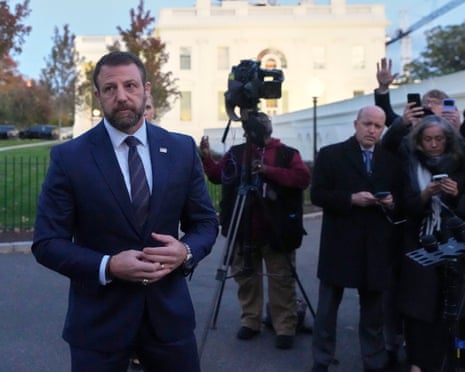
"Just to make sure we understand, there is no indication, and we had no reason to believe as of right now, that this was a threat to the United States," Mullin stated. "This was a telecommunication outage throughout the FAA… There is no evidence yet that this was a nefarious attack; it is just a telecommunication outage, as of right now."
However, Mullin’s briefing drew swift bipartisan condemnation for mixed messaging, notably when he incorrectly claimed the last nationwide ground stop occurred on September 11, 2001—overlooking a domestic pause enacted by the FAA in January 2023.
Congressional Democrats on the House Homeland Security Committee published a scathing rebuke of the administration’s handling of the incident. "Trump and his cabinet are completely out of their depth," the committee stated on social media. "Their incompetence, secrecy, and recklessness are putting Americans in danger—and they can’t even clearly explain to the American people what’s happening."
Conversely, the Republican-led Senate Commerce Committee, chaired by Senator Ted Cruz, pointed to decades of systemic underinvestment in federal infrastructure. The committee emphasized that the nation’s core air route traffic control centers have faced modernization delays for generations, noting that the physical architecture housing these centers has remained largely unchanged since the era of the Johnson administration.
Transportation Secretary Sean Duffy, a former media personality appointed to lead
the Department of Transportation, confirmed via social media that FAA technicians were working around the clock to isolate the failure. Duffy’s statements coincided with renewed scrutiny regarding the pace of infrastructure upgrades, particularly after the White House and the FAA recently requested an additional $30.1 billion from Congress to address critical modernization needs, following a previous $12.5 billion appropriation approved the prior year.
Broader Economic and Logistical Impacts
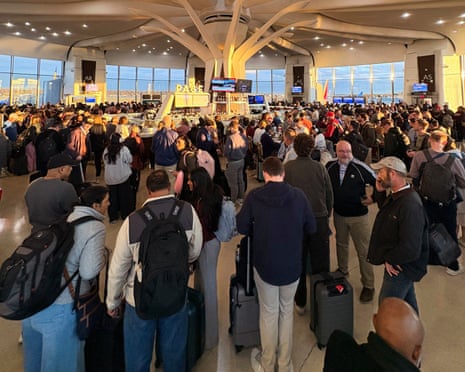
The sudden paralysis of U.S. airspace reverberated far beyond commercial aviation terminals. With millions of travelers stranded—leading to chaotic scenes at facilities such as Ronald Reagan Washington National Airport (DCA), where passengers utilized luggage as makeshift workstations while refreshing flight status applications—alternative transportation networks experienced immediate strain. Amtrak reported a surge in web traffic and customer service inquiries, issuing public statements noting that it was experiencing higher-than-normal call volumes as stranded flyers scrambled to secure alternative ground transportation.
The incident also focused renewed academic and journalistic attention on the fragility of the national air transportation grid. Observers noted that the crisis occurred precisely as aviation experts and industry veterans warned that commercial aviation was operating on increasingly narrow margins of safety due to a combination of aging hardware, persistent air traffic controller shortages, and rising flight volume.
Implications and Outlook
Friday’s unprecedented ground stop serves as a stark reminder of the technological dependencies governing modern global commerce and travel. While the immediate priority for federal authorities centered on restoring full operational redundancy and identifying the exact point of failure within the L3Harris-managed telecom network, the longer-term implications are profound.
The event guarantees intense legislative oversight hearings in the coming weeks, where federal regulators, cabinet secretaries, and private defense contractors will face rigorous questioning from lawmakers demanding structural accountability. As the United States navigates an increasingly digitized transportation landscape, the 2026 FAA telecommunications collapse has permanently altered the national conversation regarding how critical infrastructure is maintained, funded, and protected against systemic failure.